
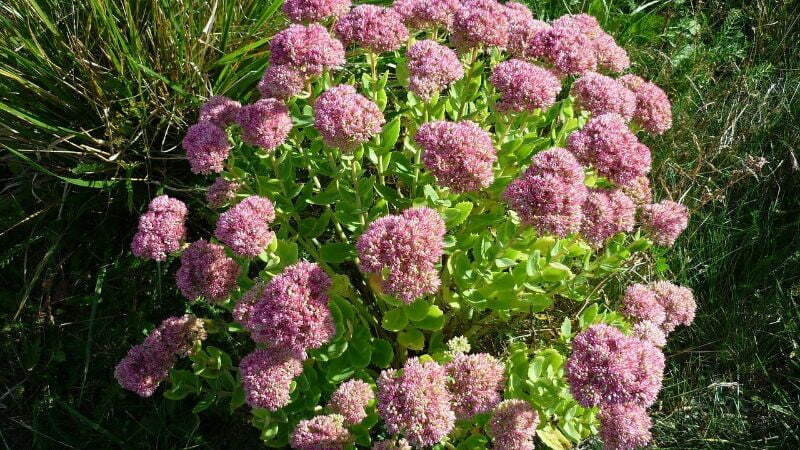
Late in the summer, flower stalks with many buds grow, like broccoli. Individual 1/2-inch wide star-shaped flowers make 6-inch-wide flower heads. The stunning pink flowers grow to a rosy-orange color and have robust stems that can be used as cut flowers. Seed heads add interest to the garden in the fall and winter, as well as attracting birds and being utilized in floral arrangements. Once established, ‘Autumn Joy’ is drought resilient due to the water stored in the succulent stems, leaves, and roots.
Is Autumn Joy sedum invasive?
Autumn Joy sedum is a cultivar of the Eurasia-native Hylotelephium telephium. With the exception of the most northern states, the southern tip of Florida, and the southern California coastline, it has adapted successfully to the United States. The Autumn Joy sedum, unlike many other Eurasian species imported to North America, is not invasive.
Every step of this hardy perennial’s life cycle is incredibly fascinating to study. A patch of small, green clusters of leaves growing from the earth in early spring looks like a miniature cabbage patch. The plant will develop to a height of 1 1/2 to 3 feet, stretching out its fleshy, gray-green, serrated leaves into a compact, spherical shape. The tops of the stems bear pale green, umbel-shaped florets that resemble broccoli. These florets gradually change color from pale green to a dusty, rosy pink, and then to a rich, deep red-pink tint. The blossoms eventually fade to a russet brown, giving a garden a burst of color until the first hard frost. Dried flower arrangements can make use of faded flowers.
This perennial is virtually maintenance-free, requires little water, and is frequently visited by bees, butterflies, and the beautiful Tarantula Hawk wasp, which is the state insect of New Mexico. Rabbits and deer, on the other hand, avoid it, which is a big benefit for hardworking gardeners. Autumn Joy sedum is drought tolerant and may be grown in full sun in a variety of soils, from sand to clay, acidic to alkaline it doesn’t seem to mind. Plant in rock gardens, along pathways and borders, and in flowerbeds with other plants. Division or cutting are the two methods of propagation. Do not be concerned if it freezes to the ground in the winter and then completely vanishes once the dead foliage has been removed. In the spring, it will reappear. Autumn Joy sedum almost always delivers on its promises.
Autumn is a beautiful season. While it patiently awaits its turn in the spotlight, Joy sedum is content to offer a rich, green backdrop to spring and summer bloomers. With its magnificent deep red-pink flowers set among the orange, red, and gold fall foliage of neighboring plants, it takes the house down in the autumn.
Autumn The joy sedum is an excellent choice for a Santa Fe landscape. It’s not only a lovely, low-maintenance plant, but its dramatic changes as it goes through its yearly cycle of life will captivate you from spring to frost.
How quickly does sedum spread?
Succulents grow at varied speeds depending on the variety. Climate, soil type, watering, and fertilizing all influence the size and rate of growth of a plant. In a pot, slow types will stay small, whereas fast ground cover varieties, such as Sedum, can spread up to 1″ each month during the growth season.
Does sedum multiply?
Sedums are easy to grow, and once established, they will gradually cover rock walls and creep over rock gardens on their own. Seeds and new clones at the base of mature plants are used to proliferate the plants. Sedums can be propagated in three ways: from seed, leaf cuttings, and stem cuttings. Cutting-grown sedums bloom in their first or second year, while seed-grown sedums bloom in their third year.
Does autumn Joy sedum need to be divided?
You should know how to divide sedum so you can spread more of these attractive plants, whether you have little spreading rosettes or towering Autumn Joy stonecrop. Sedums thrive in hot, dry climates and bring lively color and quirky form to difficult-to-plant regions. Sedum separation is a simple project that will quickly increase the number of easy-to-grow plants. New divisions form quickly and require little more attention.
Late fall to early spring is the best time to divide perennial perennials. When you know when to divide sedum, you can ensure that it recovers quickly and roots well. Because many sedum plants die back in colder climates, determining where the plant is until new growth appears in early spring can be difficult. It is best to separate the plants at this time.
Plant division can increase blooms and improve plant health. Every three to four years, sedum should be divided. Some growers advise dividing the plant after it has blossomed and while it is still developing. Although recovery will be longer, these resilient small succulents should be able to bounce back rather quickly.
Is sedum a ground cover?
White flowers bloom on Sedum album, which has green leaves that becomes crimson in the fall. It blooms in the summer and makes a great ground cover for rocky embankments or thin, weak soils. White sedum, on the other hand, is a slow-growing plant. Drought causes the leaf to turn pinkish, yet this plant has a high endurance for dry environments.
About Sedum
Sedum, often known as “stonecrop,” comes in a wide variety of types and species, making it suited for use in practically any garden design. They’re hardy, easy to care for, and pollinators adore them!
Based on the growth characteristics of the plants, we split sedum into two categories: low-growing sedum and upright sedum.
- Sedum is a low-growing plant that spreads along the ground and grows to only a few inches (or less) in height. They’re ideal as a ground cover along walks, in rock gardens, or cascading down a stone wall because of this.
- Sedum that grows upright forms tall, upright clumps with a dense mass of tiny reddish-pink flowers. They’re ideal for border gardens or pollinator gardens because of their height and gorgeous blossoms. Although upright sedum was reclassified to a different genus, Hylotelephium, a few years ago, it is still referred to as a “sedum.”
What can I plant with Autumn Joy sedum?
Sedum’s Companion Plants
- Chrysanthemums and asters Hardy perennials like asters and chrysanthemums bloom in the fall.
- Fescue in the color of blue. Autumn Joy’s gentle green stems and leaves contrast wonderfully with blue fescue’s spiky, blue-gray foliage.
How does Autumn Joy spread?
When propagating Autumn Joy via division, be sure to do so on a day that isn’t too hot.
Dig around the plant’s circumference until it can easily be lifted out of the soil (no heavy pulling).
Plant the fresh division in the designated spot and keep the soil moist until the plant takes root.
If you’re going to propagate with cuttings, go for fresh growth rather than older mature stems, which root significantly slower.
Taking cuttings throughout their growing season, either early in the morning or late in the afternoon, is the optimal period.
To protect the cuttings from drying out before planting, place them in a plastic bag with a damp paper towel.
Plant the cutting in a cactus soil mix that drains well and wait for roots to form.
Listen to podcast:
Sedums are a diverse plant family. Some sedums are low-growing ground covers, while others grow taller and make wonderful flower border companions. Sedums have thick leaves and bright flowers that last even after they’ve outlived their usefulness. Because of the fleshy leaves, this is an ideal plant for arid locations, and some types have lovely foliage. While creeping sedums spread and form a low-growing mat of greenery over time, tall garden sedums form clumps and pair nicely with tall garden perennials for a late-summer flower display. Because the dried blooms of my tall sedums are still appealing, I often leave them in the garden after they have ceased flowering.
Sedums can be found all across New England. Plant locally acquired transplants or divisions from a friend’s garden in full or part sun on well-drained soil from spring through early October. Sedum plants thrive in a pH range of neutral to slightly alkaline. Creeping kinds should be spaced 6 inches to 1 foot apart, while towering cultivars should be spaced 1 to 2 feet apart.
Keep young plants well-watered at all times. Drought tolerance is higher in older plants. Sedums do not require particularly fertile soils to thrive. Each spring, apply a little layer of compost.
Tall sedums, especially those growing in partial shade, can become lanky and flop over. Plants can be caged to maintain them upright, or new growth can be pinched in the spring to encourage more branching and shorter plants. Once the center of the clump starts to die away, divide tall sedums every few years. In the spring, dig clumps, divide into wedge-shaped portions, and replant in the same spot or give plants away. Don’t deadhead sedums since the dried flower heads are just as lovely as the flower heads in full bloom. Cut the entire plant back to the ground after a freeze and compost the tops.
In rock gardens or in a flower border, creeping sedum cultivars thrive. Combine sedum with low-growing flowers like alyssum. Coneflowers, rudbeckia, and Russian sage are all good companion plants for tall garden sedum species.
“The most well-known tall sedum is “Autumn Joy.” On a hardy 2-foot tall plant, it bears pink flower buds that open to a copper color. “Elsie Gold” is identical to “Autumn Joy,” except the leaf borders are cream-colored. “Even when not in bloom, “Maestro” has lovely mauve-colored blooms and burgundy-colored foliage, making it an attractive perennial. “The leaves of “Cloud Nine” are variegated.
For low-growing plants “Vera Jamison” is a little shrub with pink flowers and dark green foliage that grows to be less than a foot tall. Pink flower buds bloom to yellow flowers on Sedum kamtschaticum, a creeping species. A variegated leaf variation is also available.
How do you keep Autumn Joy sedum from falling over?
Plants that are lanky should be staked.
- 6 inches into the earth, pound 18-inch wooden stakes around the perimeter of the sedum area.
- To thin out a heavy patch that is toppling over, dig up 8-by-8-inch clumps of sedum in the spring or fall.