
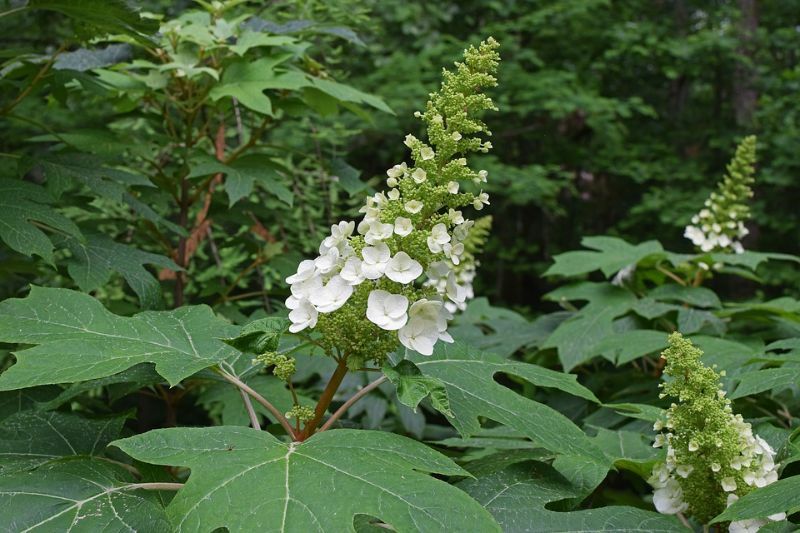
Oakleaf hydrangeas (Hydrangea quercifolia), which are native to the southeast, are lovely all year. Spring and early summer are the best times to see these hydrangea plants in bloom. When the panicle blooms are young, they are greenish white, but as they mature, they take on delicate colors of pink and brown. When new flowers stop blooming, the blossoms stay on the plant and mature into gorgeous blooms.
The lobed leaves can grow to be as long as 12 inches (31 cm). They are bright green in the spring and fall, but as autumn progresses to winter, they become vivid colours of crimson and orange. In the winter, the bark peels back, revealing the dark layer beneath, making them a charming and fascinating shrub.
These characteristics make cultivating oakleaf hydrangeas in your garden a delight. You’ll discover that caring for oakleaf hydrangeas is pretty simple.
What kind of hydrangea is Oak Leaf?
The oakleaf hydrangea is the only member of the genus with noticeable fall foliage colors. When most deciduous plants shed their leaves in November and December, the oakleaf hydrangea remains fully clothed in magnificent deep crimson to purple leaves that last well into the winter.
From the ground up, oakleaf hydrangea is a deciduous, rounded shrub with a mounding shape.
Large clusters of flowers are held in place by strong, sturdy stems above dark green foliage on top and yellowish green beneath.
The stems are a lovely cinnamon or tan hue, with small flakes of bark peeling off. This understory shrub grows in the shade of mixed hardwood trees, beside streams, and on forested hillsides in the wild. It is an ornamental plant that grows best in a moderately shaded natural or landscaped woodland setting, particularly with morning sun and afternoon shade in the cultivated landscape. It can be grown in zones 6 through 9, with some varieties reaching zone 5.
Showy clusters of creamy white or pink flowers grow on the previous year’s wood, depending on the cultivar.
The majority of varieties have single flowers, while a few have double blossoms.
The blossoms are borne in inflorescences that are 6 to 12 inches long and 3 to 5 inches wide and remain for 4 to 6 weeks or longer before becoming tan or deep pink. The dried blossoms provide interest to the plant throughout the autumn.
The following list, which is far from comprehensive, describes a variety of oakleaf hydrangea varieties, as well as their typical sizes and floral displays.
While a few varieties can reach heights of 12 feet or more, the majority of cultivars are medium-sized, growing to be between 5 and 8 feet tall on average.
Many compact cultivars are available for the gardener with a tiny garden that grow 4 feet tall or less and have proportionately smaller foliage and bloom clusters.
- ‘Alice’ is 12 feet tall and 12 feet broad. This shrub is best suited to larger gardens that can accommodate a shrub of this size. In late summer, the huge white blossoms turn rosy pink before finally turning tan. In the year 2000, ‘Alice’ was awarded a gold medal by the State Botanical Garden of Georgia.
- ‘Alison’ stands 8 to 10 feet tall. While this cultivar is similar to ‘Alice,’ it is a little wider and the inflorescences are held higher than those of ‘Alice.’ By the end of the summer, the huge white bloom clusters have turned pink and are going tan.
- ‘Harmony’ stands 10 feet tall and is 10 feet wide. Clusters of exceptionally huge, dense, sterile, double blooms characterize this variety. Their weight can cause branches to bow down. This unusually gorgeous cultivar is not typically found in nurseries, however the weight of the blossoms may be an issue.
- ‘Amethyst’ is 6 feet tall and 6 feet wide. The flowers transition from white to rose in this petite cultivar produced by Dr. Dirr. As ‘Alice’ and ‘Amethyst’ grow older, their inflorescences turn a deep pink color.
- ‘Gatsby Gal’ is 5 to 6 feet tall and 5 to 6 feet wide. This and the following two selections are from Proven Winners’ Gatsby series, which was released in 2016. ‘Gatsby Gal’ features erect flowers that appear big in comparison to the shrub’s small stature.
- ‘Gatsby Moon’ is 6 to 8 feet tall and 6 to 8 feet broad. The inflorescences have densely packed, very full double flowers, similar to those described above for ‘Harmony.’ Rather than turning pink, the blossoms turn white to green.
- ‘Gatsby Pink’ grows 6 to 8 feet tall and 6 to 8 feet broad. The large, long-lasting flower heads change color from white to a beautiful shade of medium pink in a matter of seconds.
- 6.5′ tall by 9′ broad is ‘Queen of Hearts.’ This cultivar was developed by the United States National Arboretum’s shrub breeding program from a cross of the cultivars ‘Snow Queen’ and ‘Pee Wee,’ the same cross that produced ‘Ruby Slippers,’ detailed below. The blossoms start out white and fade to a deep pink tint as they age.
- ‘Snow Queen’ is 6 feet tall and 6 feet broad. ‘Snow Queen’ can withstand brighter conditions and retains its single-flowered inflorescences more upright than other varieties. The Royal Horticultural Society’s Award of Garden Merit was given to it in 2012.
- ‘Snowflake’ is 7 feet tall and 7 feet broad. This variety, which received the Royal Horticultural Society’s Award of Garden Merit in 2012, blooms for longer than most other cultivars. It has long (15 inch) spikes of double hose-in-hose flowers that stay on the plant for a long period. The blossoms turn pink and then light tan as they age.
- ‘Little Honey’ is 4 feet tall and 5 feet broad. The golden yellow spring foliage of this ‘Pee Wee’ sport darkens to chartreuse green in July and finally becomes red in the fall. For optimal results, give it morning sun and afternoon shade. White blooms have petite inflorescences, measuring 5 to 6 inches long and cone-shaped, as compared to other oakleaf hydrangea species.
What does a oak leaf hydrangea look like?
The Oakleaf Hydrangea is a deciduous shrub that can reach a height of 8 feet. It has fuzzy 4- to 12-inch oakleaf-shaped leaves when young. Late in the fall, the leaves turn red or purple. In the late spring and summer, a pyramidal cluster of white blossoms grows, eventually turning purple.
How do I know if my hydrangea is Oakleaf?
Oakleaf hydrangea is distinguished by its foliage. The leaves are lobed and look like oak leaves. Oakleafs, unlike their famous siblings with pink and blue “mophead” flowers, are native to the United States and are strong, cold tolerant, and drought resistant.
Does oakleaf hydrangea grow in shade?
To ask which of my plants is my favorite is like asking which of my children is my fave! A difficult topic to answer, but since I’m not in danger of hurting sensitive young egos, I’d have to say the oakleaf hydrangea is one of my favorites (Hydrangea quercifolia). The reason for this is that this is a plant that has four distinct seasons of appeal. That appeals to me since it saves me time, energy, and money. It rewards me in the spring, summer, fall, and winter once it has established.
Hydrangea quercifolia is a shrub that grows to be around six to eight feet tall, with a maximum height of ten to twelve feet. The huge, dark green leaves have silvery undersides and resemble the Northern Red Oak, from which it receives its popular name. It can be grown in zones 5 through 9.
Cone-shaped flowers can grow up to a foot in length. The blossoms start out white, then acquire a pink blush before turning red as the seasons pass. Single or double florets might be found.
Although the spring and summer are lovely and lush, I am looking forward to the warm days and cool nights of October and November, when the flowers change red and the foliage takes on a variety of yellow, orange, red, brown, and burgundy hues. In protected areas, the leaves last for a long time before falling to reveal an uneven branching structure of cinnamon-colored peeling bark. The contrast against a snowy white bedspread is breathtaking.
Oakleaf hydrangeas thrive in hotter climates, but they like some afternoon shade. It can be grown in full sun in its northern range. The more sun exposure you get, the more flowers you’ll receive, and the more stunning the fall color will be.
This shrub can survive drier soil than its mophead relatives, but not wet feet. Plant it in acidic, wet, well-drained soil supplemented with compost or other organic matter. It can be used as a specimen feature in the landscape or as a mass planting in shaded wooded regions.
Pruning is rarely essential, although it should be done after the flowers have faded and before August. Late summer and early fall are the best times to plant flower buds for the next year. By simply snipping off old flowers, you can “deadhead” them at any time. I like to leave the blossoms on the plant throughout the winter months so that I may enjoy them.
You can cut longer stems for flower arrangements before August if you’re cutting blossoms for arrangements. After that, only remove short stems to avoid losing next year’s blooms.
Oakleaf hydrangeas are generally pest and disease free. This is another bonus in my eyes because it means that plants will look and perform their best all year long without the need of chemicals (always a last resort in my book).
The double flowered variety ‘Snowflake’ is arguably the most popular. Its creamy white blossoms can reach a length of a foot.
In the spring, the foliage of ‘Little Honey’ turns golden, then chartreuse, then green, with a gorgeous burgundy red fall color.
Oakleaf hydrangeas are a perennial favorite in my yard. They’re lovely all year with stunning leaves, exquisite flowers, and fascinating bark, and they’re hardy in many regions of the country. They’re pest and disease resistant, bloom in the shade, and are very little maintenance. What more could we expect of a plant for our landscapes and gardens?
Is oakleaf hydrangea a panicle hydrangea?
The oakleaf hydrangea gets its name from the shape of its foliage, which resembles oak tree leaves. Hydrangea quercifolia, its scientific name, is derived from the Latin word “quercifolia,” which literally means “oakleaf.”
The oakleaf hydrangea leaves not only resemble oak tree leaves, but they also turn color in the fall, making it the only type of hydrangea that does so. Their leaves range in color from golden orange to bright crimson to deep mahogany, making them one of the most appealing shrubs for your autumn landscape.
One of the few hydrangeas native to the United States is the oakleaf hydrangea. The smooth hydrangea is the only other hydrangea that is endemic to the United States. The oakleaf hydrangea has white cone-shaped flower heads that are similar to panicle hydrangeas. It comes in two varieties: single bloom and double blossom. Its flowers, like those of the panicle hydrangea, will turn pink as the plant matures.
The oakleaf hydrangea is tougher than its cousins and can endure a wider range of climate conditions than most bigleaf hydrangeas. Oakleaf hydrangeas are more winter resistant and can withstand drier conditions. These oakleaf hydrangeas, unlike mopheads, require drier, well-drained soil because they are susceptible to waterlogging.
Because of its long-term benefits, the oakleaf hydrangea is a popular choice for gardens. Their flowers appear in the early summer and continue until the end of the season. When autumn arrives, their leaves take the stage, becoming a vibrant orange and scarlet color. Avoid growing them in deep shade in your yard since too much shade may cause their fall foliage hues to fade. Hardiness zones 5 through 9 are ideal for oakleaf hydrangeas.
Is oakleaf hydrangea a panicle?
If the macrophylla hydrangea is the Diva Queen of the garden, I’d say the oakleaf hydrangea is the King.
Oakleaf hydrangea, Hydrangea quercifolia, is a towering shrub that can grow fairly large over time. Most can reach a height of 6 to 8 feet and a width of 6 feet or more. Some plants, like as Ruby Slippers, have been bred to be dwarf-sized (see below).
The coarse-textured, oakleaf-shaped leaves of this shrub are larger (8+ inches long) than any of the other hydrangea species, giving it a king-like aspect. Oak is called “Quercus” in botanical latin, hence oakleaf hydrangea is Hydrangea quercifolia.
The creamy conical formed panicles can be small (4 inches) to big (12 inches), single or double florets, and tightly packed or loosely held florets, depending on the cultivar.
In my yard, oakleaf hydrangeas bloom sooner (in May) than other hydrangea varieties, and I notice bees and other pollinators swarming about the flowers.
What does an oakleaf hydrangea look like in winter?
If not removed, hydrangea flower heads turn dry and brown in the fall and will stay that way throughout winter. Hydrangeas shed their leaves in the fall as well, but their brown stems remain upright unless clipped.
What side of the house do you plant hydrangeas?
The north-facing side of your home, regardless of where you live in the country, receives very little sunlight. This, combined with the fact that a north side garden is exposed to north winds, makes selecting the proper plants for a landscaping project more difficult. Fortunately, there are a variety of plants that will grow in these conditions while also adding beauty and value to your home.