
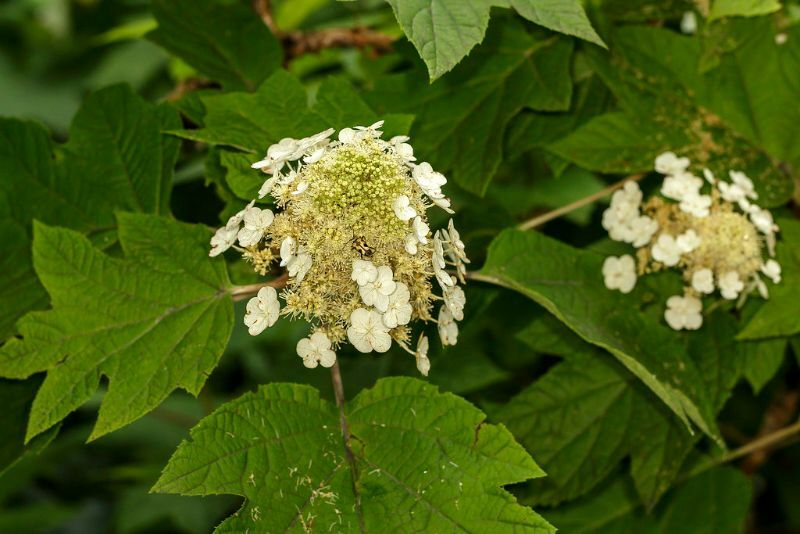
To ask which of my plants is my favorite is like asking which of my children is my fave! A difficult topic to answer, but since I’m not in danger of hurting sensitive young egos, I’d have to say the oakleaf hydrangea is one of my favorites (Hydrangea quercifolia). The reason for this is that this is a plant that has four distinct seasons of appeal. That appeals to me since it saves me time, energy, and money. It rewards me in the spring, summer, fall, and winter once it has established.
Hydrangea quercifolia is a shrub that grows to be around six to eight feet tall, with a maximum height of ten to twelve feet. The huge, dark green leaves have silvery undersides and resemble the Northern Red Oak, from which it receives its popular name. It can be grown in zones 5 through 9.
Cone-shaped flowers can grow up to a foot in length. The blossoms start out white, then acquire a pink blush before turning red as the seasons pass. Single or double florets might be found.
Although the spring and summer are lovely and lush, I am looking forward to the warm days and cool nights of October and November, when the flowers change red and the foliage takes on a variety of yellow, orange, red, brown, and burgundy hues. In protected areas, the leaves last for a long time before falling to reveal an uneven branching structure of cinnamon-colored peeling bark. The contrast against a snowy white bedspread is breathtaking.
Oakleaf hydrangeas thrive in hotter climates, but they like some afternoon shade. It can be grown in full sun in its northern range. The more sun exposure you get, the more flowers you’ll receive, and the more stunning the fall color will be.
This shrub can survive drier soil than its mophead relatives, but not wet feet. Plant it in acidic, wet, well-drained soil supplemented with compost or other organic matter. It can be used as a specimen feature in the landscape or as a mass planting in shaded wooded regions.
Pruning is rarely essential, although it should be done after the flowers have faded and before August. Late summer and early fall are the best times to plant flower buds for the next year. By simply snipping off old flowers, you can “deadhead” them at any time. I like to leave the blossoms on the plant throughout the winter months so that I may enjoy them.
You can cut longer stems for flower arrangements before August if you’re cutting blossoms for arrangements. After that, only remove short stems to avoid losing next year’s blooms.
Oakleaf hydrangeas are generally pest and disease free. This is another bonus in my eyes because it means that plants will look and perform their best all year long without the need of chemicals (always a last resort in my book).
The double flowered variety ‘Snowflake’ is arguably the most popular. Its creamy white blossoms can reach a length of a foot.
In the spring, the foliage of ‘Little Honey’ turns golden, then chartreuse, then green, with a gorgeous burgundy red fall color.
Oakleaf hydrangeas are a perennial favorite in my yard. They’re lovely all year with stunning leaves, exquisite flowers, and fascinating bark, and they’re hardy in many regions of the country. They’re pest and disease resistant, bloom in the shade, and are very little maintenance. What more could we expect of a plant for our landscapes and gardens?
Will oakleaf hydrangeas grow in full shade?
Oakleaf hydrangeas are understory plants in their natural habitat, so they like some afternoon shade, especially in hotter regions where nearly full shadow is required. Oakleaf hydrangeas can tolerate full sun in the north. The brilliance of the fall color may be reduced if there is too much shade.
How much sun is too much for hydrangeas?
We propose a maximum of 2 hours of morning sun in the southernmost regions (Zones 89). Your hydrangea shrubs’ leaves and blooms may burn if they are exposed to too much sunlight. Also, feel the soil with your fingers to check whether it needs to be watered.
What kind of light does an oakleaf hydrangea need?
Oakleaf hydrangeas are low-maintenance plants that only require the following:
- Site and sunlight – Oakleaf hydrangeas thrive in broad sun to moderate shade in northern climates. Give them morning sun and protection from powerful afternoon rays in southern zones.
- Rich, well-drained, somewhat acidic soil is ideal for oakleaf. Take the time to amend your soil around planting time if you live in a region with a lot of clay. Pennington Acts Quickly Gypsum aids in water penetration and drainage, as well as loosening compacted soil and encouraging proper root growth. Pennington UltraGreen Plant Starter with Vitamin B1 also aids in the reduction of transplant shock.
- Water – Oakleaf hydrangeas thrive in soil that is evenly moist but never saturated. Thoroughly water the soil, then check it by hand before watering again. Avoid overwatering to avoid root rot. Wait a few days if the soil is damp before checking again.
- Fertilizer At planting time, use a complete fertilizer like Pennington UltraGreen All Purpose Plant Food 10-10-10 to provide your hydrangeas with the nutrition they require. Each year, feed your oakleaf with the same fertilizer or a flower-enhancing fertilizer like Pennington UltraGreen Color Blooms & Bulbs Plant Food 15-10-10 in early spring. Then, four months later, in mid-summer, feed it again.
Which hydrangeas tolerate the most shade?
For shady areas, oakleaf hydrangeas are the ideal choice. Their striking oak-shaped leaves give them their name! With soft spring buds, enormous blooms in summer, vivid fall foliage, and peeling winter bark, oakleaf hydrangeas are easy to enjoy in all four seasons.
When should you plant oakleaf hydrangeas?
Oakleaf hydrangeas can be produced from cuttings from established shrubs, but they’re more commonly found in three-gallon pots at your local garden center, which can be put right into your yard, according to Zawojski. Planting should be done in the spring, early summer, or early to late fall, according to him. “Do not plant bushes during periods of extreme heat, such as July and August, or January and February,” he advises.
Is 4 hours of sun enough for hydrangeas?
Many hydrangea species thrive in part shade (at least four hours of direct sunshine per day) and even complete shade (less than four hours of direct sunlight per day). The blue, pink, or white bigleaf hydrangea (Hydrangea macrophylla, zones 5-11) is one of the species in this category. The pH of the soil determines the color of the blooms. Blue flowers grow in acidic soils, while pink blooms grow in alkaline soils. According to the Missouri Botanical Garden, depending on the variety, bigleaf hydrangeas can bear mophead or lacecap flowers.
When do hydrangeas bloom?
The blooming season of hydrangeas is determined by the kind and cultivar, as well as your planting zone. The majority of new growth hydrangeas form buds in early summer and bloom in the spring, summer, and early fall. Hydrangeas may stop blooming in the middle of summer in hot locations, but they will rebloom in the fall.
How do you cut back hydrangeas?
Hydrangea plants do not require pruning when allowed ample growing room in the garden. All that is required is the clearance of dead wood on a regular basis.
Do you need to deadhead hydrangeas?
Hydrangeas can be deadheaded to keep them blooming well into the fall. Hydrangeas produce wonderful cut flowers, so you don’t have to wait till the blossom wilts. Allow those early autumn blooms to fade on their own. Close to your freeze date, you don’t want to encourage fresh development.
How do you control hydrangea color?
Hydrangeas are unique in that their color may be controlled. Keep in mind, however, that not all hydrangea varieties may be color-adjusted. H. macrophylla, or bigleaf hydrangeas, respond to changes in soil pH. Hydrangeas can absorb aluminum thanks to a low soil pH, which gives the blossoms a lovely blue hue. Reduce the pH of your soil by adding sulfur or peat moss to encourage blue hydrangea flowers. During the growth season, you can also apply more aluminum sulfate to the soil. When you add ground limestone to raise the pH, pink and scarlet blooms pop.
A soil pH test might help you fine-tune the color of your hydrangeas. To avoid causing damage to the plant, keep the pH below 7.5. All hydrangeas will naturally fade in the fall, no matter what alterations you’ve made. Don’t worry, the plant will bloom again in the spring with fresh, bright blooms.
Can hydrangeas grow in shade?
Hydrangeas prefer dappled or occasional shade, but won’t blossom in direct sunlight. It’s not so much an issue of whether they favor sun or shade, but rather how much sun do hydrangeas require. Your hydrangeas will require more sunlight as you move further north in your garden. Six hours of sunlight every day is a good rule of thumb. Hydrangeas grown in the south, on the other hand, can thrive with only three hours of sunlight.
Can hydrangeas grow in full sun?
Hydrangeas thrive in the morning sun, but not so much in the scorching afternoon sun. For these beauties, partial shade in the late afternoon is great.
Can you grow hydrangeas in pots?
Even if you don’t have enough space in your garden to cultivate hydrangeas, learning how to grow hydrangeas in a pot allows you to enjoy these lovely blooms. As long as you follow the principles of hydrangea care, the process is pretty simple. Choose a pot that is at least 18 inches in diameter to accommodate the mature size of your hydrangea. Look for non-porous pots to assist hydrangeas maintain a consistent moisture level. Excess water will be able to drain adequately through drainage holes. Dwarf hydrangeas like Little Lime, Mini Penny, and Buttons ‘n Bows are good choices.
How do you keep hydrangeas from wilting?
Watering in the mornings can help keep your plants from wilting. Some hydrangea cultivars are unable to withstand the heat. They’ll wilt a little in the afternoon heat, no matter how much water you give them. Mulch in a thick layer can help retain moisture and keep the soil cool. You shouldn’t be concerned if your hydrangeas bloom again as the day progresses. It’s preferable to have a little wilting in the middle of the day than to overwater and drown your hydrangeas.
Why do my hydrangeas wilt in the sun?
Hydrangeas can droop for a variety of causes, although disease is rarely one of them. Drooping hydrangeas are frequently expressing their dissatisfaction with local conditions. Wilt is caused by too much sun and not enough water, and high bloom loads can force delicate branches to bend to the ground. Droopy hydrangea plants can be exacerbated by an overabundance of fertilizer.
Correcting the problem will necessitate extra care for your hydrangea. Before attempting to remedy the conditions that caused the initial droop, you’ll need to play detective to figure out what’s wrong with your plant. A soil test and careful observation may be all that’s required to pinpoint the root of the issue.
What should I plant in front of oakleaf hydrangea?
Soil Oakleaf hydrangea grows best in moist, organic, fertile, well-drained, slightly acidic soil with a pH of 5.06.5. It is drought resilient once planted, but it does benefit from water in extremely dry conditions. It’s critical to have good drainage. Although the plant prefers damp soil, wet feet are not an option.
Full to moderate shade is fine for this shrub.
It does, however, perform better when exposed to the sun for at least a full day or more, resulting in a richer floral show, stronger stems, and more beautiful autumn foliage.
Some cultivars can tolerate a more sunny location. On the other hand, heavy shadow produces fewer blossoms but larger leaves.
Trimming – Oakleaf hydrangeas require very little pruning, if any at all.
If pruning is required to shape or reduce the size of the shrub, do so soon after the flowers have faded.
Late in the summer, this shrub produces bloom buds for the next year.
To put it another way, it grows on ancient wood.
Pruning at any other time of year will result in the loss of the blossoms for the next year.
Insects This plant is rarely bothered by insects, with the exception of spider mites and aphids.
Deer will nibble on this plant, especially the sensitive, new spring foliage, so use a deer repellent or a physical barrier to protect it.
Propagation – Stem cuttings can be used to propagate the plant. The plant can also be propagated by layering because the branches are low to the ground.
When used as a solitary specimen, a backdrop to smaller shrubs, bulbs, or perennials, a component of a mixed border, a deciduous hedge, or a mass planting, oakleaf hydrangea is a powerful yet elegant shrub.
If oakleaf hydrangeas have a flaw, it’s that their enormous, coarsely textured foliage might be intimidating to a novice gardener. Rest confident that the foliage mixes in beautifully with plants with smaller leaves. Evergreens, for example, with their finer needles and scaly branches, provide a nice contrast. Boxwoods’ more formal round shape and compact, thick leaves contrast nicely with the looser appearance of oakleaf hydrangea. Oakleaf hydrangeas pair well with taller ferns like ostrich or cinnamon ferns, as well as shorter grass-like plants like liriope.
Easy-care The oakleaf hydrangea is particularly beneficial in the landscape because it provides year-round interest. It makes an immediate impact in the spring when its bold, beautiful leaf emerges. In the summer, the dark green foliage contrasts with the huge, long-lasting clusters of creamy white or pink blooms. Many cultivars mature to a medium pink or deep rose color over time. With its rich, deep burgundy/purple foliage that lasts all winter, the oakleaf hydrangea really shines in the fall. Additional interest is provided by the dried tan or light brown flower heads. The flaking tan bark adds a tactile aspect to the white environment in the winter.
An Illustrated Encyclopedia of Hardy Trees and Shrubs by Dirr (Dirr, Michael A., 1997)
“Selection, Pruning, and Care of Hydrangea,” (ext.vt.edu/chesapeake/programs/anr/Pruning) Virginia Cooperative Extension Publication
“Problem-Free Shrubs for Virginia Landscapes,” according to the author. 450-236 (ext.vt.edu/450/450-236/) is a Virginia Cooperative Extension publication.
HORT-84P (ext.vt.edu/HORT/HORT-84/), “Selecting Plants for Virginia Landscapes: Showy Flowering Shrubs,” Virginia Cooperative Extension Publication HORT-84P (ext.vt.edu/HORT/HORT-84/), “Selecting Plants for Virginia Landscapes: Showy Flowering Shrubs,” Virginia Cooperative Extension Publication HORT-84P (
Hydrangea quercifolia, University of Connecticut College of Agriculture, Health and Natural Resources Plant Database (hort.uconn.edu)
Cooperative Extension of North Carolina State University (plants.ces.ncsu.edu/plants/all/hydrangea-spp)
Hydrangea Production at Tennessee State University (tnstate.edu/faculty/ablalock/documents/Hydrangea)