
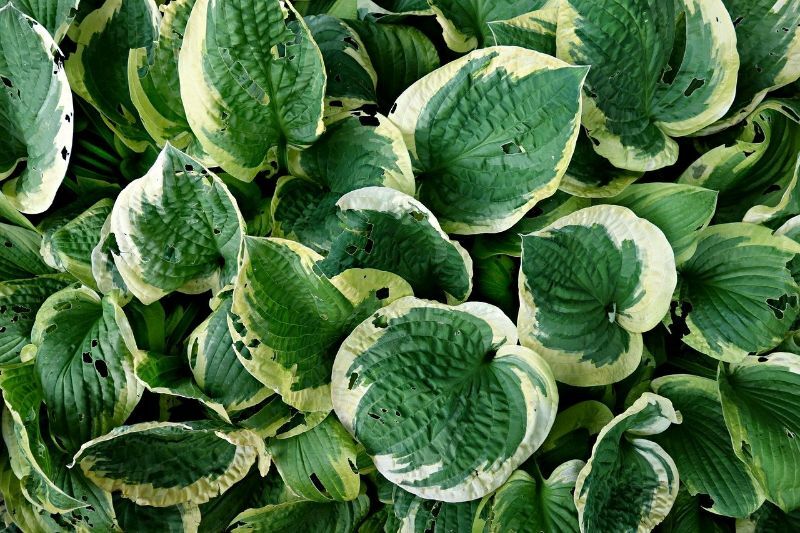
You may have a clue as to what the holes look like and where they are on the leaf if you notice what they look like and where they are on the leaf. Large, uneven holes in the leaves could indicate the presence of a gnawing pest, such as grasshoppers. To stop them from eating, use Carbaryl dust (Sevin) in the morning. A naturally occurring microbe called Nosema locustae can be used as an alternate treatment for these pests.
You may have vine weevils if you notice fresh holes in the leaves of your hosta that are smaller than paper punch holes. In the evening, as dusk sets, dust these with Sevin. Beneficialnematodes can also assist in the control of these problem insects.
If neither of these describe where or how your hosta plant has holes, slugs, snails, or both may be at blame. At night, use a flashlight to inspect the leaves, paying special attention to the ground and the undersides of the leaves. Sluggo, a granular product, may be used to get rid of them. You can also pick them up and throw them in some soapy water. Alternatively, you can set up a DIY beer trap just where the slugs can drink, fall in, and die. A shallow lid from a peanut butter jar will suffice, but it will need to be refreshed every few days.
How do I keep bugs from eating my hostas?
Horticultural oil is the greatest approach to keep bugs away from hosta plants. Spray the hostas with 0.3 liters of water with 1 teaspoon of detergent and 2 tablespoons of horticultural oil. Cleaning the entire surface around the hostas of rotting plant debris where insects can hide is also necessary.
What causes tiny holes in hosta leaves?
What causes holes in the leaves of hostas? This is one of the most often asked questions about hosta plants. Slugs or snails are frequently the culprits when it comes to pests eating hostas. These nocturnal foragers, which eat small holes in the leaves, are perhaps the most frequent of the hosta pests. Snail trails of silvery tint can be found around the garden area, indicating their presence. Beer traps may be used to control these slugs, which they crawl into and die in.
The adult black vine weevil is another insect pest that eats hosta leaves. This bug makes uneven notches along the outer edges of leaves as a sign of its presence. Their larvae also cause damage to hosta plants by feeding on the crown and roots, resulting in yellow, wilted foliage.
Nematodes, which are minute roundworms, infect hosta plants in the same way as fungi or bacteria do. They flourish in damp environments, just as fungal infections. Nematodes eat on the leaves, resulting in brown spots between the veins, giving the leaves a striped appearance. This usually happens in the late summer. Plants that have been harmed should be destroyed. Most nematode attacks can be avoided by providing proper distance between plants, using soaker hoses to avoid damp foliage, and removing and destroying all diseased plants.
Do you believe that only bugs consume hostas? Reconsider your position. Hosta plants are frequently eaten by deer and rabbits. Deer, on the other hand, may leave merely stalks where once lovely hosta leaves grew, whilst rabbits prefer to nibble on the young shoots.
What can I spray on hostas to keep bugs away?
Oil for Horticulture The oil aids the pesticide’s adhesion to the hosta’s foliage and stems, allowing it to be more effective at killing insects on the plant. To prepare horticultural oil, add 2 tablespoons of oil to each gallon of insecticidal soap.
What is eating my hostas plant?
Hostas are eaten by what animal? You can usually blame deer, voles, or mice if yours suddenly vanish. Slugs, snails, cutworms, black vine weevils, and nematodes are some of the bugs that can cause more slow damage. Hostas are rarely eaten by rabbits and squirrels, however bunnies do appreciate the fragile spring shoots.
Do you know what eats hostas? If that’s the case, you’ve come to the correct place. Because different species can leave similar indications, it can be difficult to know which animal is eating your hostas.
How do you protect hostas from slugs?
Copper rings can be efficient slug deterrents; if a slug tries to cross one, it gets a ‘electric shock,’ compelling it to retreat. Put rings around sensitive plants like hostas and bury them deep since slugs can get below them.
Some gardeners swear by wrapping copper tape around the rims of pots, however the RHS found this to be useless in a recent trial. However, research is still ongoing.
Get plants on side
If you’re looking for a mild way to get rid of slugs, try using plants that deter them and act as a natural pesticide. You can keep slugs at bay without using chemicals this way. Slugs are repelled by the aroma of astrantia. Wormwood, rue, fennel, anise, and rosemary are among the herbs that repel slugs.
Remove shelter & encourage beneficial wildlife
Under bricks, garden furniture, and huge logs, slugs will seek refuge. To expose slugs to natural predators, remove potential slug shelters. Slugs won’t be able to survive in your garden if you make it inappropriate for them to live in. Encourage natural predators to take care of the problem, such as toads, newts, hedgehogs, and song thrushes.
Make a beer trap
A beer trap is a simple and inexpensive approach to get rid of slugs. Make one by half-filling a container with beer and burying half of it near sensitive plants. Alternatively, keep an eye out for specially designed beer traps. The beer’s aroma will attract slugs, who will then fall in and become stuck. To avoid catching slug-eating ground beetles, keep the rim of the container 2-3cm above the ground.
Create a prickly barrier
Slugs are soft-bodied mollusks, therefore prickly barriers work well to keep them away from valuable plants. To construct barriers and recycle undesirable leftovers and greenery, use broken egg shells, pine needles, or prickly cuttings. Sharp sand is another excellent substance to utilize. Just be sure that anything you’re utilizing won’t have an impact on the soil’s quality.
Create a slippery barrier
Slugs will be unable to scale the surface of plant pots if they are sprayed with WD40 on the outside, successfully protecting your container plants.
Lay down copper tape
Copper reacts with slug slime, causing slugs to receive a little electric shock every time they come into touch with it. Slugs will not be able to reach your plants if you use self-adhesive copper tape in your garden. The tape can be used to protect greenhouse staging, potted plants, raised beds, and anything else against these voracious mollusks.
Place a lure
To attract a big number of slugs, place a pile of old lettuce leaves or dry cat food in a wet and dark spot. As they all assemble near the food supply, round up the criminals and execute them all at once. To catch slugs on the go, combine this strategy with torchlit night hikes in your garden.
Apply nematodes to soil
Slugs are parasitic on nematodes, which are soil-dwelling microorganisms. To use, simply combine them with water and sprinkle them on the soil. For the treatment to be successful, the soil temperature must be higher than 5 degrees Celsius.
Sprinkle salt
Slugs can be killed by spraying salt on them, but be careful not to overdo it because too much salt might harm plants. As a result, it’s best employed when you’re far away from precious plants.
The eco-method
The slug’s tragic fate is to offer food for carnivorous predators because it is at the bottom of the food chain. To reduce the number of slugs in your garden, attract badgers, birds, and hedgehogs.
Chickens make excellent pets because they can give you with free-range eggs on a daily basis while also lowering the presence of slugs. Consider adopting a hen that was formerly used for commercial farming.
Alternatively, if your garden is enclosed by fencing, drill a CD-case-sized hole in the base of the fence to enable hungry hedgehogs, and possibly badgers, access to the slugs.
If you’re having trouble with moles in your garden, go here to learn how to get rid of these burrowing pests.
What kind of bugs are eating my hostas?
Cutworks, beetles, aphids, grasshoppers, slugs, snails, pill bugs, and spider mites are the most common.
The methods provided in this DIY pest control guide will assist you in repelling those pesky pests while also providing protein for your hosta plant.
If you have any of the pests described above, read the pest management guides provided to learn how to get rid of them.
If you observe animals or rats in your yard, they’re probably eating your plants. Regardless of whether or not you are present. If the problem is caused by an animal, you can use natural repellent, install fencing, or cover your hostas with a protective plant mesh.
What does slug damage look like on hostas?
Slugs are a typical hosta pest, and they are most likely eating your plants. When the temperature rises over 50 degrees and there is enough moisture from rain or watering, slugs become active. So far, this year has been a rainy one, which means ideal circumstances for slugs. They have soft bodies and feed at night and on overcast days, resembling snails without the shell. Large, uneven holes form in the leaves as a result of the feeding damage. When populations are huge, a lot of damage can happen.
How often should I put Epsom salt on my hostas?
Epsom salt enhances chlorophyll levels in hostas, reducing stunted development and making their leaves greener and thicker. It also promotes bushier plant growth and increases disease and insect resistance.
Get Rid of Slugs
The most prevalent pests that attack hostas are slugs. Slugs can be deterred by placing a tablespoon of Epsom salt in the shape of a ring around hostas. Their bodies will be irritated by the sharp crystals of Epsom salt, and they will avoid getting near your plants. For optimal results, apply once a week.
For Yellowing Hosta Leaves
Magnesium insufficiency might be indicated by yellow hosta leaves. Once a month (or more frequently if necessary), sprinkle a spoonful of Epsom salt around the base of your hosta plant per 12 inches of height until it begins to look green again.
For Lush and Healthy Hosta Plants
Even if your soil is not magnesium deficient, factors such as acidic soil, low soil temperature, soil cation exchange capacity, high potassium, and salt can all impede Magnesium uptake by plant roots.
In that case, foliar feeding your hosta plants with Epsom salt solution is a good idea:
- During the rapid growth period, mix 2 teaspoons Epsom salt in 1 gallon of water and sprinkle on the foliage once a month.
- Reduce the amount to 1 tablespoon as growth slows. Your hostas will stay lush and healthy with the foliar treatment.
Mix Epsom Salt with Fertilizer
To improve the efficiency of the all-purpose liquid fertilizer, mix a pinch of Epsom salt with it before feeding the hosta plants, then apply according to the recommendations on the fertilizer’s packet.