
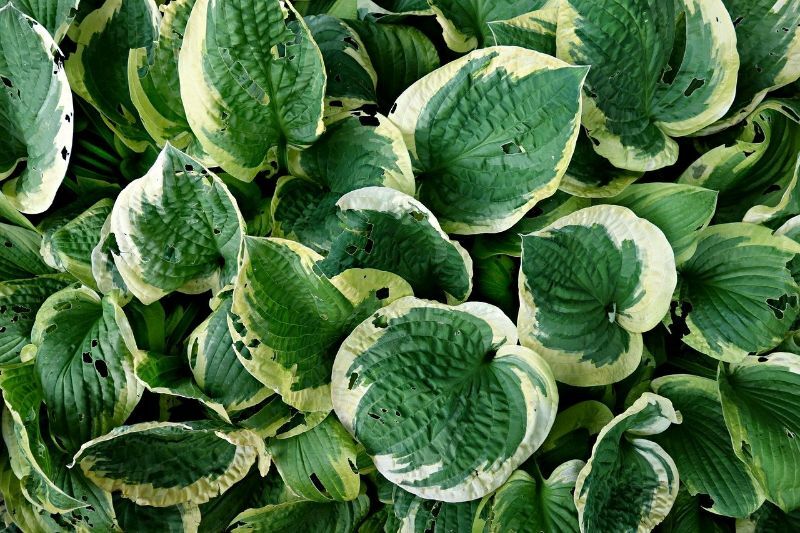
- After planting or when new growth sprouts in the spring, use a well-balanced, slow-release fertilizer.
- If the soil dries up quickly, mulch around the plants can help maintain moisture, but keep in mind that mulch can also serve as a hiding place for slugs.
- Many hosta cultivars have attractive fall color, so let them alone until frost threatens them.
- Hostas flatten out and become mushy in late autumn after a few frosts. To avoid slug and disease problems, we recommend trimming them back. Clean up the area around the plants and get rid of any brown leaves. If you run out of time, you can always wait until spring to prune them.
- Early spring is the finest time to transplant and divide since the leaves are just starting to sprout.
Transplanting or Dividing Hostas
Hostas don’t normally need to be divided for health reasons. They will simply develop slower if they have less area. If you want to divide a hosta for a more tidy landscape, do so in the early spring when the “eyes,” or growing tips, begin to emerge from the ground. Moving or transplanting a hosta to a different location is also an excellent idea now.
Leave as much of the root attached to each crown or plant as feasible. Plant the new hostas at the same depth in the soil as the old ones. Water thoroughly till the plant is established.
How do you keep hostas healthy?
Hosta care becomes a simple issue of maintenance once your plant has established itself. Fertilize your growing hostas with an all-purpose garden fertilizer each spring to keep them healthy. Additional summer fertilization may be beneficial, but it is not required. Nutrients in the form of granules should never be applied to the leaves.
Hosta plants are disease-free, with the exception of crown rot and leaf rot. Deer find them appetizing, so if you live in an area where deer are a problem, try planting daffodils around your hosta to keep them away from the new shoots.
Slugs, which produce unsightly holes in the leaves, are another issue with hosta maintenance. A little sprinkling of sand around your plants can deter them.
Hosta plants are a lovely addition to any landscape and can be grown in a variety of sizes, from a few inches to four feet (1.2 meters). Hostas are simple to care for, and now that you know how to cultivate them, you’ll find them to be a pleasant addition to your yard.
How do you care for potted hostas?
Hostas thrive in both the shade and the light. There may be special light requirements depending on the type of hosta you have. The hosta is getting too much sun if the exterior edges of the leaves are brown or the faded areas on the leaves are a dull color. In the planter, there’s a hosta that appears to be in good health and is blossoming!
Hostas grown in containers need a lot of water. Especially on hot summer days, drink plenty of water. Keep an eye on your container to make sure it’s draining properly. Hostas want damp soil that isn’t soggy.
Potted hostas might lose nutrients if they are watered too frequently. When you pot it, use a slow-release fertilizer and fertilize every other week.
How often should I water a hosta?
When it comes to growing hosta, the amount of water needed depends on the circumstances in the garden as well as the time of year. From winter to summer, the technique of watering a hosta plant will vary. Watering requirements for growing hostas increase during the hottest stages of the summer season and decline as the weather cools and the plants become dormant in the fall.
Hosta irrigation is necessary to guarantee that the plants grow to their full potential and remain healthy. These plants demand soil that is both well-draining and consistently moist at all times. This can be accomplished by employing soaker hoses or drip irrigation systems to water the plants on a weekly basis.
Watering a hosta deeply, as with many perennial plants, is essential – they require around an inch (2.5 cm) of water each week on average. Plants can develop a more robust root system that is better able to access water deep in the soil if they are watered on a weekly basis.
Do hostas need to be cut back in the fall?
Hostas should be pruned back in the late fall as a general rule. Starting with wilted or brown leaves is a good place to start. Healthy leaves can stay a little longer to aid in the storage of energy by the roots. If 25 percent or more of the hostas are dying, it’s time to prune them back. Following the first frost, all of the leaves should be cut off. Slugs and bunnies will be less likely to make your plant their winter home if you do this.
Do hostas like sun?
Sun-tolerant hostas must be protected from the heat during the hottest part of the day, even though they can withstand more sun than traditional shade-loving hostas. Hostas can withstand more sun in Zones 6 and north than they can in warmer zones. Even sun-tolerant hostas will struggle to tolerate more than a few hours of sun in the warmest zones.
Hostas for the sun do well in all growing zones when they have sufficient of moisture. Sun-loving hostas will need more water than those that grow in shadier environments. On sun-tolerant hostas, keep a thick layer of mulch on top of the soil to help conserve moisture. Visit local nurseries in August to look at hostas and decide which ones are best for your landscaping. The sun-tolerant hostas that don’t have scorched leaves are the ones you can bank on to perform in your garden.
How do you make hostas look nice?
Because hosta leaves range from crisp white or dazzling yellow to silvery blue or near-black green, working with color is one of the most interesting aspects of designing with them. When you combine these hues with different plants, they become even more spectacular. You’ll be shocked at how much your designs improve once you start doing this.
Color has a fascinating way of connecting plants and drawing the eye from one to the next. Because the color of a surrounding plant is enhanced, an uninteresting, solid-colored hosta becomes stunning. Planting a blue hosta among pink and purple flowers, for example, looks fantastic. When a gold hosta’s leaf color is repeated by yellow blooms or contrasted with purple blossoms, the leaf color becomes more striking. It will be effective even if a plant only has a small splash of the color you wish to echo. A daylily with a yellow throat, for example, will complement a gold hosta.
Variegated hostas provide the most dramatic pairings because they add a pop of color to the magnificent foliage patterns. White flowers bring out the sharpness of white-variegated leaves, while yellow blooms bring out the brightness of hosta variegation. That’s all there is to it.
Astilbes (Astilbe spp. and cvs., USDA Hardiness Zones 38) and meadow rues (Thalictrum spp. and cvs., USDA Hardiness Zones 310) are good color companions for hostas, but they only bloom for a few weeks. Use shade-tolerant annuals like impatiens (Impatiens walleriana cvs. ), nicotiana (Nicotiana spp. and cvs. ), browallia (Browallia speciosa and cvs. ), torenia (Torenia fournieri and cvs. ), and coleus (Solenostemon scutellarioides cvs.) for year-
Can hostas survive indoors?
Hostas are a leafy, shade-loving perennial with rich foliage and beautiful flowers that will impress any client. Hostas are ideal for indoor plant arrangements due to a variety of qualities. The foliage, which is their most beautiful feature, will lend depth to any plant arrangement. Hostas are a plant family comprised of several species and cultivars that come in a wide range of color, size, and shape, making it simple to select the right match for any plant arrangement. Hostas grow nicely in containers and don’t require direct sunlight, so they can be grown indoors.
Can hosta plants grow in pots?
Perennialsand even small shrubshave grown increasingly popular in containers as gardens have shrunk and breeders have developed compact types. Hostas are one of the perennials that thrives in the limits of a container. They are easy to care for and available in thousands of cultivars, making them the ideal plant for busy or preoccupied gardeners.
Mini-hostas, in particular, thrive in the confines of a container and, when grouped in a group or with other small plants, may be extremely appealing on a porch, patio, or stoop. In a container, however, any size hosta can be grown.
There are simply a few things to keep in mind when growing hostas in pots. To begin, most experts advise choosing a pot that is slightly smaller than the plant’s mature size. When planting the hosta in the container, leave less than 3 inches between the roots and the container’s edge. A small container may necessitate more regular waterings, but this is better for the plant’s general health.
Make sure your container plantings have good drainage, as with all container plantings. After a thorough soaking, the water should freely drain out of the bottom of the pot. Drill a couple more holes in the pot to improve drainage. It’s preferable to water the container thoroughly less frequently than to give the plant a small amount of water every day. However, if the weather is really hot or dry, you will almost certainly need to water your container every day or two. Hostas have the advantage of wilting a little when they get dry, but not completely drying up and dying. Your hostas are requesting a drink if they are withering. The major danger with hostas is overwatering, which can lead to crown rot.
Use a normal potting soil (never garden dirt) and water the plant in when growing hostas in pots. Fast-draining soil is recommended by some gardeners. Place the container outside in a shady or partially sunny location. While some hostas may tolerate heavy shade, the majority prefer dappled shade or morning sun.
Your hostas can be kept in pots year after year, but it’s not as simple as overwintering them in the garden. In fact, some people may winterize their container hostas by planting them in the ground. Other gardeners bury their pots outside, just like a garden hosta would, so that the roots lie underground. Another alternative is to move the pots to a covered location (such as the side of the house) and cover them with a thick layer of mulch. However, if we have a really harsh winter, this could be difficult. After the pots have gone dormant, a fourth alternative is to store them in an unheated garage or shed. However, the plants will need to be watered a few times during the winter to prevent the soil from wicking water away from the dormant roots. Do not attempt to keep hostas as houseplants over the winter. They require a time of cold and dormancy.
Are hostas better in pots?
Hostas can be planted at any time of year, although it’s best to avoid planting them in the middle of summer when temperatures are high and the soil is frequently dry due to lack of rainfall.
Where should I plant?
In the ground or in a container, all hostas thrive in moist soil in moderate shade. However, yellow-leaved varieties, as well as a few hosta cultivars that are sun-tolerant, prefer some sun.
Hostas prefer fertile soils with heavy clay, which can be improved by adding garden compost or well-rotted manure. Try hostas with thicker, waxier leaves, which are more tolerant of dry conditions. Hostas, unfortunately, are not well-suited to dry soils or exposed, windy sections of the garden.
Should hostas be in sun or shade?
A. Hostas are low-maintenance plants with a wide variety of types to pick from. Even though they are shade-tolerant, most of them will not survive in deep shadow. When given some sun, such as early sun with afternoon shade, many hostas become more strong and show their best colors.