
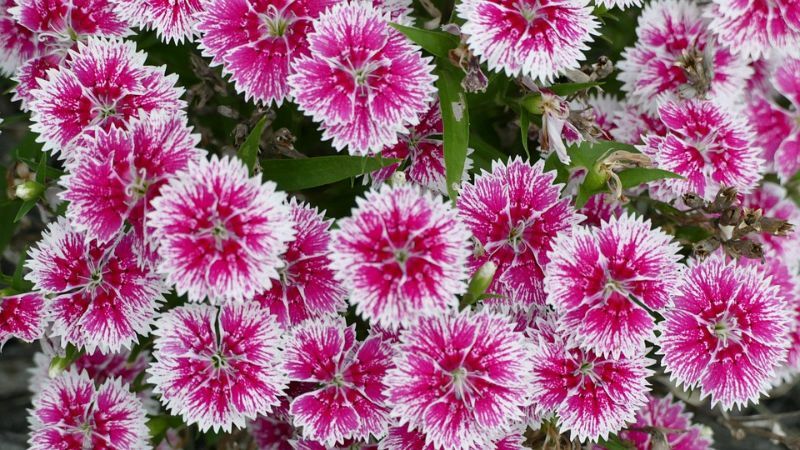
Dianthus plants are native to Europe, Asia, and Africa, and have attractive bluish-grey foliage that is spectacular even when the plants are not in bloom. Plants can have a mounded shape, an erect habit, or a trailing habit, and their foliage is slender, almost grass-like. Don’t be fooled by the moniker “pinks” while selecting dianthus types for your landscaping. While many variations have pink blooms, the fringed edges of the flower petals give this variety its name.
Types:
The majority of plants are perennial, however others are biennial or annual. Pink perennials are evergreen or semi-evergreen perennials. The common name comes from the frilly edges of the petals, which resemble pinking shears when cut. Sweet William is a perennial that is usually grown as a biennial or annual. Florists love carnations (Dianthus caryophyllus) because of their long stems and long bloom time.
Color and characteristics:
Flowers with frilly petals are solitary, semi-double, or double. They’re available in almost every color except blue, as well as patterned bicolors. The foliage is strappy and grass-like, with green, blue-green, or silver-green hues.
Toxicity:
Some people may have slight skin irritation from Dianthus foliage, which normally lasts only a few minutes. If swallowed, the plants might be somewhat hazardous to pets.
Does dianthus bloom all summer?
Drought-tolerant dianthus plants are ideal for sunny places near the edge of a flower border or a sidewalk. The plants freely take up residence in the fissures of a rock wall, where their roots can remain cold. Pinks stretch out in small flower pots to form a lovely spectacle. They thrive in the cool spring and fall conditions, but they are remarkably flexible. They endure heat and thrive in areas with excessive rainfall and humidity as long as they are planted in well-drained soil. Dianthus blooms bloom profusely in early spring and summer, but if you clip the blossoms off as they fade, many dianthus will rebloom later in the gardening season. Hedge shears will suffice, leaving a tufty mound of greenery behind. Mulch away from your Dianthus as much as possible.
Do dianthus come back every year?
Pinks should be grown in full sun in well-drained compost. To stimulate a second flush of blossoms, cut back after flowering and feed with a liquid tomato feed. In the autumn, reshape the plant.
Dianthus are short-lived plants that get woody at the base and seem straggly after a few years. However, cuttings may be easily propagated, allowing you to grow new plants every year.
Wait until the buds have somewhat opened before picking pinks as a cut flower; if you pick them while the buds are closed, the aroma won’t be as intense. In a cool room, they can last for a number of weeks.
Can you plant dianthus in the ground?
Pinks, carnations, and Sweet William all thrive in rich, well-draining soil that is evenly damp but not waterlogged. Cheddar pinks and other Alpine dianthus prefer a slightly alkaline, sandy soil with good drainage.
Will dianthus survive winter?
Annual dianthus tolerates minor frost well, but strong freezes can be damaging. Dianthus can be grown as a winter annual in milder climates.
Is Sweet William and dianthus the same thing?
Sweet William (Dianthus barbatus) is another name for the dianthus plant, which has a cinnamon or clove scent. The plants are tiny, growing to a height of 6 to 18 inches (15-46 cm). Pink, salmon, red, and white are the most common colors in Dianthus blooms. On thick stems, the foliage is thin and sparingly scattered.
Until 1971, when a breeder discovered how to develop forms that did not set seed and hence had a longer bloom time, Dianthus had a limited flowering season. Modern kinds bloom from May to October on average.
Do you deadhead dianthus flowers?
- To produce the most amount of flowers throughout the year, the plant will require full sun. It’s possible that the plant won’t produce as many blooms if it doesn’t get enough sunshine (if any at all).
- Deadheading annual dianthus is extremely crucial to keep the plant from generating seeds and spreading. Do not deadhead if you want to collect seeds to develop more plants or if you want the plant to spread spontaneously in your garden.
- Using rubbing alcohol, sterilize the shears or scissor. This reduces the danger of disease transmission from plant to plant.
- You may decide to trim the blooms before they become sad-looking. That’s fine, and you’ll be able to appreciate the cut flowers in an arrangement!
Is dianthus poisonous to dogs?
Carnation poisoning symptoms differ from person to person. Among the signs and symptoms are:
The carnation is a member of the Caryophyllaceae family and the genus Dianthus. There are many different kinds of carnation, but when consumed, they all cause gastrointestinal discomfort in dogs. Pinks, sweet William, and wild carnation are all common names for the carnation. The most common carnation species seen in gardens is Dianthus caryophyllus.