
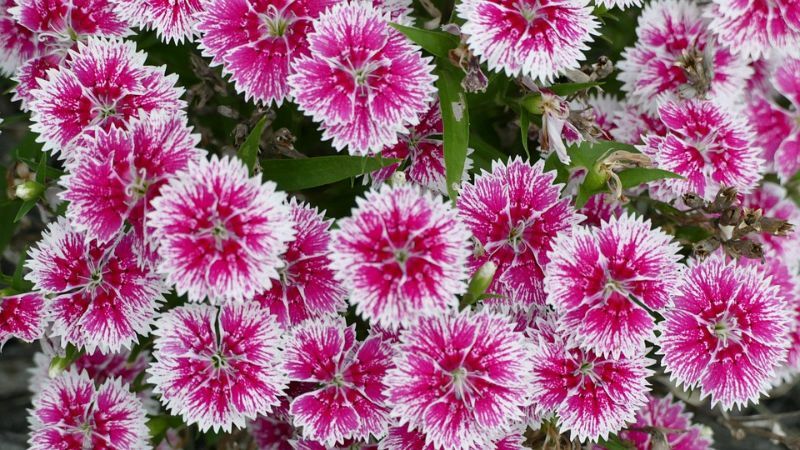
When planting dianthus, wait until the threat of frost has gone and plant them at the same level as they were in the pots, with 12 to 18 inches (30-46 cm) between the plants. Mulch should not be used near them.
To keep the foliage dry and prevent mildew spotting, water them just at the base of the plant.
Do pinks grow back every year?
To stimulate a second or even third flush of flowers, deadhead spent blooms and feed with a liquid tomato feed. Some of the more traditional pinks may only bloom once or twice a year.
Cut back any faded blossoms and unkempt leaves in the autumn. Trim the foliage lightly to encourage new growth.
Pinks don’t live very long they tend to sprawl in the middle and become woody at the base so it’s fairly uncommon to have to replace them after six years. Each year, you can take cuttings to ensure a steady supply of plants.
Do dianthus plants come back every year?
These plants are perennials with a short life span, although they are commonly planted as annuals in Missouri and other colder climates. Annuals have a single growing season. Many Dianthus types, on the other hand, self-seed every year. That is to say, they re-grow each spring.
Types:
The majority of plants are perennial, however others are biennial or annual. Pink perennials are evergreen or semi-evergreen perennials. The common name comes from the frilly edges of the petals, which resemble pinking shears when cut. Sweet William is a perennial that is usually grown as a biennial or annual. Florists love carnations (Dianthus caryophyllus) because of their long stems and long bloom time.
Color and characteristics:
Flowers with frilly petals are solitary, semi-double, or double. They’re available in almost every color except blue, as well as patterned bicolors. The foliage is strappy and grass-like, with green, blue-green, or silver-green hues.
Toxicity:
Some people may have slight skin irritation from Dianthus foliage, which normally lasts only a few minutes. If swallowed, the plants might be somewhat hazardous to pets.
Is dianthus easy to grow?
The majority of dianthus flowers are simple to grow and may survive in a variety of environments. They thrive in bright sunlight, but they despise the intense heat of mid-summer. After the first bloom, deadhead the plants to ensure a second bloom later in the summer or early in the fall.
Why are my dianthus dying?
When a plant is affected with storage rot, also known as botrytis blight, the petals of cut flowers turn dark. It’s possible that the cut stem ends will decay. This is most common when there is a lot of humidity, and it can be treated with a fungicide.
Do pinks flower in winter?
Because pinks are so popular, we thought we’d share some tips on how to grow them.
They are resilient plants that like a sunny, well-drained location and require little maintenance and attention while providing a spectacular display of fragrant flowers throughout the summer. Pinks don’t have to be planted in the garden; they also make great patio plants and can be grown in a variety of containers, including window boxes, hanging baskets, and pots – which is especially useful if you have heavy soil.
Allow 1215 between each plant when planting. Pinks can be planted at any time of year, but if you’re planting in the Spring, wait until the worst of the winter weather has passed remember, they don’t like the wet! They don’t mind the cold, and depending on the species, flowers can appear as early as April.
If you’re planting in the summer, make sure you keep watering the plants until they’ve established themselves – but don’t overdo it, as you might rot their roots even in the heat. Plant no later than October for autumn planting, and then store plants in a cold frame or greenhouse until spring to shield them from the worst of the winter weather.
Pinks are fairly tolerant of most garden soils; a PH level of about 6 is excellent, and they prefer alkaline to acidic soils. However, they must have sufficient drainage. Add some grit to the soil where you’re planting them if the soil is clay or poorly drained. This will assist prevent their roots from absorbing too much moisture from the environment, which could lead to root rot during wet weather. They can dry out rapidly in the summer, so extra watering during very hot dry spells is recommended; this also encourages them to continue flowering (depending on the variety).
Compost: If you’re growing Pinks in pots, a good grade John Innes compost will work best. Make sure the drainage holes in the pot are well crocked.
Flowering can begin as early as April and last until the end of the season. In the summer, simple deadheading will encourage additional blossoms. Cut back into the plant’s center once the blooming stem has completed flowering. This will result in a much more tidy and bushy plant.
Feeding: Begin feeding as soon as the plants are transplanted to pots and continue throughout the flowering season. Plants in the soil require less feeding; a broad liquid feed such as Phostrogen suffices.
All garden pinks are hardy in the winter. In the fall, tidy up each plant by removing any dead leaves and trimming back any messy or scruffy sections to give it shape and encourage it to bush out from the base. You may see a purple mottling on some of the leaves over the winter months; this is normal and will not harm the plant.
Pinks do not like to be waterlogged because this causes root rot, so consider container planting if your garden soil is heavy and prone to being quite wet in the winter.
How do you maintain dianthus?
The instructions for caring for dianthus are pretty simple. Apply fertilizer every six to eight weeks and water the plants when they are dry. You can also incorporate a slow-release fertilizer into the soil before planting to eliminate the need to feed the plants.
Because some dianthus cultivars self-sow, deadheading is critical to reducing volunteer plants and encouraging additional blooming.
Perennials have a short life span and should be propagated through division, tip cuttings, or even layering. Dianthus seed is also widely available at garden centers, and it may be started inside six to eight weeks before the last frost date.
How do you make dianthus bushy?
Cut the plant’s height in half using clean shears to encourage bushier growth and more bloom buds. Trim or pinch back overgrown and lanky stems at any time during the summer growth season to keep the plant in shape. Make the cuts near a leaf bud on the stem to induce branching.