
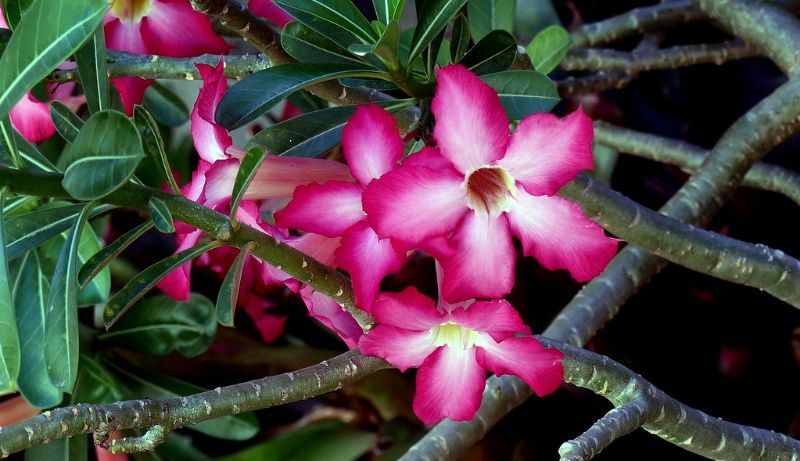
While cultivating a desert rose from seed is pretty simple, most gardeners have greater luck growing them from cuttings. They will not only start readily and rapidly from cuttings, but they will also maintain the actual nature of hybrid plants, as hybrids will revert if grown from seed. As a result, you might be asking yourself, “How can I grow a desert rose from cuttings?”
Take a clipping from the branch’s tip. Allow a day or two for the cutting to dry before wetting the end of the desert rose cutting and dipping it in rooting hormone. Place the cutting in a well-draining growing medium, such as perlite or sand and soil. Water the cuttings on a daily basis, making sure the water drains away from the soil. Mist the cuttings with a spray bottle on a daily basis.
It is possible to grow a desert rose from seed or cuttings. You can have your own desert rose plant for your home with a little patience.
How do you replant a desert rose?
First and foremost, safety! When working with this plant, use gloves because it releases a deadly sap! Look for a container with a diameter of 1 to 2 inches (2.5-5 cm) larger than your previous one. To give the desert rose the dry roots it wants, make sure the container you choose has sufficient drainage.
Thick-walled, bowl-shaped containers are recommended since they not only allow the roots to fan out but also have a shallowness to them, allowing the soil to dry more quickly. You can use any type of pot, including clay, ceramic, and plastic; however, clay pots may be a good choice because they absorb excess moisture from the soil and reduce the risk of root rot.
Use a cactus or succulent-specific potting mix or standard potting soil combined with equal parts perlite or sand to create a well-draining soil. If you’re repotting a desert rose, make sure the soil is completely dry before gently removing the plant from its container. If you prop the container on its side and try wiggling the plant loose with a tight grip on the plant’s base, the extraction may be easier.
If the container is pliable, such as plastic, gently squeeze the sides to assist coax the plant out. After that, spend some time scraping the old soil from around and between the roots while holding the plant by its base. Remove any unhealthy roots you find and apply a fungicide to the cuts.
It’s now time to relocate the facility to its new location. The ultimate goal with a desert rose is to have an exposed engorged caudex above the soil level, as this is the plant’s distinctive feature. A thick, swelling portion of the stem near the soil level is known as the caudex.
“Lifting” refers to the process of encouraging an above-ground bulbous caudex. However, you should wait until your plant is at least three years old before lifting and exposing the caudex. If your plant is of the appropriate age, you should position it an inch or two (2.5-5 cm) higher above the soil line than it was previously.
If you’re going to expose the caudex, keep in mind that the freshly exposed area is prone to sunburn, so gradually expose the plant to direct sunlight over several weeks. Place your plant in its new container, then backfill it with soil, spreading the roots out as you go. After repotting, don’t water the plant for a week or so to allow any damaged roots to heal properly, then gradually resume your regular watering schedule.
What type of soil is best for desert rose?
Soil. The desert rose plant, as its name suggests, is adapted to naturally dry, desert-like environments, which means well-draining sandy or gravelly cactus soil. The pH of the soil should be neutral to acidic, ideally ranging around 6.0.
Origin:
It is a traditional food plant, a useful, attractive hedge, and a source of firewood and medicines in the coastal region of southern Africa. It is now found in Africa and other warm places of the world.
Plant Description:
It’s a spiky plant with a gummy white sap that can be managed as a hedge or shrub, or let to grow into a straggly tree up to 5 meters tall with a proclivity to spread on other plants. The opposite and ovate leathery glossy evergreen leaves are 2.5-5cm long.
Relatives:
Apocynaceae is a family of plants. There are a few relatives with edible fruits, including C. spinarum, an Australian native that is utilized as bush tucker. These should only be eaten when they are completely ripe. Poisonous are the white latex and unripe fruits. C. carandas is a cousin from India.
Propagation:
Carissa is easy to produce from seeds, however vegetative propagation is recommended. Young branches can be nicked and bent downwards, then left for a few months to create a callus. The cutting should then be separated from the parent and placed in sand in a shady location until roots grow.
Flowering and Pollination:
The 5-lobed starry, white, delightfully fragrant flowers appear individually or in clusters at the apex of branches. Flowers are flawless, however on some plants, flowers with stamens longer than the style may function as male flowers. In functionally female flowers, the stamens are the same length as the style but lack pollen. As a result, plants are usually classified as dioecious, and cross-pollination between different types of plants can help fruit set. Night-flying insects such as beetles and hawk moths are the most common pollinators, but bees and manual pollination can also help.
Cultivation:
Carissa is tolerant to both direct sunlight and shade. It can survive salty sea spray rather well. If the temperature dips below -2°C, young plants require protection. Carissas are slow-growing, but they are drought-resistant and robust. Although carissas can withstand drought, they will produce more fruit and flowers if water is provided during flowering and fruiting.
Pruning:
Pruning helps to keep it under control and stimulates denser growth with more fruiting tips, resulting in more fruit. It’s best cultivated in thin rows in an orchard to make harvesting the fruits that grow on the tops of the bushes easier.
The Fruit:
Berries are round or oval in shape, measuring up to 6cm in length and 4cm in width. When grown, the skin color changes from green to a vivid red crimson with a whitish bloom. The strawberry-colored flesh is delicious and contains 6-15 little edible brown seeds, as well as a milky sap. Although many improved cvs produce plum-sized fruit, seedling fruit is typically significantly smaller. The vitamin C content is comparable to citrus, while the carbohydrate amount is 10-15%. The fruit has a tart flavor and is loaded with white latex within.
Fruit Uses:
When the fruit is somewhat soft to the touch, it can be eaten whole. When fruits are briefly warmed, the latex dissolves and a ruby-red, delectable juice may be pressed out, which can be used to produce jelly, jam, wine, vinegar, and a variety of desserts when sweetened. Aluminum pots should not be used since latex can attach to them.
How do I get desert rose to branch?
Using a pair of sharp, clean pruners, cut back long, lanky shoots to about the same length as other stems. Any branches that rub or cross other branches should be pruned. Cut slightly above a leaf node or where the stem connects to another stem. There will be no ugly stub this way.
To achieve a more natural appearance when pruning a desert rose, make cuts at a 45-degree angle.
Throughout the season, keep a constant eye on your plant, especially when it’s hot and humid. Leaves and stems with white fuzz or other symptoms of powdery mildew or other moisture-related diseases should be removed.
How do you make desert rose soil?
Yes, if you start with a high-quality potting mix, you’ll simply need to add elements that improve drainage and acidity levels to make the potting material acceptable for your Adenium.
You can use a combination of coarse sand, perlite, pumice, or vermiculite to improve the drainage of the soil mix.
Coconut coir or peat moss can be used to boost acidity while also helping to improve water retention. Peat moss has the ability to retain more water than the other two.
Follow these general recommendations to turn these elements into a viable soil mix for your Desert Roses:
It is crucial to note, however, that Adenium does not require actual soil. These plants thrive exceptionally well in a soilless environment.
Two Soilless Adenium Recipes
Make a base substrate of equal parts ground fir bark and peat moss for a mature plant (or coconut coir). This is a superb base for both tropical and desert cacti potting mixtures. Both of the recipes that follow rely heavily on this foundation.
Instructions
Combine all of the ingredients in a large mixing bowl. To make a smooth and easy-to-work-with mixture, break up any large lumps or clods.
Before using the potting substrate, soak it completely. Allow for at least an hour of soak time before draining any surplus water.
You should be able to squeeze moisture out of the mixture, but it should not feel moist.
Does a desert rose need full sun?
Q: Last summer, I purchased a lovely desert rose shrub. I transplanted it into a terra cotta pot and placed it in a protected location to avoid frost damage. I just realized the sturdy stem is soft and squishy now. What went wrong, and what can I do to prevent this from happening again?
A: The Desert Rose (Adenium obesum) is a lovely and exotic-looking plant that needs very little care. The overall shape is akin to a well-trained bonsai tree, with an expanded trunk base and twisted limbs. Simple five-petaled flowers emerge in many shades of pink, white, red, and yellow in the summer.
In the summer, the Desert Rose thrives in full sun with regular watering. When the temperature drops to 55 degrees or below, you should drastically reduce your watering. It’s best to use a terra cotta pot because it allows water to drain fast. When repotting, use a cactus mix and avoid using a pot that is too large.
If your plant is being watered on a regular basis by seasonal rain, you may wish to relocate it to a dryer place. The plant will rot if the soil is damp for an extended period of time.
Sunlight
Desert roses require a lot of sunlight, and a lack of light could be the reason why they aren’t flowering. Place the plant where it will receive at least five to six hours of direct sunlight per day, if not more.
Fertilizer
A desert rose doesn’t need much fertilizer, but it does need to be fed on a regular basis to ensure that it gets the nutrients it needs to blossom. Using a balanced, water soluble fertilizer, feed an outdoor plant two or three times during the spring and summer. During the spring and summer, feed indoor Adeniums once a week with a half-strength water-soluble fertilizer.
It may also assist to apply a phosphorus-rich fertilizer or bone meal to induce flowering.
Why are the leaves falling off my desert rose?
Because the desert rose requires more water during the months when it is actively growing, if it does not receive adequate hydration, it will drop all of its leaves and return to dormancy. Overwatering, on the other hand, can lead to root rot. Grow your desert rose on sandy, fast-draining soil to avoid either problem. Water it whenever the soil is dry two inches below the surface during the growing season.
Is Epsom salt good for desert roses?
Epsom salts are highly recommended by rose producers in particular. It not only makes the foliage greener and lusher, but it also generates more canes and roses, according to them. To apply Epsom salt to existing rose plants, either mix 1/2 cup of the salts into the soil surrounding the bush and water well, or dissolve 1/2 cup of the salts in water and use to moisten the soil around the rose bush. This is best done in the spring, when the buds are just beginning to open.