
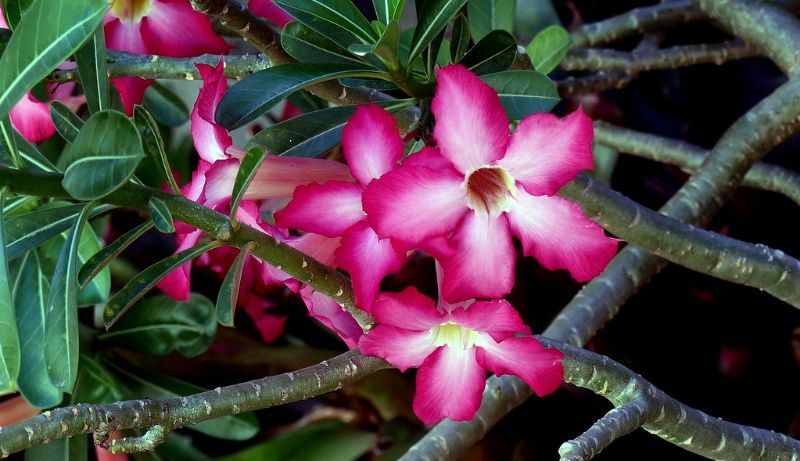
When dealing with the tough growing circumstances of dry places, the succulent desert rose (Adenium obesum) thrives at temperatures as high as 90 degrees Fahrenheit, relying on moisture and nutrients stored in its fleshy stems and caudex for sustenance. When planted in well-draining soil with a pH between 6.1 and 6.8 in an area that receives full sunlight, desert roses, which grow in USDA plant hardiness zones 10 through 12, explode with beautiful, crimson-bordered pink flowers and lush, spirally arranged leaves virtually year-round. Cuttings or seed can be used to propagate a desert rose, but plants propagated by cleft grafting flower within a year.
How do you start a desert rose from a cutting?
While cultivating a desert rose from seed is pretty simple, most gardeners have greater luck growing them from cuttings. They will not only start readily and rapidly from cuttings, but they will also maintain the actual nature of hybrid plants, as hybrids will revert if grown from seed. As a result, you might be asking yourself, “How can I grow a desert rose from cuttings?”
Take a clipping from the branch’s tip. Allow a day or two for the cutting to dry before wetting the end of the desert rose cutting and dipping it in rooting hormone. Place the cutting in a well-draining growing medium, such as perlite or sand and soil. Water the cuttings on a daily basis, making sure the water drains away from the soil. Mist the cuttings with a spray bottle on a daily basis.
It is possible to grow a desert rose from seed or cuttings. You can have your own desert rose plant for your home with a little patience.
Why do you graft desert roses?
Grafting is the only reliable method of propagation for designated Adenium cultivars and variations. Cuttings can sometimes be rooted, but grafting is more easier. Because the outcomes are frequently subpar, grafts are made from known kinds with better and more predictable characteristics such as blooming period, quantity, shape, pattern, and color.
How do I branch a desert rose?
Using a pair of sharp, clean pruners, cut back long, lanky shoots to about the same length as other stems. Any branches that rub or cross other branches should be pruned. Cut slightly above a leaf node or where the stem connects to another stem. There will be no ugly stub this way.
To achieve a more natural appearance when pruning a desert rose, make cuts at a 45-degree angle.
Throughout the season, keep a constant eye on your plant, especially when it’s hot and humid. Leaves and stems with white fuzz or other symptoms of powdery mildew or other moisture-related diseases should be removed.
Can you split a desert rose?
Desert rose owners are used to repotting, so it’s safe to assume that a repot is in your near future, and more than likely many times over. Is the size of your desert rose what you want it to be? If you answered no, you should repot it every year or two until it reaches the size you want, as general development slows once the plant gets pot bound.
Have the roots of your desert rose gotten inside the container, or has the thick, swollen stem (caudex) overwhelmed it? If you answered yes, it’s a good indication that you should repot. Roots of desert roses have been found to break through plastic containers and even split or crack clay or ceramic containers.
Repotting a desert rose is also necessary if you fear it has root rot, which the plant is prone to.
How do you get seeds from a desert rose?
Mature desert rose plants will produce seeds with a lot of patience and a little luck. These grow inside a seed pod that looks like a bean. The seeds are tiny and cling to fluffy pappus, similar to dandelions. The seeds from these plants might drift away with the wind when the pods burst open.
Gardeners who want to save seeds for propagation should leave the pods on the plants until they are fully mature. Instead of selecting the pods, wrap them in wire or place them in a net bag.
Why are leaves on desert rose turning yellow?
A Desert Rose’s leaves may be affected by a variety of pests, causing them to turn yellow and eventually dry up. Mealybugs, a fluffy white insect that feeds on the vegetation, are one of them. If you come across these insects, kill them all with a cotton swab dipped in rubbing alcohol.
Aphids, small greenish insects, and spider mites, which are not visible but produce web-like coverings on leaves and buds, are also possible pests. Both bugs feed on the plant’s juices, causing the leaves to yellow, wilt, and fall off. To get rid of bugs in a small area, use a forceful jet of water. Spray the plant with insecticidal soap diluted at a rate of 5 teaspoons per gallon of water if the infestation is severe. As needed, repeat the spray every two weeks.
Fungal Problems
If a Desert Rose is cultivated in very damp conditions, it may develop fungal stem rot, which begins at the stem tip and spreads to the leaves, turning them yellow and brown. The stem eventually darkens or turns yellow, softens, and the problem moves down the stem toward the soil. To rescue the plant, trim back the afflicted section of the stem, removing the soft tissue and replacing it with healthy, firm tissue. To avoid illness spread, disinfect the knife or shears by cleaning the blade with rubbing alcohol after each cut.
Is Epsom salt good for desert roses?
Epsom salts are highly recommended by rose producers in particular. It not only makes the foliage greener and lusher, but it also produces more canes and roses, according to them. To apply Epsom salt to existing rose plants, either mix 1/2 cup of the salts into the soil surrounding the bush and water well, or dissolve 1/2 cup of the salts in water and use to moisten the soil around the rose bush. This is best done in the spring, when the buds are just beginning to open.
How do you grow a bonsai desert rose?
Under the correct conditions, desert rose bonsai can thrive inside. Because this species needs bright, direct light, place it in a location that gets plenty of it, such as a south-facing window. To keep your plant healthy, make sure the temperature does not dip below 40 degrees at night.
Which season is best for Adenium grafting?
When they are actively growing, grafting is the perfect time to do it. Also, time it such that after you’ve completed the grafts, you’ll still have nice weather to continue growing. I’m guessing you’d do that in the West Indies.
How do I get more leaves on my desert rose?
Because the desert rose is a sun-loving plant, place it in the brightest location possible. It looks great in landscaping beds and borders as well as containers and planters on decks, patios, and other outdoor areas.
For optimal effects, water the desert on a regular basis. The plant can survive in low-water situations, but it will lose some or all of its leaves if it dries out too severely. (Don’t worry if this happens; if it gets adequate water again, your desert rose will grow new leaves.)
If desired, fertilize desert rose with a general-purpose fertilizer in the spring and summer. Follow the directions on the fertilizer package carefully.
It should be noted that desert rose is not suitable for human or animal consumption. This plant is poisonous in all of its components.