
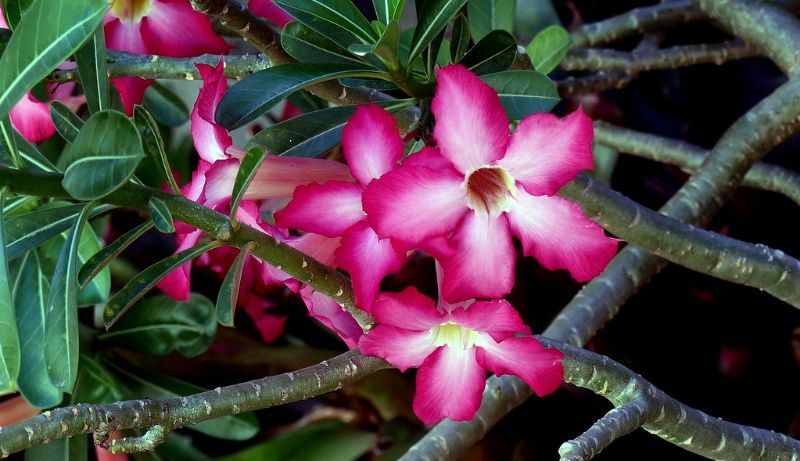
Seeds or cuttings can be used to propagate this plant. The propagation procedure is straightforward.
Planting from Seed
Growing desert rose bonsai from seed can be difficult, but if you start with fresh seeds, you’ll have a better chance. Fresh seeds have a higher chance of germinating, so make sure you buy them from a reliable source.
Start your seeds in a well-draining medium, such as sand and soil or perlite, in a container. Lightly cover the seeds with the medium. Once every three days, water from below and above until seedlings sprout. The seedlings should then be placed on a heating pad to keep the temperature of the developing seeds above 80 degrees.
Planting From Cuttings
Desert rose bonsai can also be started from cuttings. Take a clipping from the tip of a branch to do this. Allow the cutting to dry for a few days before moistening it and dipping it in rooting hormone.
Place the cutting in your growing medium and give it a daily watering. In as little as two weeks, it should take root.
Can desert rose be bonsai?
Although the Desert Rose is a popular ornamental plant, it is rarely seen as a bonsai. It is popular in Southeast Asian countries, particularly Thailand. Under the ideal conditions and with sufficient care, the plant is strong and healthy. Although it doesn’t have a very ramified branch structure, the Desert Rose Bonsai adapts well to growing in a pot, making it a good candidate for bonsai. Unless you live in a tropical environment, the plant will lose its leaves in the winter. The Desert Rose’s milk sap is toxic. Take a look at our Bonsai tree identification guide if you need help recognizing your tree.
How do you shape a desert rose?
Using a pair of sharp, clean pruners, cut back long, lanky shoots to about the same length as other stems. Any branches that rub or cross other branches should be pruned. Cut slightly above a leaf node or where the stem connects to another stem. There will be no ugly stub this way.
To achieve a more natural appearance when pruning a desert rose, make cuts at a 45-degree angle.
Throughout the season, keep a constant eye on your plant, especially when it’s hot and humid. Leaves and stems with white fuzz or other symptoms of powdery mildew or other moisture-related diseases should be removed.
How poisonous is desert rose?
Every aspect of these plants piques your curiosity. On mature plants, the stems of the Desert Rose plant swell substantially, resembling those of a bonsai tree. This succulent has colorful flowers and intriguing tight clusters of narrow, green leaves when not in bloom.
However, there is one thing to keep in mind when cultivating this plant, especially in the house. Its sap is harmful, and children and pets should never come into contact with it. If you acquire sap on your hands while touching the plant, you should wash them right away.
What type of soil is best for desert rose?
Soil. The desert rose plant, as its name suggests, is adapted to naturally dry, desert-like environments, which means well-draining sandy or gravelly cactus soil. The pH of the soil should be neutral to acidic, ideally hovering around 6.0.
How do you grow a desert rose indoors?
A Desert Rose plant necessitates a lot of bright light. Only a few houseplants should be in direct sunlight. Because direct sunlight can burn the leaves of indoor houseplants, high light only refers to brilliant indirect light. Spider Mites thrive in hot, dry environments, causing blooms to fade quickly.
Are Desert Roses succulents?
Echeverias, also known as Desert Roses, are undoubtedly the most appealing of all succulents, treasured for their incredible colors and variety, with the exquisite leaf color of many kinds peaking in the cooler months. Full sun, morning sun, or very bright, indirect light are preferred by desert roses. The Americas are home to this species.
How long does a desert rose live?
The desert rose can live for more than 500 years. It has distinguishing qualities that allow it to last for decades. For example, its stem has a bloated base that continues to inflate over time and can grow up to two meters in diameter. The stem stores critical nutrients that the plant uses to nourish the other parts of the plant as the weather changes.
Measure the diameter of the stem to determine the age of a desert rose. Every millimeter symbolizes one year for this slow-growing plant. It’s a seasonal succulent that sheds its leaves when the season isn’t right. Surprisingly, the plant receives sufficient nutrients even when other plants begin to die due to extreme weather conditions.
Why are the leaves falling off my desert rose?
Because the desert rose requires more water during the months when it is actively growing, if it does not receive enough moisture, it will drop all of its leaves and return to dormancy. Overwatering, on the other hand, can lead to root rot. Grow your desert rose in sandy, fast-draining soil to avoid either problem. Water it whenever the soil is dry two inches below the surface during the growing season.
Sunlight
Desert roses require a lot of sunlight, and a lack of light could be the reason why they aren’t flowering. Place the plant where it will receive at least five to six hours of direct sunlight per day, if not more.
Fertilizer
A desert rose doesn’t need much fertilizer, but it does need to be fed on a regular basis to ensure that it gets the nutrients it needs to bloom. Using a balanced, water soluble fertilizer, feed an outdoor plant two or three times during the spring and summer. During the spring and summer, feed indoor Adeniums once a week with a half-strength water-soluble fertilizer.
It may also assist to apply a phosphorus-rich fertilizer or bone meal to induce flowering.