
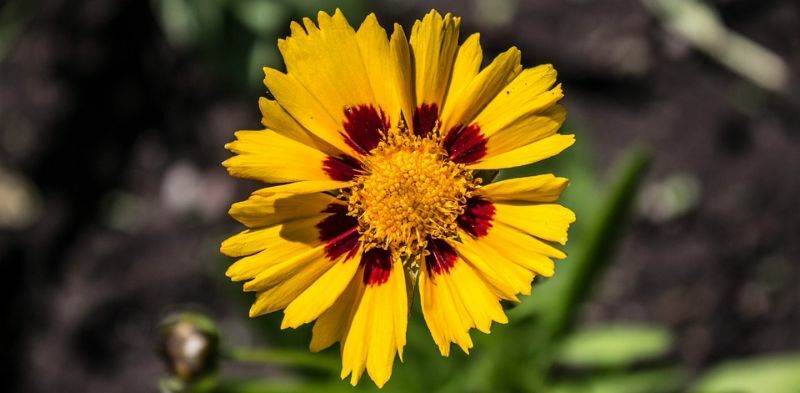
Many gardeners value Coreopsis, often known as Tickseed, for the vibrant colors of its blossoms and their capacity to tolerate a wide range of soil conditions. There are approximately 100 species and innumerable hybrids to choose from, including annuals and perennials. Most of them are low-maintenance, drought-tolerant, and have a lengthy flowering season, lasting from early summer to late autumn, or even longer if deadheaded. Their seeds attract birds, while their nectar attracts butterflies. These American native prairie plants are workhorses in sunny borders and create wonderful cut blooms.
- Coreopsis are prolific bloomers, producing masses of stunning single, semi-double, or double daisy-like flowers in a variety of rich gold, yellow, orange, or red colors.
- Coreopsis rosea, with its gorgeous rose pink blooms, is a remarkable species. Bicolor Coreopsis flowers have a contrasting color in the center, which adds to their beauty.
- The foliage of Coreopsis varies in size and texture, ranging from enormous, low-growing leaves to mounds of narrow, finely textured leaves.
- Coreopsis grow in upright clumps that range in height from 6 in. to 48 in. (15-120 cm) depending on the variety. Although many cultivars self-sow across the garden, some are sterile.
- Coreopsis need at least 6 hours of direct sunlight per day to thrive. In partial shade, they become leggy, yet some afternoon shade is preferred in hot summer locations.
- They don’t mind what kind of soil they’re in as long as it’s well-drained. Poor, sandy, or rocky soils are tolerated by some.
- Once established, Coreopsis is drought tolerant. If your tickseeds are provided frequent water, however, you will have the best blossom production.
- Coreopsis are popular in beds and borders, rock gardens, cottage gardens, prairies, and meadows because they are easy to grow. They look great in containers or in a vase at home.
- The taller kinds are ideal for the rear of the border and cutting gardens, whereas the shorter, mounding variants are ideal for edging.
- Coreopsis are disease-free and low-maintenance plants that attract bees and butterflies but are neglected by deer.
- Cut off the spent blossoms to keep the flowers coming. Shearing the plant in midsummer (after the first flush of blooms) should help clean it up and encourage an autumn rebloom.
- Perennial coreopsis can be propagated by division, and some species can also be grown from seed or terminal cuttings. If put in a well-drained medium in warm, moist circumstances, seeds germinate in 2-3 weeks.
Why is it called tickseed?
When rookie gardeners hear the word tickseed, they are likely to flee for their lives. Ticks are one of the parasites you don’t want to see in your yard or around your house, so the idea of a flower that can attract ticks sounds like a nightmare. Of course, anyone who knows anything about tickseeds knows that the name of this bloom isn’t a danger. (However, if ticks are a concern, try planting some of these deer-resistant plants!)
Tickseed is a popular name for Coreopsis and a few other genera of flowering plants with beautiful heads. Coreopsis, the genus name, means “bug-like” in Greek. The popular name Tickseed comes from the form and color of the seeds, which resemble ticks. Coreopsis are stunning blooms that would be a welcome addition to any garden. Tickseed comes in a variety of colors, including yellow, peach, red, and fuchsia, and they look great in patio planters and borders. Oh, and some of them also attract bees and butterflies, so you can be assured that your buds will be fertilized properly!
Is tickseed same as Coreopsis?
Coreopsis plants (also known as Tickseed) are deer resistant and attract butterflies. Our native Coreopsis are known for their beautiful yellow flowers and are prized for their long bloom time. Tickseed blooms from late spring to late summer, and the yellow blossoms are always welcome. Coreopsis flowers are easy to grow and make excellent cut flowers. These perennials prefer full sun and well-drained soil. Keep the plants deadheaded for the finest flowering results. Leave a few seed heads on the plant at the end of the season so it can self-seed.
What is tickseed used for?
Root tea was used by the Amerindians to treat diarrhea and as an emetic. Tea made from dried tops to strengthen the blood. To produce a drink for internal discomfort and bleeding, boil the plant. Other Uses: Was used to make yellow and red dyes.
Does tickseed come back every year?
Some coreopsis are perennial, meaning they live for more than a year, while others are annual, meaning they only live for a year.
When shopping for and selecting which coreopsis to plant, it’s critical to first determine if the desired plant is an annual or perennial in your location. In warmer climates, some plants are perennial, while in colder climes, they do not survive the winter.
In front of taller summer perennials like garden phlox, bee balm, or coneflowers, plant annual coreopsis. Annual coreopsis looks beautiful in pots on patios and balconies as well.
How does tickseed spread?
Coreopsis has only one flaw: it is short-lived and unreliable in terms of perenniality. Many gardeners lament the fact that it only lasts two or three years. Others have seen that some varieties self-seed all over the garden and grow up in unexpected locations. Despite these drawbacks, this perennial favorite remains popular and is regularly planted or replanted year after year.
In order to improve Coreopsis, famous plantsman Darryl Probst and others instituted a number of hybridization programs.
Plant trials, including a three-year trial undertaken at the Mt. Cuba Center botanical garden in Delaware between 2012 and 2014, show that these hybridization efforts have improved the species.
With so many highly hybridized selections on the market these days, it’s a good idea to take a step back and learn about Coreopsis kinds and species.
Coreopsis is a genus of roughly 100 annual and perennial plants belonging to the Asteraceae (aster or daisy) family.
They can either form clumps or spread by rhizomatous roots.
The majority of Coreopsis species are clump forming.
Unfortunately, these are usually short-lived, and several of the members of this group are best handled as annuals.
Rhizomatous species have a longer lifespan and are more dependable perennials.
The following are some of the clump-forming and rhizomatous Coreopsis species commonly found at garden centers around the Mid-Atlantic:
- Coreopsis auriculata (Lobed or Mouse-Eared Coreopsis) Coreopsis auriculata (Lobed or Mouse-Eared Coreopsis) Orange-yellow blooms and oval-shaped leaves characterize this rhizomatous species. When in bloom, it develops spreading clumps that grow 2 to 3 feet tall and spreads quickly by rhizomes and seeds. A dwarf cultivar, ‘Nana,’ is half the size and one among the best in the genus. ‘Jethro Tull’ and ‘Zamphir,’ two popular C. auriculata cultivars, with open-ended, fluted ray blooms.
- C. grandiflora (Large-flowered Coreopsis) This clump-forming plant blooms early in the season and then blooms again later in the season.
- Although it is not a true perennial, lasting only 2 or 3 years on average, it has a strong ability to self-seed and may appear as a pleasant surprise throughout your garden.
What is another name for tickseed?
Coreopsis (/kripss/) is a flowering plant genus in the Asteraceae family. Calliopsis and tickseed are two common names for this plant, which is also used for a variety of other plants.
Is tickseed an invasive plant?
The National Garden Bureau, a non-profit organization dedicated to promoting the joys of home gardening, chooses one perennial, one annual, one bulb, and one edible plant to honor each year. It’s an excellent method to learn about a new plant or to learn more about one you already have.
The perennial coreopsis, sometimes known as tickseed, is the first of 2018’s four plants (Coreopsis). See 2018: Year of the Calibrachoa and 2018: Year of the Beet for details on two more 2018 winners.
Coreopsis is a genus of over 80 species that originated in the New World, with roughly 45 of them found in North America. Annuals and perennials, they are herbaceous plants that are generally small (rarely more than 2 1/2 feet/75 cm tall).
They have daisylike inflorescences that look like individual blooms but are actually compound flowers, as is typical of the Asteraceae family (sunflower family). They have a central disc of fertile florets surrounded by eight ray flowers (more in double and semi-double variations) and a serrated tip. The dominant flower color is yellow, with a reddish-brown halo on occasion.
The common name, tickseed, is derived from the Greek word coreopsis, which means “like a bug.” It gets its name from the bug-like appearance of the seeds of some former species, such as beggar-ticks, which have two projections that adhere to fur and clothing like ticks. Surprisingly, beggar ticks were long ago relegated to the genus Bidens. There are no “bug-like” seeds in any extant Coreopsis species!
Only a few species are cultivated, especially among the hardiest (the vast majority of species are tropical and cannot be grown in cooler climes except as annuals), but they nonetheless provide a wide range of options for our flower beds. Many coreopsis flowers continue to bloom throughout the summer, especially if deadheaded. Coreopsis has long been a favorite in gardens due to their prolific and long-lasting blooms… they also make great cut flowers.
Coreopsis are often meadow plants that thrive in full sun. They can take moderate shade, but prefer to be in direct sunlight. They adapt to all types of well-drained soils, and the most are drought-tolerant. Many species, however, rely on good drainage, particularly during the winter months. Clay soils are particularly troublesome. Many coreopsis thrive in raised beds because they provide improved drainage. Also, coreopsis prefers a soil that is not extremely fertile, as overly fertile soil can lead to weak stems that flop.
Pollinating insects (bees, butterflies, hoverflies, and others) enjoy coreopsis, and seed-eating birds frequent them in the fall and winter… if you don’t deadhead, of course!
From spreading beneath roots, rhizomatous types create masses of single stems. They’re the most hardy coreopsis, living for decades with little attention and being the most resistant to cold damp. They’re not usually invasive, but they may spread beyond their planting area if there are no plants to shade them out, necessitating control in some cases.
Clump-forming types have many stems that grow in tufts. They are usually short-lived in the garden, especially in soils that remain moist in the winter, frequently only surviving two or three years. You may, however, keep them alive for decades by creating new plants every two years from divisions or cuttings. As though to make up for their short lifespan, they are relatively simple to grow from seed, and many will bloom the first year from seed placed inside, which is a feat few perennials can achieve.
Annual variety, by definition, only live for one year. The majority of them survive by profuse self-sowing.
This coreopsis native to the southeastern United States stands out in a genus dominated by plants with narrow leaves by having trifoliate leaves that are relatively large, sometimes nearly spherical. The botanical (auriculata) and common names are derived from the two little leaflets at the base of the much larger center leaflet, which are supposed to resemble mouse ears.
The plant grows in a low rosette with little yellow flowers and evergreen leaves. It’s a long-lasting plant with short rhizomes that isn’t particularly invasive. It’s the first of the coreopsis to bloom, blossoming from spring to early summer because it’s a short-day plant (most others are long-day plants, with mid- to late-summer flowers).
The most popular mouse-ear coreopsis cultivar is ‘Nana,’ which grows to barely 10 in (25 cm) tall, but ‘Zamphir,’ which grows to 12-24 in × 12 in (30-60 cm x 30 cm) and has tubular ray blooms that resemble trumpets, is also extensively grown.
This coreopsis was once the most widely grown species in the genus (now C. verticillata), and most people just refer to it as coreopsis.
It’s a clump-forming plant that produces a plethora of green stems with narrow leaves. Lower leaves are simple, but those on flower stems have three to five lobes. The inflorescences are yellow orange in color, with a hint of reddish-brown at the base of the deeply serrated ray flowers. They range in size from 1 in to 2 in (2.5 cm to 6 cm) in diameter. It blooms all summer and into the fall, especially if you deadhead it (remove the faded flowers).
This species is one of the shortest-lived, very susceptible to powdery mildew and intolerant of damp winter conditions. Continue cuttings and divisions to keep it going. It also grows swiftly and easily from seed, blossoming the first summer after being grown from seed inside in March.
Large-flowered coreopsis can grow up to 36 inches (90 cm) in height in the wild, although practically all cultivated cultivars are much shorter, ranging from 16 inches to 24 inches (40 cm to 60 cm). The species and cultivars combine to form a cluster with a diameter of 12 in (30 cm). It’s a hardy plant that thrives in USDA and AgCan zones 3 and up.
Many hybrids are easy to grow from seed, including ‘Early Sunrise’ (double yellow, 16 in × 12 in/40 cm x 30 cm), which won an All-America Selections Award and a Fleuroselect Gold Medal in 1989.
What grows well with tickseed?
Tickseed is a popular native perennial flower that thrives in a variety of light and soil conditions. There are many newer tickseed types with a variety of bloom colors, including pink, scarlet, and bicolors, but they are not as hardy in all regions of our region. Tickseed leaves come in a range of shapes, ranging from lobed to thin and thread-like. In the summer, the plants produce little daisy-like single or semi-double flowers. Some types’ flowers are also suitable for cutting. Tickseed, like daylilies, is one of the easiest perennial flowers to plant since they grow in less than optimum soil fertility conditions as long as the soil is adequately drained.
While many kinds of tickseed are hardy in New England, some are only here for a brief time. Plant seeds indoors under grow lights 6 to 8 weeks before your last frost date, and then transfer outside once all threat of frost has past. You can also get divisions from a friend’s garden or buy transplants from a nearby garden center. Plant in full or part sun in well-drained soil from spring to early October. Plants should be spaced 1 foot apart.
Make sure to give fresh plants plenty of water. Tickseed requires little maintenance once grown and is drought resistant. To keep the soil moist and weeds at bay, cover plants with bark mulch.
The soil must be well drained during periods of damp summer weather, otherwise the plant will get crown rot. Tickseed may easily self-sow. In the spring, pull out self-sown seedlings. Taller types have a tendency to sprawl and may require support to avoid falling over. Insects and illnesses aren’t a problem for tickseed in general. Plants should be divided every 3 to 4 years to revitalize the mother plant and create extra transplants for replanting or giving away. After a frost, cut the plants back to the ground in the fall.
Plant coneflowers, blazing star, rudbeckia, and gaillardia with tickseed flowers. In meadows and wildflower beds, taller varieties are preferred. Tickseed is also a butterfly favorite. Plant some near the house or on the deck.
“Moonbeam” is a popular pale yellow-colored cultivar with small, fern-like leaves that grows only 1 foot tall. “Creme Brulee” has a similar appearance to “Moonbeam,” but is a faster-growing plant. “Early Sunrise” is a semi-double flowering plant that reaches 16 to 20 inches tall. However, in our climate, it may be short-lived. “Flying Saucers” has sterile yellow blooms that don’t self-sow. It’s a tougher plant that returns year after year and spreads less than other types. “American Dream” is a pink-flowered cultivar that grows 8 to 16 inches tall, although in colder climates, it may need protection.