
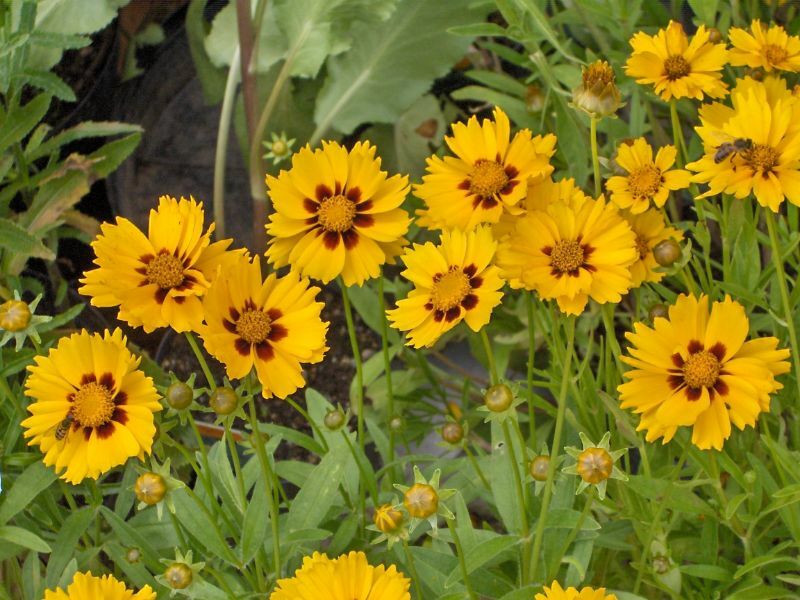
Many gardeners value Coreopsis, often known as Tickseed, for the vibrant colors of its blossoms and their capacity to tolerate a wide range of soil conditions. There are approximately 100 species and innumerable hybrids to choose from, including annuals and perennials. Most of them are low-maintenance, drought-tolerant, and have a lengthy flowering season, lasting from early summer to late autumn, or even longer if deadheaded. Their seeds attract birds, while their nectar attracts butterflies. These American native prairie plants are workhorses in sunny borders and create wonderful cut blooms.
- Coreopsis are prolific bloomers, producing masses of stunning single, semi-double, or double daisy-like flowers in a variety of rich gold, yellow, orange, or red colors.
- Coreopsis rosea, with its gorgeous rose pink blooms, is a remarkable species. Bicolor Coreopsis flowers have a contrasting color in the center, which adds to their beauty.
- The foliage of Coreopsis varies in size and texture, ranging from enormous, low-growing leaves to mounds of narrow, finely textured leaves.
- Coreopsis grow in upright clumps that range in height from 6 in. to 48 in. (15-120 cm) depending on the variety. Although many cultivars self-sow across the garden, some are sterile.
- Coreopsis need at least 6 hours of direct sunlight per day to thrive. In partial shade, they become leggy, yet some afternoon shade is preferred in hot summer locations.
- They don’t mind what kind of soil they’re in as long as it’s well-drained. Poor, sandy, or rocky soils are tolerated by some.
- Once established, Coreopsis is drought tolerant. If your tickseeds are provided frequent water, however, you will have the best blossom production.
- Coreopsis are popular in beds and borders, rock gardens, cottage gardens, prairies, and meadows because they are easy to grow. They look great in containers or in a vase at home.
- The taller kinds are ideal for the rear of the border and cutting gardens, whereas the shorter, mounding variants are ideal for edging.
- Coreopsis are disease-free and low-maintenance plants that attract bees and butterflies but are neglected by deer.
- Cut off the spent blossoms to keep the flowers coming. Shearing the plant in midsummer (after the first flush of blooms) should help clean it up and encourage an autumn rebloom.
- Perennial coreopsis can be propagated by division, and some species can also be grown from seed or terminal cuttings. If put in a well-drained medium in warm, moist circumstances, seeds germinate in 2-3 weeks.
What is the difference between coreopsis and tickseed?
Coreopsis plants (also known as Tickseed) are deer resistant and attract butterflies. Our native Coreopsis are known for their beautiful yellow flowers and are prized for their long bloom time. Tickseed blooms from late spring to late summer, and the yellow blossoms are always welcome. Coreopsis flowers are easy to grow and make excellent cut flowers. These perennials prefer full sun and well-drained soil. Keep the plants deadheaded for the finest flowering results. Leave a few seed heads on the plant at the end of the season so it can self-seed.
Does tickseed come back every year?
Some coreopsis are perennial, meaning they live for more than a year, while others are annual, meaning they only live for a year.
When shopping for and selecting which coreopsis to plant, it’s critical to first determine if the desired plant is an annual or perennial in your location. In warmer climates, some plants are perennial, while in colder climes, they do not survive the winter.
In front of taller summer perennials like garden phlox, bee balm, or coneflowers, plant annual coreopsis. Annual coreopsis looks beautiful in pots on patios and balconies as well.
Is coreopsis and tickseed the same plant?
Tick weed is a blooming perennial native to North America that is also known as tickseed or coreopsis. Summer through early fall, the plants grow up to 4 feet tall and produce yellow daisy-like flowers. Tick weed is popular for its ease of care, steady performance, adaptability to a variety of growing situations, and gorgeous blossoms. Once established, tick weed is relatively low maintenance. Tick weed grows in USDA Zones 4 through 9 and requires minimal maintenance in most parts of the country.
How does tickseed spread?
Coreopsis has only one flaw: it is short-lived and unreliable in terms of perenniality. Many gardeners lament the fact that it only lasts two or three years. Others have seen that some varieties self-seed all over the garden and grow up in unexpected locations. Despite these drawbacks, this perennial favorite remains popular and is regularly planted or replanted year after year.
In order to improve Coreopsis, famous plantsman Darryl Probst and others instituted a number of hybridization programs.
Plant trials, including a three-year trial undertaken at the Mt. Cuba Center botanical garden in Delaware between 2012 and 2014, show that these hybridization efforts have improved the species.
With so many highly hybridized selections on the market these days, it’s a good idea to take a step back and learn about Coreopsis kinds and species.
Coreopsis is a genus of roughly 100 annual and perennial plants belonging to the Asteraceae (aster or daisy) family.
They can either form clumps or spread by rhizomatous roots.
The majority of Coreopsis species are clump forming.
Unfortunately, these are usually short-lived, and several of the members of this group are best handled as annuals.
Rhizomatous species have a longer lifespan and are more dependable perennials.
The following are some of the clump-forming and rhizomatous Coreopsis species commonly found at garden centers around the Mid-Atlantic:
- Coreopsis auriculata (Lobed or Mouse-Eared Coreopsis) Coreopsis auriculata (Lobed or Mouse-Eared Coreopsis) Orange-yellow blooms and oval-shaped leaves characterize this rhizomatous species. When in bloom, it develops spreading clumps that grow 2 to 3 feet tall and spreads quickly by rhizomes and seeds. A dwarf cultivar, ‘Nana,’ is half the size and one among the best in the genus. ‘Jethro Tull’ and ‘Zamphir,’ two popular C. auriculata cultivars, with open-ended, fluted ray blooms.
- C. grandiflora (Large-flowered Coreopsis) This clump-forming plant blooms early in the season and then blooms again later in the season.
- Although it is not a true perennial, lasting only 2 or 3 years on average, it has a strong ability to self-seed and may appear as a pleasant surprise throughout your garden.
Why is it called tickseed?
When rookie gardeners hear the word tickseed, they are likely to flee for their lives. Ticks are one of the parasites you don’t want to see in your yard or around your house, so the idea of a flower that can attract ticks sounds like a nightmare. Of course, anyone who knows anything about tickseeds knows that the name of this bloom isn’t a danger. (However, if ticks are a concern, try planting some of these deer-resistant plants!)
Tickseed is a popular name for Coreopsis and a few other genera of flowering plants with beautiful heads. Coreopsis, the genus name, means “bug-like” in Greek. The popular name Tickseed comes from the form and color of the seeds, which resemble ticks. Coreopsis are stunning blooms that would be a welcome addition to any garden. Tickseed comes in a variety of colors, including yellow, peach, red, and fuchsia, and they look great in patio planters and borders. Oh, and some of them also attract bees and butterflies, so you can be assured that your buds will be fertilized properly!
Can you plant tickseed in pots?
All summer long, tickseed creates a great border. Grow it in a clean flower garden to offer a bright yellow anchor to a plethora of bright blooms.
You may also plant it in containers and place it on a sunny terrace to greet any visitors to your home.
Cut a few blossoms and bring them inside whenever you need a little extra cheer.
They’ll live up to a week if you add some homemade fresh cut flower food, put them in a vase, and refresh the water daily.
Do I cut down coreopsis in the fall?
The care of coreopsis in the winter is actually done in the autumn. After you’ve completed a few crucial tasks, you may stay inside and read a good book, safe in the knowledge that you and your coreopsis plant are both safe and warm.
When it comes to preparing coreopsis plants ready for winter, the most common question is “Should coreopsis be cut back in autumn?” Many sites recommend cutting coreopsis almost to the ground in the autumn. While deciding whether or not to prune back is essentially a personal choice, it isn’t always the healthiest option for the plant.
Allowing dead growth to remain in situ over the winter provides some insulation for the roots. It also adds texture and a wonderful cinnamon color that lasts all winter until the plant is pruned in the spring. However, wilting blossoms must be removed, especially if you wish to avoid reseeding.
Cut coreopsis back if the untidy appearance drives you nuts. If your garden is prone to fungus or other moisture-related issues, pruning might be a good idea. Use caution and leave at least 2 or 3 inches (5-7.6 cm) of stems in tact, as cutting the plant too short before a harsh winter could kill it.
What is tickseed good for?
Tickseed, also known as Coreopsis, is an easy-to-grow perennial that prefers full sun and can grow in a variety of soils. These native colormakers come in a wide spectrum of colors, from the classic sunny yellow to a variety of eye-catching bicolors. These robust perennials can withstand dry, hot weather and produce blooms that persist for weeks. Deer-resistant and pollinator-friendly.