
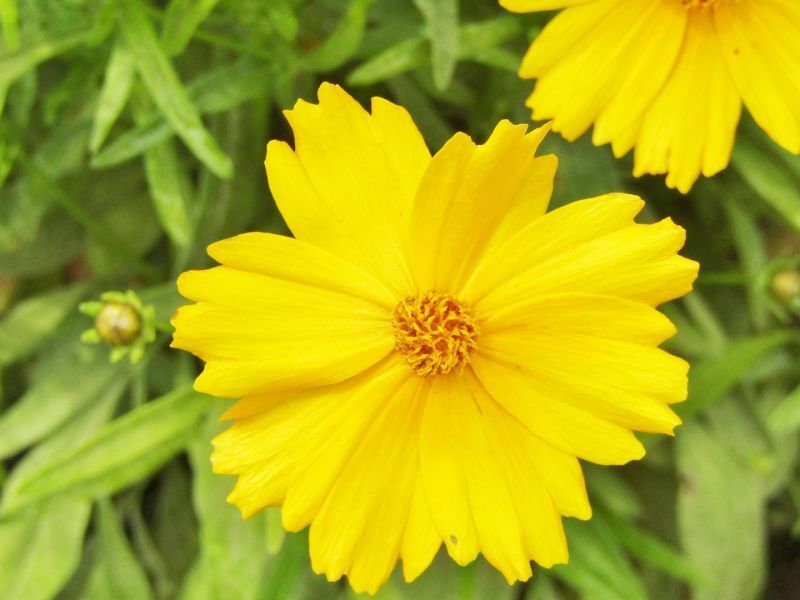
In the early spring, before new growth begins, cut all overwintered foliage and stems to the ground level. This is also a good time to start feeding the plants for the season.
When the flower petals begin to droop and fall, cut each flower stem back to the plant’s crown. After the blossom fades, the plant will not grow new flower buds on the stem. When a stem is first developing, it may produce more than one flower bud. Pinch the stem back far enough to remove the complete faded flower structure, not just the petals, in that situation. Remove the entire stalk once all of the flowers on it have blossomed. If deadheaded frequently, most large-flowered tickseeds will bloom until fall, but they bloom most prolifically during the long, hot days of summertime.
When should coreopsis be cut back?
After the summer growth season, trim back Coreopsis cultivated as a perennial. Reduce the plant’s height by one-third to one-half. According to the University of California Cooperative Extension, pruning should not reach into the older brown woody growth, as this could destroy the plant.
How do you prune tickseed?
Pruning. To extend the blooming period of tickseeds, deadhead them. Shear the plant to 1/3 of its original size or snip off the flowers right above the next bud. It’s possible that by cutting it back like this, the tickseed will generate new buds.
Do I cut back tickseed for winter?
Many perennials benefit from being pruned down for the winter months so that they can come back with vigor the following spring.
Cutting them back at all, though, might be fatal for this short-lived perennial. The stems and foliage on the plant benefit from being left intact since they act as insulation and help shield the crown from the cold.
So, regardless of your growth zone, after the plant has died all the way back, you should ideally leave the stems and foliage in situ. In the fall, the leaf changes color to a lovely mahogany before drying to a brownish-gray tint, giving dimension to your landscape.
Yes, you’re putting some tasks off until the spring. All you have to do is cut the dead stems down to two to three inches above the ground once the earth thaws and all risk of frost has passed, and fresh blossoms will sprout.
You can prune your coreopsis down to four to six inches above the ground if you need a nice, clean look in your garden over the winter. The stems will provide some insulation for the crown, and your landscaping will seem neater as a result. If you cut any more, you risk losing your daisy-like perennial to the harsh winter weather.
Can I cut back coreopsis in the spring?
A: Marguerite daisies are considered as annuals in other gardening regions, but as you’ve discovered, they become woody perennials in southern California! To keep the plants in shape, pinch and prune them while they’re still young. Because your plants are overgrown, it may take an entire growing season to gradually diminish their size without causing undue stress. Remove roughly one-third of the length of the stems in early spring, just before new growth begins. New growth will be forced from below the incisions. During the growing season, remove any wasted blooms as well as some stems. This will foster bushy growth while also keeping the plant’s height and width under control. In a same way, you can shrink the size of your coreopsis. Cut back the stems once the blooms have faded to keep the plants looking lovely, and fresh flowering stems will grow lower down on the plant. Take advantage of your new surroundings!
How do you maintain coreopsis?
- By mixing Miracle-Gro Garden Soil for Flowers with the native soil in your garden bed, you can create a perfect habitat for plants to take root.
- Plants should be watered thoroughly at the time of planting and as needed during the season.
- Feed Miracle-Gro Shake ‘n Feed Rose & Bloom Plant Food to your plants for huge blooms and loads of color.
How do you winterize tickseed?
In the autumn, whether you decide to prune back or not, surround the plant with plenty of mulch. Apply at least 2 or 3 inches (57.5 cm) if you reside in the northern reaches of the growing zone, and more if you live in the northern reaches of the growing zone.
After late summer or early fall, don’t fertilize coreopsis. It’s not a good idea to stimulate young, sensitive growth that will be suffocated as temps drop.
Until the ground freezes, keep watering coreopsis and other perennials. Although it may seem counterintuitive, roots in damp soil are better able to resist freezing temperatures than those in dry soil. Watering and mulching are the most critical actions to do when it comes to winterizing coreopsis plants. Because the plant will be in a dormant stage of growth, no extra coreopsis winter care is required.
Remove the mulch as soon as the threat of frost has passed in the spring. If you wait too long, moist mulch could attract pests and illness. Apply a little application of all-purpose fertilizer, followed by a thin coating of new mulch.
How do you split coreopsis?
Coreopsis propagation
- To begin, carefully dig out a mature plant clump, keeping the roots as intact as possible.
- Split the clump into smaller portions with a pointed trowel, making that each section has multiple healthy roots.
Should I deadhead tickseed coreopsis?
Coreopsis is a low-maintenance plant that can withstand both heat and poor soil. The plants grow well in USDA plant hardiness zones 4 through 10 across most of the United States. The fact that coreopsis are native to the United States and grow wild in American woodlands makes the easy-care attribute unsurprising.
The flowers are held high above the garden soil by their thick stems, which gather together. There are several different sorts of blossoms, ranging from bright yellow to pink with yellow centers to dazzling crimson. All of them live a long time, yet they finally wilt. This raises the question of whether or not coreopsis should be deadheaded. Deadheading is the process of removing faded flowers and blossoms.
Individual flowers bloom and perish as the plants continue to bloom through early October. Coreopsis deadheading, according to experts, helps you obtain the most blooms out of these plants. What are the benefits of deadheading coreopsis? Because it conserves the energy of the plants. Once a blossom has been consumed, the energy that would have been used to produce seeds can now be used to produce more blooms.
Do you deadhead tickseed coreopsis?
Once the blooms have bloomed, coreopsis is easy to care for. For more blossoms, deadhead wasted blooms on growing coreopsis frequently. Late in the summer, prune back growing coreopsis by one-third to ensure a continuous display of blossoms.
Coreopsis maintenance is restricted, as it is with many native plants, to occasional watering during periods of acute drought, as well as the above-mentioned deadheading and trimming.
Fertilizing growing coreopsis is unnecessary, and too much fertilizer can reduce blossom production.
Add some coreopsis to your garden beds now that you know how to grow them and how easy they are to care for. You’ll appreciate the long-lasting beauty of coreopsis flowers and the ease with which they may be cared for.