
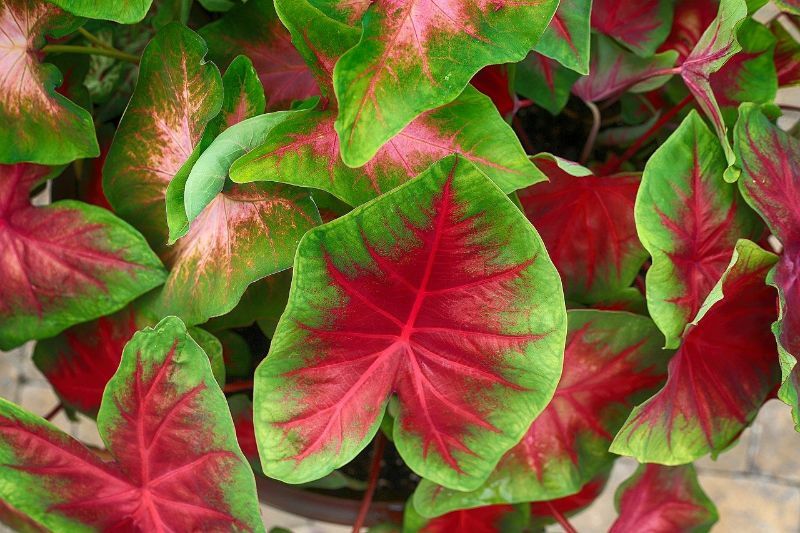
Caladiums can be planted with colorful blooming plants like hydrangeas, begonias, impatiens, and achimenes. Caladiums are often paired with begonias in gardens. In filtered sunlight, both plants thrive, and neither will overrun the other at the roots or during the blooming phase. Colorful blossoms from hydrangeas and impatiens adorn the caladium’s broad, leafy canopy.
What to plant with caladiums in pots?
Caladiums prefer well-drained soil, so avoid planting them in a wet place. Another essential aspect is light. Caladiums are shade-loving plants that thrive in partial to full shade. Some kinds may also withstand direct sunlight. Pete’s yard includes a combination of sun and shade, so he grows sun-tolerant caladiums like Red Flash and Rosebud in the sunnier sections. In shaded locations, he grows Fannie Munson, Candidum, and Dragon Heart, which have leaves that are too sensitive to direct sunlight.
Don’t forget about the containers. Caladiums thrive in container gardens, including hanging baskets. Coleus, impatiens, licorice plant, euphorbia, tradescantia, lysimachia, begonias, and elephant ears are just a few examples of heat-loving annuals. Cannas, calibrachoa, and other popular container plants can be paired with sun-tolerant types.
How do you landscape a caladium?
Caladiums perform best when planted in warm, well-drained soil. Caladium tubers should be started indoors in late winter and transplanted outside once soil temperatures have warmed up in late spring. If you’re not sure which side is the top, plant the tubers on their sides.
Do caladiums like sun or shade?
Caladiums thrive in shaded areas of the yard and garden. They thrive in full to partial shade in southern climates. Most caladiums can be grown in the sun in northern climates if they are given enough water and their leaves are shaded during the warmest portion of the day.
Planting Caladium tubers
Caladium can be found growing on limestone outcrops in tropical rain forests, where it receives plenty of humidity and frequent rain. However, the porous earth there will never contain any standing water. These are the kinds of considerations you should make when planting tubers.
This doesn’t require a large pot. A recommended pot size is 5 times the diameter of the tuber. With a perlite amendment of 1/3 volume, most bagged soil will perform just well. Perlite is used to make the soil lighter and more porous while yet allowing the roots to get enough water. Don’t forget to include a drainage layer and drainage holes at the bottom of the pot.
Take a good look at your tuber. On one side, you’ll see a big “eye” that resembles tree rings. This is the silver lining. From the eye, the primary shoot will emerge. If you want your plant to have tall petioles and huge leaves, pot it eye up. If you plant it on the side, though, it will appear more dense, with shorter, smaller, but more numerous leaves.
Plant the tuber shallowly, with just enough soil to cover it. Put it in a warm place with water. It can take anywhere from a few weeks to a few months for your plant to start developing.
Watering Caladium and winter storage
When the first shoot appears and has grown a couple of centimeters, increase the watering (about 1in). Never allow the soil to become entirely dry at this time. Just make sure it’s not submerged in water.
Caladiums require a lot of dampness. So daily showers from a spray bottle will suffice, but don’t leave any large water drops on the foliage.
Caladiums are plants that become dormant for part of the year. The leaves will begin to fade at the end of the growth season. When all of the foliage has faded and your plant has entered the winter dormancy, you will need to minimize watering until it is completely stopped.
It should be kept in its pot at a temperature of no less than 16°C (60°F). It will require a two-month relaxation period. After that, remove the tuber, change the soil, and replant it in a larger pot if the tuber has grown significantly.
Fertilizing Caladium
If you want good size tubers to develop for the next season, you must feed your Caladium during active growing. A well-balanced fertilizer with an NPK of around 8-8-8 would suffice.
Once a month, apply the soluble fertilizer straight to the soil (as directed on the label) without spraying or spilling it on the foliage. Caladium leaves are extremely sensitive to fertilizer and are easily burned.
Long-release granules with a similar NPK can also be strewn. During the growth season, use roughly 1/2 tbsp three times.
Right light conditions for Caladium
Caladiums planted outside may have a difficult time getting light. If the leaves are exposed to too much direct sunlight, they will be burned or their lovely pink hue may fade. If there isn’t enough light, the colors may not be as vibrant as you would want.
If you’re growing your Caladiums indoors, an east or west facing window is ideal. They only require a few hours of sunlight in the morning or evening to exhibit their full splendor.
Caladium propagation
Obtaining tubers is the simplest method for a home grower. They’re usually accessible from late fall through early spring, when Caladium is dormant. There are numerous benefits, including a reasonable pricing, ease of shipping, and a plant that is true to type.
The last one is something you won’t get via seed propagation. Seeds containing hybrids will be snatched, resulting in hues that differ from the parents. It will usually revert to its original, basic form, but in rare situations, you may receive a new and exciting kind.
Can you plant caladiums with hostas?
Annuals are typically cultivated from seed and planted in the spring and summer months, blooming for one season only before dying. You’ll have to replant them every year.
Although most annuals like full sun, there are a few that prefer shade and will offer a lovely flash of color when blended with your hosta plants.
Golden Shrimp Plant
The popular names for Pachystachys lutea are “lollipop plant” and “golden shrimp plant.”
It’s a tropical flowering plant with silky stalks and lovely flowers. It reaches a height of about 48 inches.
The plant is only cold hardy in zones 10 and 11 and is used as an annual in most regions. It thrives in partial shade and lends a splash of color to hosta beds.
Impatiens
Impatiens (also known as Buzy Lizzy) have bright flowers that will brighten up any gloomy and shady garden bed.
The plant comes in single and double varieties, and it’s a perfect choice if you don’t enjoy deadheading because it’s self-cleaning.
Caladium
A plant with the color of caladiums would not be expected to thrive in a shady location, but that is exactly where it thrives.
It comes in a wide range of colors, from white to pink and scarlet, and makes an excellent companion plant for hosta.
Caladium leaves are heart-shaped, resembling an elephant’s ear, and brightly colored.
In colder climates, you can dig out the tubers to overwinter caladiums, but you should do so early.
My experience has taught me that as soon as the temperature reaches 50 degrees F, the plant vanishes!
The contrast between caladiums and hostas in one garden space can be seen in these caladiums at the Springfield Botanical Gardens in Missouri. It’s an absolutely breathtaking sight!
Coleus
This vibrant annual grows best in cool, wet, well-draining soil. Overwatering will result in root rot, so be careful.
Some coleus cultivars can withstand the sun, but most prefer filtered shade with the sun shining primarily in the morning. Here are some growing tips for coleus.
This makes them an excellent companion plant for hostas, as they bring color and intrigue. To make the plant bushier, pinch out the tops.
The Toledo Botanical Gardens’ shot depicts a huge planting of coleus, caladiums, and hostas, demonstrating how well they complement each other.
Foxglove
Digitalis, popularly known as foxgloves, is a biennial flower. The plant grows for the first year, blossoms the following year, and then dies. It’s a cross between an annual and a perennial in appearance.
It is, however, a prolific re-seeder and hence acts as a perennial. This striking plant doesn’t require much sunlight, making it excellent for a dark border where hostas thrive.
It’s an ideal companion for hosta plants since the towering bell-shaped flowers offer drama, texture, and gentleness to the garden bed. Here’s where you can learn more about foxgloves.
Other annuals that made good hosta companions.
- The leaf and flower of the dragon wing begonia are both spectacular. Its sibling plant, the angel wing begonia, prefers the shadow as well. They have similar appearances, but their leaves are distinct colors.
Is coleus the same as caladium?
While both are excellent garden foliage plants, coleus comes in a considerably wider spectrum of color, pattern, and texture than caladiums. Caladiums may not give the spectacular color variations of coleus due of their limited color pallet, but they do suit traditional gardeners well. Coleus, on the other hand, provides more adventurous gardeners with a plethora of drama.
What are the pods on caladiums?
Caladiums aren’t known for their flowers, but they do produce an unusual bloom when grown in larger tubers. The flower-like bud on a caladium is a spathe, which is a tiny modified leaf that sheathes the inner reproductive organs, as previously described. A spadix is located within the curving spathe. This is a stiff structure that houses the plant’s sexual organs.
The overall result isn’t really attractive, but it is an unusual plant adaption worth noting. The spathe/spadix is a gorgeous morphology in some species, such as calla lilies, and is regarded the most attractive aspect of the plant. Caladium inflorescences are small, green to green yellow, and unpleasant in appearance.
Caladium blooming can take a few years to notice, and even then, you’ll have to split the leaves to get a good look at these tiny flowers.
What do caladium flowers look like?
Caladiums are tropical perennials with colorful, heart-shaped leaves that are endemic to wet and dry tropical forests in South and Central America. Caladium bicolor, a Brazilian plant, is the most common of several decorative species of the genus Caladium in the arum family (Araceae). This species (also described as C. x hortulanum) has thousands of identified cultivars, but other species and hybrids are occasionally accessible. They are easy to cultivate as summer “bulbs” or houseplants, even though they are only hardy to zones 9 and 10.
Other popular names for caladium are angels wings and elephant ears (but don’t mix them with other plants with the common name elephant ears, such as Alocasia, Colocasia, and Xanthosoma).
This is a “old-fashioned” shrub with striking leaves that has been cultivated in Europe since the late 1700s. The leaves have strongly colored midribs, contrasting borders, and mottled, veined, and striped patterns in varying colors of green, white, pink, rose, and/or red. The leaves are carried on long petioles that emerge directly from the underground tuber; there are no stems.
The fancy-leaved kinds, with their huge, heart-shaped or semi-heart-shaped leaves on long petioles (12 to 30 inches tall), are more compact than the strap- or lance-leaved types, which have shorter and narrower, ruffle-edged leaves on short petioles (usually less than 12 inches tall). The fancy-leaved forms have more leaves per tuber than the lance-leaved types (derived from C.picturantum).
Caladiums can bloom, producing a single (rarely 2-3) characteristic arum-type flower with a green or pinkish spathe encircling a short white spadix, despite being grown as foliage plants. White berries with a few to many seeds make up the fruits. Most people remove the inflorescence because it depletes the plant’s energy, which could otherwise be utilized to grow more leaves or a larger tuber.
Caladiums can be used to give color and texture to shadow gardens as well as deck and patio pots.
For maximum impact, plant them in realistic clusters of a single cultivar, or mix and match for a multi-colored effect in smaller spaces. To create colorful fountains, combine them with ferns, astilbe, and shade-tolerant iris, or intersperse them with other shade-loving plants. Impatiens or fuchsias with flowers in similar or contrasting colors are a good match.
Choose coleus or begonia varieties that compliment each other for a season-long display of color and texture in the leaf. As a stunning specimen plant and focal point in a flower bed, use a single, big plant in a raised pot or urn. Combine caladium with green or black elephant ears for a tropical appearance. The lance-leaved varieties are ideal for window boxes and smaller containers. In fresh flower arrangements, chopped leaves can keep for several days.
Caladiums have a tuberous corm that they grow from. Tubers come in a variety of sizes dependent on their diameter. The more leaf buds a tuber has, the more foliage it produces, hence bigger tubers yield more foliage. A huge, center bud is surrounded by multiple tiny buds on each tuber (eyes). The greatest leaves will come from the central bud, but it will also prevent the smaller buds from sprouting. By gouging off the main, center bud with the tip of a sharp knife, you can stimulate the small buds to grow and create more slightly smaller leaves. Just make sure you don’t hurt any of the nearby little buds.
Start caladium tubers inside 4-6 weeks before the average last frost date in the Midwest, or buy potted plants. Place the knobby side of the tuber with the eyes up (both roots and shoots come from the top of the tuber) and just cover it with dirt. Keep the container in a brightly lit, warm area (70°F or higher). After the final frost, move the growing plants outside either in pots above ground or buried into the earth, or transplant into the ground so the tuber is 11/2″- 2 deep. Because they prefer a wet, rich, light, and well-drained soil, most soils should be amended with plenty of compost or other organic material. It is frequently preferable to keep them in containers rather than planting them in the ground in locations with heavy soils.
Low temperatures will injure tubers and plants, and plants will not grow much until temps warm up, so don’t rush to move them out. They thrive in soil temperatures of at least 70 degrees Fahrenheit, and planting them in chilly soil will cause the tubers to rot. Because high soil temperatures alter leaf color, plants in hot regions should be mulched to keep soil temperatures below 85°F.
Traditional varieties thrive in part-shade conditions. They will grow in full shade, but their vitality and color will suffer. Many newer, sun-resistant types, especially in cooler, northern climates, may be grown in part to full sun. Ensure that the soil is kept evenly moist but not damp throughout the growing season.
Caladiums are heavy feeders and, especially in containers, require regular fertilizing during the growing season. Because too much nitrogen can damage leaf color, choose a low-nitrogen or balanced formulation.
Caladiums thrive in the hot, humid summer months, but when the weather cools, they begin to droop and lose leaves. Tubers must be brought in before the first frost in temperate zones if they are to be retained during the winter (or before soil temperatures drop below 55oF). Lift any tubers in the ground, remove most of the soil, and dry for a week in a warm, shady location before cutting off the leaves and storing for up to five months in dry sphagnum moss or a mesh bag in mild temperatures (55-60oF). Tubers in containers can be carried inside for the winter and left undisturbed in the pots. As the leaves die back, allow the growing media to dry up. The containers can be kept in either light or darkness, but the temperature should never go below 55 degrees Fahrenheit. When new growth sprouts in the spring, start watering again.
As a houseplant, give a warm environment with plenty of humidity and bright but indirect light. Caladiums will go dormant after a few months in leaf, even if they are grown inside. Stop watering them when their leaves begin to wilt. Allow the plant to rest before watering it again after new growth appears.
Caladiums are mostly pest-free, especially in the north. Tuber rot, which can occur in storage or after planting, is most common in cool weather and can be avoided by following proper storage and planting techniques. Too much sun, not enough water, or fertilizer sitting on the leaves causes leaf burn or scorch on thin-leaved varieties. Caladiums can be propagated by separating tubers in the spring before potting them up. Allow the tuber to dry for a few days to callous over before planting; cut the tuber into pieces that have at least one eye or knob. If enough of the plant is consumed, it is poisonous, and handling the plants can irritate the skin of sensitive people.
Caladium cultivars come in thousands of varieties; these are only a few of the most popular.