
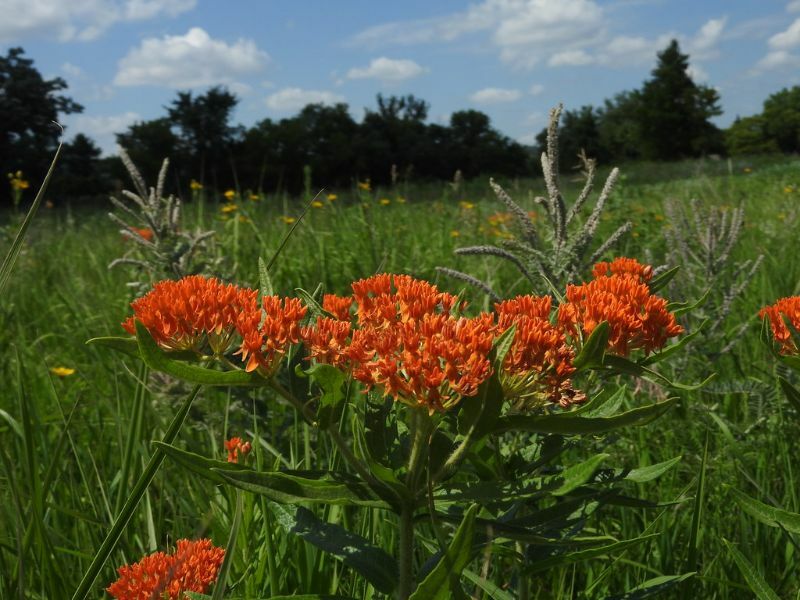
The term “butterfly weed” comes from the fact that it is the primary food source for butterflies, particularly monarch butterflies, who use it as a host plant during their caterpillar and butterfly stages. However, the monarch butterfly isn’t the only pollinator attracted to butterflyweed. The butterfly weed attracts a variety of butterflies, as well as honey bees, bumble bees, and hummingbirds. Swallowtails, painted ladies, hairstreaks, and fritillaries are all attracted to butterfly weed. Unfortunately, because plants often don’t flower until their third year, patience is required to enjoy what the butterfly weed can contribute to your garden. Although the wait is long, butterfly weed blossoms are well worth the wait. It’s a good idea to bring your camera because there’s a beautiful display of bright orange blossoms and a long list of regular visitors.
Butterfly weed is a herbaceous dogbane family member native to the eastern United States and Canada’s dry fields, prairies, meadows, forests, canyons, and slopes. It thrives in full sun in loamy or sandy soils with good drainage. Butterflyweed is grown for its ornamental appeal, and its blossoms are used to make a variety of cut flower bouquets.
Each butterfly weed plant has a multi-branched, erect stem that grows one to three feet tall. After a few years, each branch is coated in hairs and turns woody, with flower clusters emerging at the ends of each branch as the plant matures. Butterfly weed leaves are lanceolate, linear, or oblong in shape, with smooth edges and pointy points, and alternately placed on the stem. The upper side of the leaves is darker and more lustrous than the underside.
Butterfly weed produces vivid orange flower clusters of petite, five-petaled, star-shaped flowers three years after sowing. Butterfly weed blooms from May to September and hosts an apollinator party all summer long.
The butterfly weed plant’s fruit is a slender, hairy greyish-green pod that ripens around the end of summer or the beginning of fall. Hundreds of seeds are contained in each pod. The seeds have silky white tufts of hair that help them disseminate and find new homes by allowing them to fly on the breeze.
People and Pets Shouldn’t Eat It
Both humans and animals are poisoned by all portions of the butterfly weed. If you eat the blossoms, stems, leaves, or root, you’ll get diarrhoea and vomiting. It’s possible that touching the sap will irritate your skin. Butterfly weed can make you sick even if you only eat a small quantity. Small animals are especially vulnerable since even small doses, as low as.01 to.05 percent of their body weight, can kill them. Although this is more of a problem with grazing animals than with pets, use extra caution when planting and seek medical attention right away if you fear a child or pet has eaten butterfly weed.
Varieties of Butterfly Weed
True orange is the blossom color of the original hardy species variety of Asclepias tuberosa, which is commonly sold as Asclepias tuberosa. “The variety “Hollow Yellow” has yellow flowers. “Cinderella” is a cultivar that produces pinkish-red blooms. “Gay ButterfliesMix” is a genus of plants with red, orange, and yellow flowers.
‘The’ “Silky Mix, also known as Asclepias curassavica, is a gorgeous variety of Asclepias tuberosa. Butterfly, Silky Deep Red Weed has beautiful two-toned flowers with yellow-orange crowns and deep red-orange corellas. Silky Scarlet is a tropical plant that grows as a perennial in frost-free areas and as an annual in freezing-temperature areas. Silky Scarlet blossoms are a variety of colors, ranging from salmon to bright pink, as well as tints of yellow, orange, and red. In frost-free locations, Silky Gold has golden yellow flowers that bloom all year.
Growing Conditions for ButterflyWeed
Butterfly weed thrives in full sun, but it can also thrive in partial shade as long as it gets at least six hours of direct sunlight per day. Butterfly weed has evolved to thrive in less-than-ideal soil conditions, including clay, dry, and even rocky soil and drought. USDA zones three through nine are suitable for this plant.
Care of Butterfly Weed
Keep butterfly weed well hydrated throughout its first season, but once it has established itself, don’t worry about it. Butterfly weed does not require fertilizing. Once a year, a topdressing of compost or composted manure is all that is required to keep butterfly weed alive and well.
How to Plant Butterfly Weed
Sow butterfly weed seeds straight into the soil for spring sprouts in the fall, or sow indoors after cold stratification in the winter. Direct sowing is the favored method of propagation due to their long taproots.
How To Propagate Butterfly Weed
Seeds or root cuttings can be used to propagate butterfly weed. Because butterfly weed has a lengthy taproot that might be difficult to transplant, seed is the best way to propagate it. Around the beginning of fall, seeds can be picked and preserved. They can be brought inside or buried just beneath the topsoil in the ground to survive the winter, then planted immediately into your garden beds in the early spring.
Garden Pests and Diseases ofButterfly Weed
Crown and root rot can be a problem if you grow your butterfly weed in a moist environment. Plant your butterfly weed in a hole with the crown just slightly above the soil line to avoid crown rot. Increase soil drainage and avoid overwatering your butterfly weed plants to reduce the danger of root rot.
As the parasites feed on the sap, yellow-orange oleander aphids (Aphis nerii), sometimes known as milkweed aphids, create colonies that encase the plant’s stems and leaves. Honeydew, a clear, sticky waste product that attracts a black, sooty mold, is excreted in large quantities by the bugs. A covering of powdered, soot-like fungal filaments covers the plant. A burst of water from the watering hose can be used to knock down small infestations of oleander aphids. Insecticidal soap or horticultural oils, sprayed to saturate stems and foliage, may be required for heavier infestations.
Do you cut back butterfly weed inthe fall?
Begin with clean, disinfected gardening shears, and disinfect the tool after each plant. Butterfly weed can irritate your skin, so wear gloves to protect yourself. Before new growth grows, prune your butterfly weed between late winter and early spring. Reduce the plant’s height to a third or half of its original size. All of your cuts should be no more than a quarter inch away from a leaf or leaf node.
How often should I waterbutterfly weed?
When the soil dries out, water young plants to keep them moist until they’re firmly established and exhibiting fresh growth. Butterfly weed should only require water during periods of extreme drought once it has established itself.
Is butterfly weed invasive?
Butterfly weed (Asclepias tuberosa), unlike common milkweed (Asclepias syriaca), does not have the swiftly spreading roots that make it invasive.
Is butterfly weed poisonous tohumans, dogs, or cats?
Both humans and pets are poisoned by butterfly weed. Large amounts are required to produce pain in humans, but because children, dogs, and cats are smaller, their danger is greater. Bloating, fever, difficulty breathing, dilated pupils, muscle spasms, and death can all result from eating butterfly weed. Call the Poison Control Center at 800-222-1222 for human poisoning, or the ASPCA’s Animal Poison Control Hotline at 888-426-4435 for animal poisoning.
USDA Native Status: L48 (N), CAN (N)
The enormous, flat-topped clusters of bright-orange flowers on this bushy, 1 1/2-2 ft. perennial are appreciated. The leaves are primarily alternate, measuring 1 1/2 to 2 1/4 inches long, pointy, and smooth on the edges. The 2-5 inch wide yellow-orange to bright orange flower clusters are at the apex of the blooming stalk. The magnificent flower heads are set against a dark green backdrop of stiff, lance-shaped leaves.
In home gardens, this beautiful plant is usually cultivated from seed. Its vibrant blossoms are a magnet for butterflies. Pleurisy Root was given to Butterfly Weed because its tough root was chewed by the Indians as a remedy for pleurisy and other respiratory illnesses. Although it’s known as Orange Milkweed, this plant doesn’t have any milky sap.
Does butterfly milkweed come back?
Perennials, or plants that come back year after year, are native milkweeds. Their aerial portions (flower, leaves, and stem) die back in the winter, but their rootstock survives. After the seed pods have matured and the seeds have had time to grow, cut down milkweed stems in the late fall or winter.
Does butterfly weed rebloom?
During the spring and summer, butterfly weed (Asclepias tuberosa) develops green foliage and clusters of little red, orange, or yellow flowers. Plant hardiness zones 4 through 10 according to the US Department of Agriculture. The plant dies back each winter, but if correctly clipped, it reappears each year from its perennial root system. If consumed, all components of the butterfly weed are poisonous.
Will butterfly weed bloom first year?
Milkweed, also known as asclepias, is native to North America, and one of them, Asclepias tuberosa, has been named Perennial Plant of the Year by the Perennial Plant Association this year. This plant, sometimes known as butterfly weed or butterfly milkweed, has bright orange flowers that attract a variety of butterflies and bees with nectar and pollen. Butterfly weed’s leaf isn’t a favorite meal of monarch caterpillars, but it can help them survive. This drought-tolerant plant prefers a dry, sunny environment and is hardy in Zones 3 to 9.
Upright stems with clusters of bright orange flowers contrast attractively with the shiny green leaves of butterfly weed. Unlike other members of the genus, the stem sap is not milky. This milkweed is not invasive since it does not spread by runners like common milkweed (Asclepias syriaca). Although deer are not attracted to butterfly weed, aphids can be an issue in gardens and greenhouses.
This plant is expected to be in great demand in the next years. Butterfly weed blooms readily the first year after seeding, but there are a few crucial elements to remember if you want to grow it professionally.
This species displays some of the most extreme photoperiod reactions we’ve ever seen. It’s an obligatory long-day plant, which means it has to flower during long days. When grown at an average of 68° F, plants develop quickly under photoperiods of 14 hours or more, and begin flowering about eight to nine weeks after transplant. Plants that are exposed to photoperiods of 12 hours or less, on the other hand, die dormant after a few days (Figure 1, pictured above). Leaves droop, shoot growth appears to stop, and existing flower buds may suffocate (Figure 2). Unfortunately, simply reverting to longer days will not return the plants to active growth. A nine-week or longer cold treatment is required to break this dormancy; in our testing, all dormant plants treated to 41° F for 15 weeks bloomed.
It is critical to provide long days to plants in order to keep them actively growing. We propose at least 16 hours of daylight or four hours of night disruption illumination. A minimum intensity of 2 molm2s1 should be delivered by photoperiodic illumination. Use incandescent lights or LED bulbs intended to control blooming that emit both red and far-red radiation. Maintain these extended photoperiods for plants until natural daylengths reach at least 14 hours.
Butterfly weed has a huge tap root, making transplanting or dividing established plants difficult. It’s critical to utilize a well-drained medium in container production, so consider adding more perlite to a standard peat+perlite mix. During production and cold treatments, be careful not to over-water. The taproot attracts fungus gnat larvae, so keep an eye on the roots if your plants aren’t doing well.
Butterfly weed can grow up to 3 feet tall in the wild, but in container production, our plants were only 12 to 18 inches tall when they first bloomed. Sprays of daminozide (e.g., B-Nine, Dazide), paclobutrazol (e.g., Piccolo, Bonzi), and uniconazole (e.g., Piccolo, Bonzi) are apparently helpful for height management (e.g., Sumagic, Concise). To help fill out containers, use many plugs per pot or squeeze seedlings soon after transplant.
What month does milkweed come back?
There are milkweeds that grow well in practically every hardiness zone, with over 140 different varieties. Winter milkweed care varies depending on your zone and the type of milkweed you have.
Milkweeds are herbaceous perennials that flower in the summer, set seed, and then die back in the fall before sprouting again in the spring. To extend the blooming duration of spent milkweed blooms, deadhead them in the summer. When deadheading or pruning milkweed, however, always keep a watch out for caterpillars, which eat the plants throughout the summer.
Milkweed requires very little winter maintenance in general. In cold climes, however, certain garden types of milkweed, such as butterfly weed (Asclepias tuberosa), will benefit from additional mulching. In fact, if you wish to offer your milkweed plant’s crown and root zone some extra winter protection, it won’t mind.
Pruning can be done in the fall, but it isn’t required for winterizing milkweed plants. It’s entirely up to you whether you prune your plants in the fall or the spring. Birds and small animals use the natural fibers and seed fluff of milkweed plants in their nests in the winter. As a result, I like to prune back milkweed in the spring. With clean, sharp pruners, trim last year’s stems back to the ground.
How fast does milkweed grow back?
This week, a question came into Ask Gardenerd that I had asked myself last year:
“This is my first year planting swamp milkweed for monarch butterflies, and I’ve already seen two butterflies emerge from their cocoons this morning.” This year, I had five plants; next year, I’m going big. Question: There is a lot of information on how to get plants started, but none on how to maintain them at the end of the season. Should we prune the stems of the existing plants or leave them alone? Now that winter is approaching, I’m not sure what to do. “Thank you, Bob”
You’re right, Bob, not many websites discuss what to do with milkweed once the season is through. Last year, I came across the problem while staring at an 8-foot stem of Asclepias Physocarpa that had been stripped of its leaves following a season of successful Monarch residence. So, what’s next? The answer is that it is debatable.
If the milkweed you’re growing, like the Asclepias Physocarpa depicted above, performs as an annual in your hardiness zone, you can spread the open seed pods about the soil and trim the stalks down to the ground. The roots will disintegrate over time, and new plants will emerge from the seeds that have been disseminated.
This milkweed was supposed to be a perennial in my garden, but I opted to cut it down after waiting several months for fresh growth (while other milkweeds sprouted new leaves).
Just in case it chose to leaf out again, I left around 6 of stem above ground, but it didn’t. Instead, seeds I distributed nearby sprouted into new sprouts.
You indicated that you’re growing Asclepias incarnata, or swamp milkweed. Although it is technically a perennial, if you have problems like I had (no leaves sprouting), re-seed and prune down old foliage.
If the milkweed is a perennial, such as Asclepias curassavica (tropical milkweed), you’ll find little leaves emerging from the plant’s base after the upper stems have been destroyed. Hold your breath for that. Then trim the stems back to the new growth, and the plant will take off.
As a reminder, if at all feasible, cultivate milkweeds that are native to your state. We have numerous native milkweeds in California, and seeds for at least one of them can be bought via Theodore Payne Foundation.
Why did my milkweed not come back?
Milkweed that is sown in the fall is unlikely to make it through the winter. There could be a variety of reasons why they didn’t all show up. Before germination, milkweed seeds must be chilled for a length of time. Because the swamp milkweed sprouted but not the other, it’s possible that the seeds were kept too damp or too dry.
Butterfly Weed Fall and Winter Care
Butterfly Weed can be pruned back to the ground in the fall and winter. Simply take pruning shears and cut the plant to the ground whenever the leaves and stalk appear dead or dry. It will reappear in the spring.
In late summer and early autumn, when the flowers have gone, seed pods will begin to form.
The pods will eventually turn brown and open, dispersing Butterfly Weed seeds into the breeze.
The leaves will turn yellow shortly after this, eventually going entirely brown.
The plant is about to go dormant.
The plant can be pruned back to ground level once the foliage has become fully brown.
In the spring, it will reappear.
Why does my Butterfly Weed keep dying?
If Butterfly Weed isn’t placed in the right growing conditions, it will die. If you’ve tried planting Butterfly Weed in the same area several times and it keeps dying, there are a few things to look into:
- Test the pH level of your soil whether you have enough sun and good drainage. Butterfly Weed prefers a pH of 6-7.5.
Is Butterfly Weed Invasive?
Butterfly Weed isn’t a bothersome plant. Butterfly Weed, unlike ordinary milkweed, does not spread via rhizomes, or later or horizontal roots. The only way for Butterfly Weed to spread is by seed. Butterfly Weed does not self-seed very much, if at all, due to the nature of seed distribution (floating away on the wind).
Deadhead Butterfly Weed
Butterfly Weed can be deadheaded to extend the blooming season in the summer. However, the number of blooms you receive will be smaller than the number of blooms you received initially.
Wait until the flower petals begin to fall off a bloom before deadheading Butterfly Weed.
Then, below the bloom, cut the stalk at the first leaf junction.
I don’t deadhead my Butterfly Weed because I prefer to get as many seeds as possible.
Butterfly Milkweed can be deadheaded to limit the quantity of seeds produced.
Pruning Butterfly Weed
Butterfly Weed can be clipped if you want to keep your plants as short as possible. Trim or cut back a stalk 1/3 of its height in the early summer. This will encourage the plant to branch out, resulting in a decreased overall height.
Should milkweed be cut back?
During the fall and winter months, trim the milkweed stems to about 6 inches in height to dissuade monarchs from establishing winter-breeding colonies. Cutting back the milkweed will also aid in the removal of any OE spores that may be present. As the leaves re-sprout, re-cut the milkweed every several weeks. Because tropical milkweed dies back naturally when it freezes, it may offer fewer problems in the northern monarch breeding region.
These instructions do not apply in south Florida (south of Orlando), where a distinct, non-migratory monarch population has existed for many years. In this location, however, native milkweed planting is still recommended.