
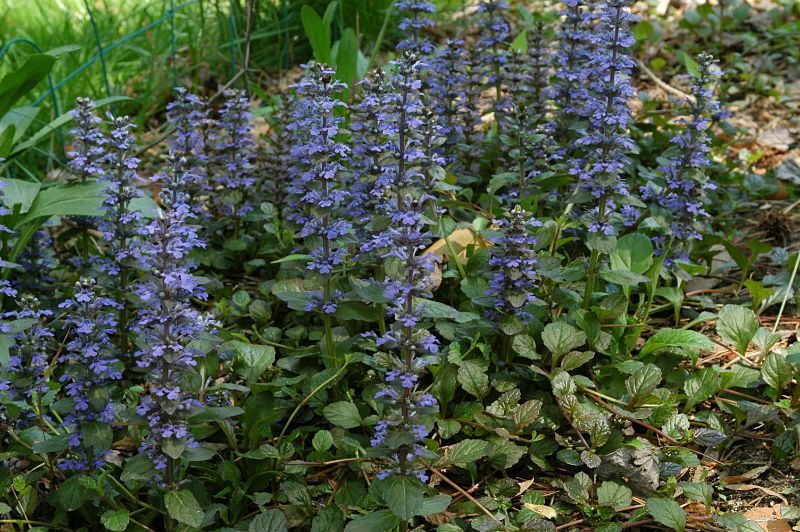
Don’t be fooled by a plant’s size. Ajugas may be little, but they are strong and hardy groundcovers. They can help with erosion control on a bank or slope, fill in a patchy lawn where grass won’t grow, or simply offer color to shaded areas. They’re also excellent for planting beneath bushes and trees.
Ajugas are very attractive because their leaf color and attractiveness last virtually all year, and they produce blue, purple, or white blooms from spring to summer. Ajuga reptans, sometimes known as carpetweed or bugleweed, is a perennial that thrives in zones 3 to 9.
The lustrous leaves of these evergreen shrubs form dense mats. They can tolerate full sun to partial shade, but full sun brings out the greatest color in the leaf. Ajugas are easy to cultivate in practically any type of soil and prefer a moist, well-draining environment, but they can endure dryness for short periods of time.
Because ajuga spreads through stolons, or horizontal stems that creep along the ground, it’s important to consider where you plant it. This mint family member spreads quickly and can become invasive. Planting too close to flower beds, lawns, or other areas where you’ll have to remove it frequently is a bad idea. If you’re worried that ajuga is an invasive plant in your area, check out the Invasive Plant Atlas.
Plant ajugas when all dangers of frost have passed. Then, spacing the holes 8 to 15 inches apart, dig holes just deep enough for the root balls. Gently loosen the roots of the plants, then plant them and firm the dirt around them. To settle them in and eliminate air pockets, water them thoroughly. Fertilizing ajugas is rarely necessary.
To keep your ajugas from becoming overloaded, you should thin them every three years or so. If desired, divide and replant established clumps in the fall or early spring.
Crown rot is an issue, particularly in hot, humid climates or in heavy soils. It’s easy to notice since the lower leaves have rot and spots on the tops of the plants. Give your plants plenty of air circulation and avoid overfertilizing to avoid this illness. Crown rot has no treatment, therefore if it appears, you’ll have to uproot and destroy the damaged plants. When it’s time to replant, consider a new type of groundcover to reduce the chances of the problem reappearing.
Patches of ajuga will occasionally die. If this occurs, remove the dead leaves but leave the roots in place. In most cases, the plants will return the next year.
Ajugas are low-maintenance plants with good rabbit and deer resistance. They don’t need to be pruned, but if you want them to look a little neater after the blooms fade, mow them using a high setting on your mower.
Try coral bells, hostas, ferns, daffodils, astilbe, forget-me-not, violas, hardy geraniums, and other woodland species if your ajugas are in the shadow.
Is Ajuga a shade or sun plant?
These plants can grow in any generally well-drained soil, and while they tolerate full sun, they develop more quickly in partial shade. Plant these perennials 6 to 12 inches apart in the spring or early fall. Remove old flower spikes by mowing or trimming them.
Sweet Woodruff
With clusters of fragrant white blooms that appear at the start of each summer, this multipurpose plant spreads swiftly to form a dense cover roughly 15 inches high. The star-shaped flowers and vivid green leaves endure long into the fall months.
Bunchberry
Bunchberry is a dogwood-like plant with emerald green foliage, huge white flowers, and clusters of brilliant red berries. It grows to a height of six to eight inches, spreads rapidly, and thrives in cool, summer shade, liking acidic soil.
Goldenstar
This stunning favorite among gardeners has bright yellow blossoms and rich green leaves. Flowers bloom in the spring and late summer, and the plant grows to be four to six inches tall. Goldenstar is resilient in both northern and southern regions, and it thrives in either part or full sun.
Trailing Periwinkle
This plant forms a dense ground cover with stunning blue, lavender, white, or purple blooms that bloom swiftly. The plant thrives in full to partial shade, and it’s a low-maintenance, pest-free addition to the base of trees or tall shrubs, or at the top of a rock wall.
How fast will Ajuga spread?
Ajuga will try to conquer the entire region in its immediate proximity. Although it is an aggressive spreader, it is relatively easy to contain because it spreads over the ground.
It is recommended that you use a shovel or a spade to edge the borders of the territory limit assigned to Ajuga twice a year, once in the spring and once in the middle of summer.
There is no need to be concerned because this plant does not spread quickly; rather, it spreads slowly and steadily.
You should not plant this next to a lawn because grass cannot compete with it and will quickly become overrun, leaving you with an Ajuga lawn rather than a grass lawn.
How do you control an ajuga ground cover?
Using impermeable black plastic sheeting, cover huge portions of ajuga to be removed (weed mulch or heavy garbage bags). Leave the area alone for at least four weeks after anchoring it with rocks. This deprives the plant of both light and water, severely limiting its ability to thrive.
Does bugleweed grow in shade?
Bugleweed grows best in a rich, wet, well-drained soil, but will withstand clay and poor soils. Plant in full sun to create a shady environment. If you’re going to plant bugleweed near to a grass area, bear in mind that it has creeping tendencies; use edging to keep it from spreading. Run a lawnmower over spent flowers to deadhead them. Seed, cuttings, or division are all methods of propagation. To avoid crowding, division can be done at any time of year and should be done every two to three years. There are no major pest or disease problems; nevertheless, crown rot can occur in hot, humid conditions or in locations with inadequate air circulation.
What ground cover is good in shade?
Cornus canadensis (Cornus canadensis) You’ll love creeping dogwood as a ground cover! It has a thicket of lush, oval leaves and blooms in the spring with the typical white dogwood flowers. It’s a disease-resistant, deer- and rabbit-resistant native ground cover that’s perfect for the shady garden.
Can creeping jenny grow in full shade?
Lysimachia species are employed as attractive plants in a variety of ways. The cultivar ‘Aurea’ of the low-growing species L. nummularia (= L. zawadzkii), golden creeping Jenny, can be a beautiful addition to containers or other settings where its growth can be regulated. This genus was previously classified in the primrose family (Primulaceae), and was reclassified in the Myrsinaceae a few years ago, but this family was recently reclassified as the subfamily Myrsinoideae in the Primulaceae – still confused? so it appears to be back where it began. This European species can be invasive, so the green cultivar is not advised for ornamental plantings, but the yellow cultivar is considerably less aggressive and can be used sparingly in attractive plantings. Moneywort, herb twopence, and creeping Charlie are some of the other frequent names for this plant (not to be confused with the lawn weed Glechoma hederacea also commonly called creeping Charlie). This herbaceous perennial has won the Royal Horticultural Society Award of Merit and is hardy in zones 3-9.
Small, spherical leaves with wavy edges grow along the thin, trailing stems of creeping plants. If you look closely, the orbicular leaves are smooth and often shiny, resembling a string of little coins, with a few glandular black spots. The nearly-evergreen foliage of the cultivar ‘Aurea’ is yellow, ranging from lime green to soft chartreuse in shade, to golden yellow in partial or dappled shade, to a brassy gold in full sun (it may burn out in more southern places in full sun), whereas the species’ leaf is a soft green.
Where the leaf nodes come into touch with the earth, the stems grow quickly, generating slender fibrous roots. This results in a dense mat that grows chaotically in all directions and is 2-4 inches tall.
In the leaf axils, single bright yellow cup-shaped flowers appear on occasion. Each 1 inch flower has five petals with dark reddish glandular spots, all of which are placed in a hairless green calyx with five triangular teeth that are shorter than the petals.
Although this cultivar does not seem to bloom as frequently as the species, the plants bloom occasionally from early summer to fall (and sometimes forms just vegetative colonies that never bloom). Because the blooms aren’t as brightly colored as the foliage, they aren’t as noticeable as the green species’ blossoms. Because seed capsules do not form rapidly, ‘Aurea’ does not spread as widely via seed as the green variety.
To ensure that golden creeping Jenny does not escape cultivation or crowd out other plants in the garden, use it with caution. It works well with tulips and daffodils as a groundcover, filling in the gaps once the bulbs’ leaves have died back for the season. However, it can outgrow other short plants, so make sure it’s in the right spot. It looks great under roses or other shrubs, as well as around daylilies, ferns, and tall perennials.
It contrasts beautifully with dark-leaved plants like ‘Amethyst Myst’ or ‘Palace Purple’ Heuchera, especially when mixed with purple ajuga. Use it as a color echo with lady’s mantle (Alchemilla mollis), a chartreuse or golden hosta like ‘Sun Power’ or ‘Sum and Substance,’ or a chartreuse ornamental sweet potato cultivar like ‘Sum and Substance’ (Ipomoea batatas). Use golden creeping Jenny as a trailing plant in containers, window boxes, or hanging baskets, or plant it along a wall or bank. It can be used in ponds, water gardens, or marginal areas along waterways in shallow (up to 2) water to offer habitat for frogs, insects, and small fish (as long as there is no risk of it escaping into natural regions).
In moist soils, L. nummularia ‘Aurea’ can be planted in practically any exposure, from full sun to light shade. Position the plant so that it receives morning sun for the finest color. It has shallow roots (which makes it relatively easy to dig out if it moves into an area where it isn’t desirable) and thrives with frequent watering. It thrives in moist soils, where other ground coverings often fail.
Slugs may attack the leaves and nearly entirely defoliate the plants in some areas when high populations are present, although Creeping Jenny has few pests. Although the plants will appear unattractive, they will generally survive.
Cuttings or division (removing rooted portions towards the edge of a patch) are both easy ways to propagate this plant. Because it quickly roots at nodes, it may take a lot of weeding to completely eradicate it from a given area.
Will hostas grow in deep shade?
Let’s start with this one because it’s usually the first perennial that springs to mind when considering shady gardening. It’s for a good reason: hostas adore being in the shadow. They do, after all, prefer the cool of the afternoon sun, so your shaded setting will be ideal for them.
Hostas, on the other hand, require a steady supply of moisture to flush out their large, gorgeous canopy of foliage, so planting them in hard, dry clay beneath your trees is not ideal.
When planting hostas, amend the soil to provide them with nutrient-rich, loamy soil in which to spread their vast roots. Investing the time and effort will benefit your hostas far more than planting them in poor soil and having to fertilize them every month to compensate for the poor soil.
Hostas are hardy in zones 3-9. They grow well in all but the hottest sections of the country. They are, however, a favorite diet of deer, so if you have these four-legged friends in your garden, you might want to browse lower down this list for alternative shade-tolerant perennials.
Recommended Hostas:
- The dazzling blue and radiant gold edged leaves of ‘Autumn Frost,’ one of the best hostas for spring color, will light up your landscape and containers with exuberant color.
- ‘Empress Wu’This massive green hosta might be better named “Wow You,” since it will undoubtedly impress all your friends when it reaches its mature height of 3-4ft tall by 5-6ft broad in around five years.
- ‘Wheee!’
- With a name like this, what hosta could be more entertaining?
- You’ll want to reach out and touch its very ruffled foliage, and when you do, you’ll be impressed by its thick leaf material. The slugs, on the other hand, will be less impressed and will seek out simpler prey.
What is full shade for plants?
Because sunlight is the most crucial factor for all plants to survive, it’s critical to comprehend it thoroughly. So, let’s talk about sunlight: what exactly do the terms “full sun,” “part sun,” “part shade,” and “full shade” mean? And how can you know what type of sun your garden receives? Light levels are defined the same way for all types of plants, whether you’re looking for annuals, perennials, or shrubs. Let’s start with the fundamentals.
A garden light meter may be used to determine how much sun the area you intend to plant in receives each day. By merely viewing your garden for a few days over the summer, you may save that money to spend on other plants. Find a site to plant, and keep track of whether or not that spot receives direct sunlight each hour of the day on a sheet of paper. To find an average, repeat this process for a few days.
Six or more hours of direct sunlight each day is considered full sun. Your garden may receive no shade at all throughout the day if you reside in a recently created subdivision or in a rural area with few trees. Perhaps your front porch faces south, with nothing blocking the sun from midday until early evening. Full sun is defined as any length of time in the sun that is greater than or equal to six hours.
Four to six hours of direct sunlight each day is considered part sun. It’s not necessary to log all of those hours in a row; it may be a few hours in the morning followed by a few more in the afternoon. When a plant enjoys part sun, it will grow and blossom best if at least some of those hours are in the afternoon, even if it does not need to be in direct light all day. In order to generate blossoms and new development, these plants require some heat and extensive light exposure.
Part shade is sometimes characterized as four to six hours of direct sunlight per day, with the majority of this time occurring in the morning when the sun’s rays are less powerful. Plants that appreciate part shade are said to benefit from “cool sun,” which refers to direct sunlight in the morning or evening as well as protection from the hot midday sun.
Less than four hours of direct sunlight per day is considered full shadow. We didn’t say 0 hours of direct sunlight since it would be deep shade, the lowest of all light levels in which only a few plants can thrive. Plants that thrive in full shade get a few hours of sun each day, usually in the morning.
Pay particular attention to how much sun plants require while shopping for or researching them. Because it’s so important to get it right, this information is always included on plant labels. Here are a few samples of what you might come across and how to understand it.
When a plant’s only light level is full sun, that means it will require at least six hours of direct sunlight to grow and blossom. If you put it in a low-light environment, it will most likely not blossom, and in some situations, the plant will die. Full-sun plants are frequently heat tolerant, and some may tolerate dry conditions. For the most sun-drenched areas of your garden, choose full-sun plants.