
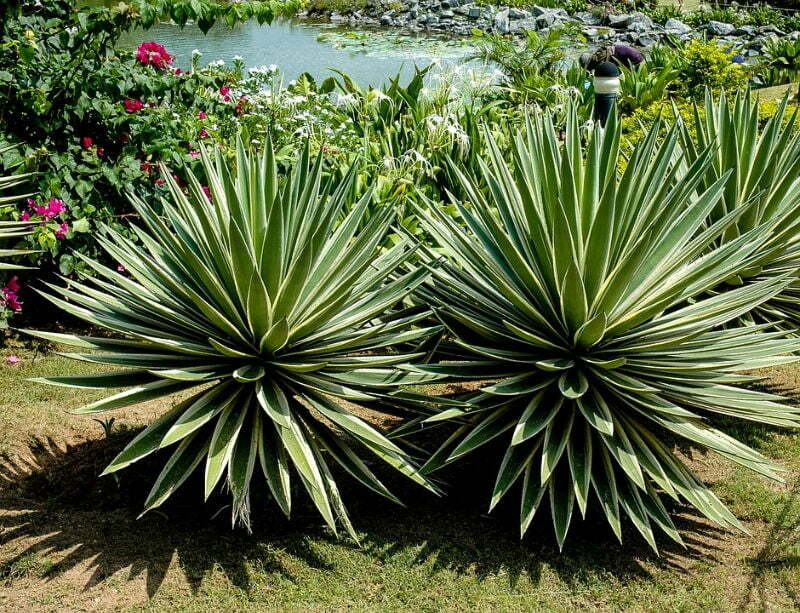
Agave (genus Agave) is a genus of over 200 species in the Asparagaceae (previously Agavaceae) family, which is endemic to dry and semiarid regions of the Americas, including Mexico and the Caribbean. The genus has a variety of economically important species, particularly those needed for the manufacturing of mescal liquors, such as tequila’s blue agave (Agave tequilana). Sisal (A. sisalana), henequen (A. fourcroydes), and cantala (A. cantala) are all high-fiber plants that could be used as bioenergy crops. Agave nectar is produced mostly by the century plant, also known as maguey (A. americana), and blue agave. A variety of species are also used as ornamentals in desert landscaping.
Where is agave made from?
Agave syrup is a sweet brown liquid made from the sap of the agave plant (a species of cactus native to Mexico). Agave is a popular sugar substitute that is now widely used as a substitute for sugar, honey, and maple syrup. After the plant’s juice has been extracted, it is filtered, boiled, and condensed into a syrup. It has a molasses-like flavor, and the darker the color, the richer the flavor.
What plant is agave made from?
Most individuals wouldn’t have known the answer to this question five years ago. Many people have been acquainted with the agave plant as a result of the increased popularity of tequila and organic sweeteners. Agave (pronounced ah-GAH-vay) is a succulent that belongs to the amaryllis (lily) family.
Agave cultivation is a seedless method. Agave farmers extract little sucker tendrils from mature agave plants and transplant them instead of seeds. These baby agave will eventually sprout a stalk-like core shoot that flowers like a lily if left to their own devices. The middle stalk is cut off before the plant can flower in agave produced for production, raising the plant’s fructose levels and allowing it to grow larger. The agave plant is harvested after six to eight years of development for tequila or agave syrup manufacture.
Where does agave come from?
Agave is a plant that grows on several continents, although it is most usually found in Mexico, where it is used to make tequila and other goods such as agave syrup and agave inulin. It grows in many parts of Mexico, particularly in the high altitudes and mineral-rich soils of the Mexican state of Jalisco. The production of blue agave, which is used to manufacture premium organic agave products, is concentrated in the state of Jalisco.
How to use agave?
In a nutshell, it’s sweetening. Organic agave syrup is a sugar alternative with a low glycemic index that works well in drinks, sauces, syrups, baking, cocktails, and more. It comes in a variety of flavors and colors, with varying degrees of flavor intensity.
All premium agave products have a smokey flavor to them. Lighter syrups have a more neutral flavor profile, whilst darker syrups have a stronger flavor profile. The lighter version is commonly utilized in direct-to-table applications such as salad dressings and mixed cocktails. The darker variety, which has a more smokey flavor, is commonly used in baking and marinades.
Because agave syrup is nearly twice as sweet as sugar, you can use it in place of sugar in cooking, baking, and other uses. Here’s how to use agave syrup in place of other sweeteners in most recipes and food applications.
How should I make agave substitutions?
- Use half as much agave syrup as brown rice syrup. Make up the difference with fluids.
- When substituting agave syrup for corn syrup, use half as much agave syrup. Make up the difference with fluids.
What are agave benefits?
Using agave syrup as a sweetener is a healthy choice. It’s organic, non-GMO verified, gluten-free, and vegan! And because it’s one-and-a-half times sweeter than sugar, you can save calories by using less of it to obtain the same sweetness levels.
Agave has a glycemic index that is substantially lower than pure sugar. Its glycemic index is less than a third of that of sugar. Agave syrup is a true sugar made from natural sources, unlike artificial (non-nutritive) sweeteners.
Where does agave naturally grow?
Tequila agave grows wild in Mexico’s states of Jalisco, Colima, Nayarit, and Aguascalientes. The plant grows best at heights of over 1,500 meters (5,000 feet) and in rich, sandy soils. Large succulents with spiky fleshy leaves, blue agave plants can grow to be over 2 metres (7 feet) tall. When blue agaves are around five years old, they produce a stalk (quiote) that can grow up to five metres (16 feet) in length and is crowned with yellow flowers. Commercial plants have their stalks removed so that the plant can focus its energy on the heart.
The greater long-nosed bat (as well as insects and hummingbirds) pollinates the flowers, which yield thousands of seeds per plant, many of which are sterile. After then, the plant dies. Planting the previously cut shoots allows the plants to reproduce, however this has resulted in a significant loss of genetic variety in cultivated blue agave.
A 50-year-old blue agave in Boston produced a 9 m (30 ft) stalk that required a hole in the greenhouse roof and flowered in the summer of 2006, despite the fact that it is rarely managed as a houseplant.
Is agave healthier than honey?
Honey comes out on top. Honey and agave nectar, on the other hand, are calorie sweeteners with little nutritional value. Honey is superior to agave nectar in the following ways:
Although agave nectar is advertised as having a low glycemic index, its high fructose level negates any potential benefits. The differences between the two aren’t large enough to merit making the switch if you don’t like honey’s taste or are a staunch vegan who doesn’t eat honey.
Finally, it’s not so much about the type of sweetener you use as it is about how much you ingest. Honey, like all other sweeteners, should be used cautiously. Excess sugar consumption can result in the following:
Added sugars such as agave syrup, corn syrup, honey, cane sugar, or brown sugar should be limited to six teaspoons (24 grams) for women and nine teaspoons (36 grams) for men per day, according to the American Heart Association.
Is tequila made from agave?
3.What is the process of making tequila? To liberate sugars for fermentation, the fructose-rich pina or heart of the agave succulent, which resembles a pineapple, is roasted or steamed. Mezcals and tequilas are both distilled spirits made from agave.
4. What method is used to gather it? A pina can grow to weigh up to 200 pounds and take up to 12 years to mature. The harvesters, known as jimadores or campesinos, will obtain a pina using a tool known as a coa de jima, which consists of a circular blade and a wooden handle. Over the course of six hours of hard labor, a well-coordinated and competent crew of jimadores can walk across a plantation and collect between three and four thousand kg of agave.
5. How can I tell if it’s tequila or not? On your bottle label, look for 100 percent agave tequila. Only bottles containing tequila without added sweeteners are eligible for this classification. A mixto tequila is made when sugar or corn syrup is added to a fermenting tank along with the agave.
6.What does it mean to be “anejo”? Expect richer, woodier, tannic notes like black tea and cocoa layered over the agave flavors when you see anejo or extra anejo stated on the bottle. These tequilas have been aged in barrels for a longer period of time.
7. What does it mean to be “reposado”? That implies it’s time to unwind. A bottle of reposado tequila is spirit that has spent two to eleven months maturing in a cask, gaining subtle vanilla, caramels, and other wood-related characteristics.
8. What does it mean to be “blanco”? According to Valencia, blanco or silver tequila is undoubtedly the most popular among enthusiasts “back home.” Blanco tequila is unaged tequila that has never been exposed to wood, resulting in the purest agave notes.
9. Yes, but where does the worm fit in? Tequila’s bottle does not include a worm. The worm, sometimes known as gusano, is linked to mezcal. A few businesses began a marketing tactic in the 1940s, attributing aphrodisiac and magical properties to the worm and the person who shot it. As you might expect, consuming the worm has no effect on desire, and premium bottles of tequila or mezcal are not marketed with worms in them.
Are agave native to Australia?
- A’mast’ (stem) up to 5m tall emerges from the plant’s center during flowering and produces many tubular, yellow blooms.
- Blue agave is pollinated by a regionally native bat (Leptonycteris nivalis) in its natural range, produces thousands of seeds per plant, and then dies.
- In Australia, agave species do not appear to generate seeds, possibly due to a lack of adequate pollinators. In Australia, agave species are thought to reproduce only by vegetative reproduction.
Is agave poisonous?
Agave is classified as slightly hazardous by the University of California Division of Agriculture and Natural Resources. It says the plant’s leaves contain oxalate crystals, which can cause severe discomfort. The needlelike crystals can irritate a sensitive person’s or pet’s mouth and throat to the point of swelling and breathing trouble. According to the Merck Veterinary Manual, agave plant leaves contain saponins and volatile oils that induce irritation and swelling. To be safe, contact a doctor, veterinarian, or poison control center if any part of the plant is chewed or eaten.
How is tequila made from agave?
Tequila is created from the Weber blue agave plant, also known as agave tequilana, a huge succulent with long, spiky leaves that resemble aloe vera. The pia bulb is found within the core of the blue agave plant. To manufacture tequila, this bulb is baked and juiced, then the juice is fermented with yeast in barrels.
Are agaves native to Arizona?
It is native to Sonora and southern Arizona. The leaf of Agave palmeri is narrower, and the flower stem is more delicate. The northernmost species, Agave utahensis, has a taller, but more compact bloom stem. Keep in mind that these plants are endangered in the wild.