
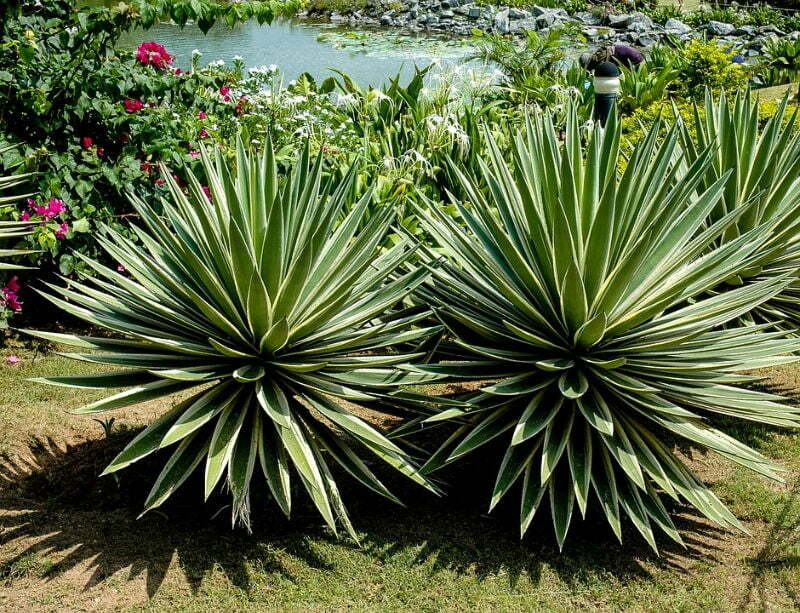
Although blue agave grows well at sea level, it favors the higher altitudes of its native region, the 4,500-foot mountains of western Mexico’s Jalisco state, where it produces its distinct flavor. Tequila created from Jalisco blue agave provides attributes that reflect where and how it was produced, similar to French wine types, and it comes with a registration number that validates its area of origin.
Blue agaves can be a dream as a landscape design element. The plants are symmetrical, drought-tolerant, slow-growing (which means less upkeep), and can thrive on slopes not to mention attractive. The most serious flaw is the spiky points, which can puncture the flesh to the bone. Similarly, the flesh’s liquid can produce skin irritations comparable to poison ivy. Gardeners should use leather gloves and wrap the leaves in cardboard when planting it.
Where do blue agave plants grow?
Tequila agave grows wild in Mexico’s states of Jalisco, Colima, Nayarit, and Aguascalientes. The plant grows best at heights of over 1,500 meters (5,000 feet) and in rich, sandy soils. Large succulents with spiky fleshy leaves, blue agave plants can grow to be over 2 metres (7 feet) tall. When blue agaves are around five years old, they produce a stalk (quiote) that can grow up to five metres (16 feet) in length and is crowned with yellow flowers. Commercial plants have their stalks removed so that the plant can focus its energy on the heart.
The greater long-nosed bat (as well as insects and hummingbirds) pollinates the flowers, which yield thousands of seeds per plant, many of which are sterile. After then, the plant dies. Planting the previously cut shoots allows the plants to reproduce, however this has resulted in a significant loss of genetic variety in cultivated blue agave.
A 50-year-old blue agave in Boston produced a 9 m (30 ft) stalk that required a hole in the greenhouse roof and flowered in the summer of 2006, despite the fact that it is rarely managed as a houseplant.
What zone does blue agave grow in?
Blue agave (Agave tequilana), sometimes known as tequila cactus, is more closely related to lilies than cacti. Only hardy in USDA planting zones 9b and 10, this sun-worshiping native Mexican thrives in the heat and despises frost. It can withstand temperatures as low as 50 degrees Fahrenheit and is robust to 25 degrees Fahrenheit. The stunning blue agave can grow to a height of 6 to 8 feet and a width of the same amount. The mature blue agave produces an edible flower stalk that grows to be over 15 feet tall, signaling the end of life. Rhizomes produce a large number of pups around and near the base of the plant before it dies.
Where does agave grow best?
Agaves thrive in the Southwest and Mediterranean climates, although they are versatile and may be planted in pots outside of their zones if winter shelter is provided.
Does blue agave grow in Texas?
Agave americana is the tallest and most stately of the native Texas agaves, reaching heights of up to 6 feet. It has gray-blue to blue-green leaves with spines at the tips and on the margins, and the elder leaves frequently curve down gracefully. The century plant can live for 10 to 25 years (the “century” is an exaggeration) before exhausting its reserves and producing a spectacular bloom stalk that can reach 15 feet in height. The primary plant dies after that, but little offshoots surrounding the base take its place. It grows in the south of Texas on dry, gravelly soils, but is naturalized and grown further north and west. A. americana, like most agaves, requires full light and well-drained soil to thrive. It is drought tolerant and grows at a somewhat sluggish rate. Supplemental water will help it grow quicker during the dry summer months, but be careful not to overwater, especially in clay soils, as too much moisture will damage the roots to rot. It can withstand temperatures as low as 20 degrees Fahrenheit and, like most agaves, is tolerant to reflected heat. Agave americana is grown in a variety of variegated forms.
Does blue agave grow in Florida?
Agave plants are incredibly easy to grow because they adore the Florida heat and are drought resistant. Plant the Blue Agave as a focal point, in a rock or succulent garden, in containers, or as a landscape accent.
Is blue agave related to pineapple?
The pia is the name given to the blue agave’s heart. And that pia is the same pia as in the pia colada! Probably because tequila is used in the pia colada. Tequila is manufactured from the heart of the blue agave plant, which resembles a pineapple.
When the plant is around a year old, the leaves are clipped to encourage the blue agave’s heart to grow larger. This permits the plant to focus its energy on increasing the size of the heart. A larger heart means more tequila will be produced. When harvested, some can weigh up to 200 pounds.
When a blue agave plant is between the ages of 8 and 14, it is harvested. If you’re making tequila from scratch, you’ll need a lot of patience!
All tequilas in Mexico are required by law to use blue agave plants, the majority of which are grown in Jalisco, Mexico. Other plants can be used, but the blue agave must account for more than half of the formula.
Tequila is a trademark owned by the Mexican government. You’ll need a license from the Mexican government if you wish to create something called tequila. They’ll also require you to adhere to their blue agave guidelines and manufacturing requirements.
Mescal is never tequila, but tequila is always mescal. Mescal can be manufactured from any type of agave plant, including blue agave.
Is blue agave poisonous?
Agave is classified as slightly hazardous by the University of California Division of Agriculture and Natural Resources. It says the plant’s leaves contain oxalate crystals, which can cause severe discomfort. The needlelike crystals can irritate a sensitive person’s or pet’s mouth and throat to the point of swelling and breathing trouble. According to the Merck Veterinary Manual, agave plant leaves contain saponins and volatile oils that induce irritation and swelling. To be safe, contact a doctor, veterinarian, or poison control center if any part of the plant is chewed or eaten.
Is agave poisonous to dogs?
When consumed, the agave (Agave spp.) plant, which grows in USDA plant hardiness zones 9 to 11, is somewhat hazardous to canines and humans. It is unlikely to kill your dog, but it will most likely cause agony and pain.
Can blue agave grow in Colorado?
This show not only drew crowds like a zoo, but it also attracted an oriole to drink from its nectar cups, as well as hundreds of bees and wasps. Hummingbirds, moths, insects, and, in some regions, bats are said to be attracted, however we didn’t spot any. Even though the flowers have lost their freshness, it is still worth a visit to view.
I asked Panayoti Kelaidis, master horticulture and head of outreach at Denver Botanic Gardens, if Agave is well-suited to Colorado weather. Some types, such as Agave parryi, A.neomexicana, and A. havardiana, thrive in the Denver-Metro-Boulder area, according to him. Other species, such as Agave lechiguilla, Agave polyanthaflora, Agave utahensis, and Agave deserti, are feasible if established in ideal conditions and in a good year. A rich, gravelly soil with some compost and a gravel mulch in full sun, especially on the south side of a rock, are among the optimal conditions, according to Panayoti. Sites that are wet or windy should be avoided. Mr. Kelaidis also mentioned that DBG has six Agaves in bloom this year, with three different kinds. Plants produced from seed obtained in cold-winter places have the best chance of succeeding in this climate.
Agaves, like cactus, may appear to require no additional water, but this is not the case. In nature, Agaves often receive summer monsoon rain in the late summer, according to Nold, who recommends a little summer irrigation. He also says that while dry clay is fine, a layer of leaves or other organic materials is usually lethal.
Jim Knopf, a landscape architect and xeriscape mentor in Boulder, said he has cultivated numerous types but none have yet blossomed. He believes that a warmer location is desirable, as is a winter snow cover that melts away. His research backs up my idea that last winter’s unexpected below-freezing cold snap injured some plants and jolted my (and others) into blooming in order to reproduce. Mr. Knopf stated that he has been growing Agave lechiguilla (also known as Shin Dagger) for ten years and has been trying to dig it out for the past two years. Agaves reproduce not only from seed, but also from “pups” that emerge from the root in a perilous manner, their jagged spine leading the way. This is significant for the Agave since the primary rosette will die after the long wait and stunning bloom.
Even without the lovely flowers, the Agave’s evergreen rosette is a beautiful architectural feature in a Colorado garden, particularly in the winter. As the rosette unfolds from the center, it’s amazing to see the impressions of the adjoining pads. Although this plant should not be grown near children, it is a treat and a surprise in the xeriscape landscape.
The book High and Dry by Robert Nold contains more information on Agaves. Timberline Gardens, Harlequin’s Gardens, and Paulino’s all have hardy plant species.