
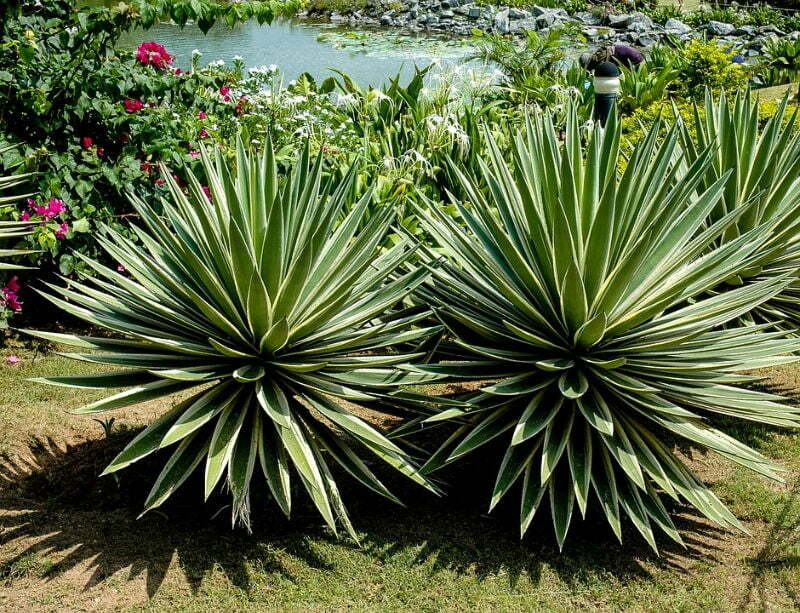
Agave syrup (also known as agave nectar) is a sweetener made from agave plants, including Agave tequilana (also known as Blue Agave or Tequila Agave) and the Salmiana, Green, Grey, Thorny, and Rainbow types. Agave syrup is less viscous and sweeter than honey.
According to Mexican rules governing certificate of origin, agave syrup is produced in the Mexican states of Jalisco, Michoacán, Guanajuato, and Tamaulipas, while the majority is produced in Jalisco.
Agave Salmiana:
Agave nectar is a natural sweetener derived from the agave salmiana’s natural juice (aguamiel). It’s gathered from live plants in Central Mexico’s high desert, where there’s a plenty of them growing wild. Hnahnu Indians who live in this area harvest it by hand from plants on their territory. A flower stalk is produced by mature agave plants. By removing the flower, a bowl-shaped hollow is created, which serves as a receptacle for the aquamiel to be secreted. This liquid is produced by the plant for 6-8 months, during which time up to 8 quarts of it is withdrawn twice daily. The aguamiel is siphoned off the plant and transferred to a container using a hollowed-out gourd. The aquamiel is immediately taken to the production plant when it is gathered. An organic, vegan, grain-free enzyme is introduced there, which converts the naturally occurring sugar molecule chains into more simple sugars, namely fructose or “fruit sugar” and a minor quantity of glucose. Water that isn’t needed gets evaporated.
Blue Agave:
Organic Blue Agave nectars are manufactured exclusively from the famed Blue Agave plant of Central Mexico. Thousands of acres of Jalisco’s subtropical region are shaped by blue agave, which adds color and character to the environment. The Amaryllis family’s blue agave (Agave tequilana var. Weber) is a slow-growing plant that distributes runners from a’mother’ plant. The runners are then picked and replanted, with some being used to make blue agave nectar (or tequila) and others becoming new mother plants. The agave is farmed and processed without the use of pesticides or genetic alteration, according to USDA Organic Standards.
A mature blue agave rises many feet tall after 5 to 7 years of growth, and its carbs are concentrated in the plant’s core. The treasure of the blue agaves is kept in the pina (so called because it resembles a pineapple after the leaves have been trimmed away). The blue agave’s long leaves contain wax, which gives the cactus its bluish appearance.
Farmers used a simple razor-sharp blade to cut the blue agave by hand. (It takes an experienced farmer less than 5 minutes to cut and trim a 100-pound blue agave pina.) Field cuttings are left in place to help replenish soil and prevent erosion.
The fibrous blue agave pina is carried to the mill and pressed, after which the inulin-rich juice is collected and cleaned.
By its very nature, inulin, a dietary fiber made up of complex carbs, is not sweet. When inulin is cooked (or hydrolyzed), it becomes pleasant nectar. The juice is heated to 161°F* (72°C) while creating the Light Blue Agave nectar. The Raw Blue Agave nectar, on the other hand, is made using a lower and slower process: the juice is warmed to a tepid 118°F (37°C) and kept at that temperature for nearly twice as long. The inulin is converted to fructose, a slow-metabolizing simple sugar found in many fruits and vegetables, through this simple process. The flavor and color of blue agave nectar are determined through filtering. The Light Blue Agave is just filtered more than the Raw-Amber Agave.
* The fact that Light Blue Agave is hydrolyzed at 161°F, the same temperature at which milk is pasteurized, is completely coincidental. The goal of heating the liquid inulin from the agave is to convert it to fructose, not to pasteurize it.
Composition
Agave nectar is a flexible sweetener that may be used in a variety of ways. It’s also certified organic and kosher, gluten- and allergen-free, and has a low Glycemic Index of 32. This is crucial since many people are concerned about their glucose intake. The major carbohydrate is inulin or fructosan, a complex type of fructose. The filtered, hydrolyzed juice is condensed into a syrup-like liquid that is somewhat thinner than honey and varies in color from light to dark depending on the amount of processing. The syrup contains natural amounts of Iron, Calcium, Potassium, and Magnesium, which contribute to the color. A procedure that uses enzymes to hydrolyze the polyfructose extract into fructose, using an enzyme derived from Aspergillus niger, is patented in the United States (black mold).
Culinary use
- Due to the moisture in the syrup, the amount of liquids in the original recipe must be lowered.
- In baking recipes, some cooks lower the oven temperature by 25 degrees Fahrenheit.
- Agave syrup is frequently substituted for honey in vegan recipes. It’s also a great way to sweeten cold drinks like iced tea since, unlike sugar and honey, it dissolves quickly in cold liquids.
Varieties
Light agave nectar has a moderate, almost neutral flavor that makes it ideal for delicate desserts, baked items, sauces, and drinks.
Amber agave nectar has a medium caramel flavor and can be used in a variety of desserts, sauces, and savory foods. It’s a fantastic “straight from the bottle” syrup.
Dark agave nectar contains richer caramel undertones and adds a unique flavor to a variety of sweets. It’s best served with chicken, beef, and seafood, and it’s also delicious on pancakes and waffles.
Agave nectar in its raw form has a mild, neutral flavor. To protect the natural enzymes, it is produced at temperatures below 118°F, making it an ideal sweetener for raw foodists and the health conscious.
The difference is due to the controlled filtering of salts and minerals in the manufacturing process, which results in a consistent product.
Raw Organic Agave Nectar has a pleasant neutral flavor and is prepared at temperatures below 115°F.
The lighter Agave Nectar grades are flavor neutral, complementing the natural flavors of coffee, tea, fruit beverages, baked goods, fresh fruits, fruit smoothies, salad dressings, jams and jellies, ice cream, yoghurts, and other prepared meals without changing their flavor. In contrast, bee honey, malt barley syrup, and a few other natural sugar replacements affect the flavor of the food they sweeten.
The subtle Agave flavor becomes more intense as the amber and black grades go. The amber grade sweetens a wide range of dishes, including dry and hot cereals, pancakes, waffles, baked goods, protein drinks, and sauces, and tastes similar to honey.
The darker grades of this sweetener, which give the rich and nuanced flavors unique to Agave, may be accentuated by heavier sauces such as BBQ, spaghetti, stews, and meat glazes. To enhance the color and flavor of the amber, a small amount of classic dark agave is added.
Agave will keep for more than a year if not opened. The color and consistency stay consistent, and it should be kept well-sealed in a cool, dark location.
No, Agave is best kept at room temperature, and once opened, it will last at least 12 months.
Q. What is Organic Blue Agave Nectar?
Agave nectar is a delectable liquid sweetener derived from the blue agave plant’s core.
Florida Crystals Organic Blue Agave Nectar is manufactured from organically cultivated Agave azul, often known as Blue Agave, which is known for producing the highest quality agave nectar for sweetening.
Q. What is the difference between the Light Agave and the Amber Agave?
Amber Agave has a deeper flavor and a somewhat thicker viscosity than green Agave. Because light agave isn’t heated as much as regular agave, it’s a flavorless sweetener. Amber Agave takes a little longer to process, giving it a deeper hue and a richer flavor. When you first melt sugar, it is clear, but as it caramelizes, it becomes darker and thicker, similar to caramelizing sugar.
Q. Is agave nectar suitable for baking?
Yes, the sweetness of Florida Crystals Organic Light Agave Nectar or Amber is ideal for baking and cooking. Because agave nectar is a liquid, it will readily blend into your favorite recipes.
Baked products with a thicker texture, such as brownies, muffins, heavier cakes, and bar cookies, will yield the greatest results.
Q. How do I substitute agave nectar for the sugar in my recipe?
Agave nectar is a liquid sweetener that may be used to sweeten baked items in the same way that sugar can, but it lacks some of the qualities of sugar. The agave recipe adaptations shown below are recommended:
- Reduce other liquids by 1/4 cup to 1/3 cup; 2/3 cup Light Agave Nectar equals 1 cup Granulated Sugar.
- Reduce other liquids by 1/4 cup and use 2/3 cup Amber Agave Nectar instead of 1 cup Brown Sugar.
If the recipe does not call for any additional liquids, increase the flour by 1/4 to 1/3 cup to absorb the extra liquid from the agave nectar. Assemble any solid components, like as butter, and make sure the agave nectar is at room temperature. Also, if other ingredients, such as chocolate chips, are sweetening the recipe, you may want to use somewhat less agave in such recipes. When using agave in classic baking recipes, softened butter should be whipped first, then the agave should be poured in and mixed. After that, you’d add the eggs.
Because agave nectar has different characteristics than granulated sugar, some baked goods may brown faster. Reduce the oven temperature by 25 degrees Fahrenheit and lengthen the baking time by a few minutes. It’s also worth noting that agave nectar-based cookie recipes don’t bake as crisply as sugar-based cookie recipes. They’ll have a cake-like texture, but they’ll be wonderful!
Q. Will substituting agave nectar work in all recipes?
Yes, although some of your completed baked foods may have minor variances. Cookies, for example, will have a cake-like texture.
Q. What recipes will Light Agave work best with?
Light Agave can be used to make light-colored sweets. Vanilla cake, muffins, and cheesecake are all delicious with it. It’s also a great addition to coffee, iced and hot teas, fruit, smoothies, and mixed drinks as a daily sweetener.
Q. What recipes will Amber (Dark) Agave work best with?
Amber Agave has a strong flavor, therefore it’s best used in darker-colored recipes like chocolate cake, brownies, and cookies. Desserts can also benefit from a combination of Light and Dark Agave.
Amber Agave can also be used to make sauces and salad dressings, as well as pouring over pancakes and oatmeal.
Q. Do I cream the agave nectar with the butter and eggs just like I do when using sugar?
Agave nectar does not cream like sugar because it is a liquid. To include agave nectar into a recipe, whisk softened butter first, then pour in the agave and combine thoroughly before adding the eggs.
Q. Can I use agave nectar for candy making?
When creating candy, agave nectar will not work. Before reaching the high temperatures required for conventional candy, agave nectar will burn. When making candy, it’s ideal to use granulated sugar.
Q. Is your agave nectar made from “Blue Agave”?
Yes, it’s derived from the Weber Blue Agave. Agave nectar can be made from a variety of agave plants, but blue agave plants are a special breed that produces high-quality nectar.
Q. Why is your agave nectar sold by weight and not by volume?
Agave nectar, like honey, has a varied consistency that fluctuates with temperature. Because the volume of agave nectar varies with temperature, the most accurate approach to quantify it is by net weight. Organic Blue Agave Nectar from Florida Crystals comes in 23.5 oz. and 11.75 oz. net weight bottles. Keep in mind that they are weighted ounces, not fluid ounces. Each 23.5 oz. bottle has 16 FL OZ, whereas each 11.75 oz. bottle contains 8 FL OZ.
Q. Does agave nectar have an expiration date?
Yes, it’ll be two years from the time it’s packed. You can use the code date to determine when your individual agave nectar bottle was packed. On one side of the bottle, the number will be printed.
The first letter of the code date is the facility where the product was packaged. The year is the second number. The third number represents the week of that year, while the fourth number represents the day of the week.
Q. What is the difference between raw agave and your product?
We can’t call the agave nectar “raw” since we heat it to pasteurize it. Heating is another method for ensuring consistency and quality.
Q. What is the process used with agave?
We heat our agave nectar goods to pasteurize them. We chose to pasteurize it as a measure of food safety and to extend the shelf life of our products because it is an imported product. Heating is another method for ensuring consistency and quality.
Q. How does agave nectar compare to sugar in calories?
Agave nectar has a little greater calorie count than sugar, but because you use less agave nectar to sweeten than sugar, you end up with the same or fewer calories.
Q. What does it mean that agave nectar has a “low glycemic index”?
The “Glycemic Index,” or “GI,” is a metric for how carbohydrates affect blood sugar levels. Carbohydrates with a high GI break down quickly during digestion and release glucose immediately into the bloodstream; carbohydrates with a low GI break down slowly and release glucose gradually into the system. The glycemic index of Florida Crystals Organic Blue Agave Nectar is in the low 20s.
Q. Can people with diabetes use agave nectar?
Traditional sugar has a higher glycemic index than agave nectar. It is absorbed more slowly into the bloodstream, resulting in a slower release of glucose. Before introducing this or any other new product to your diet, we recommend consulting with your doctor.
Q. Can I use agave nectar in place of sugar when making jams and jellies?
A. You certainly can. Simply substitute the sugar with the equivalent amount of Agave Nectar. As the jam or jelly cools, it will thicken.
Q. Will agave nectar work if I am making jam or jelly that calls for storing in the refrigerator?
A. Yes, Agave Nectar may be used in jam or jelly recipes just like sugar, thus it’s fine to keep it in the fridge.
Is raw blue agave better?
Even without a tinge of sweetness, certain dishes are perfectly excellent. It can be disappointing if your pastries, puddings, milkshakes, and smoothies don’t thrill your sweet taste buds at all. People are already transitioning to a healthier sweetener that is 100 percent natural and doesn’t have the negative effects of sugar or other commercially produced sweeteners like maple syrup and honey as a result of increased concern about sugar’s adverse impacts. The all-natural agave nectar has arrived! It’s made from raw blue agave plants that are native to Mexico and are organic. Despite its sweetness, agave nectar is healthier than sugar since it has a lower glycemic index and has less calories.
A bottle of agave nectar may resemble honey, but guess what? When you purchase agave nectar or syrup, you are purchasing a bottle of healthy bliss! There are no additives or high fructose corn syrup in 100% pure agave nectar (HFCS). As a result, rather than adding sugar to your regular meals, agave nectar can be used to achieve the same sweetness in your morning tea/coffee and everyday foods.
Agave nectar, on the other hand, comes in three various colors. In this article, we’ll look at the distinctions between:
- The color of raw agave nectar is similar to that of toasted brown sugar and molasses. The delicate flavor of Agave is present in abundance in the darker colours of agave nectar. It’s made at temperatures below 115 degrees Fahrenheit most of the time. The flavor of this sort of agave nectar is sweet and neutral.
To make raw agave nectar, a special technique is used in which the liquid is harvested from the blue agave plant. This liquid is then heated for a longer amount of time at a much lower temperature. Raw agave nectar receives its rich, dark hue and full-bodied flavor as a result of this process. It tastes best in hot and cold beverages, baked foods, dry and hot cereals, and sauces, among other things.
- Light agave nectar: Are you looking for agave nectar that tastes rich but has a distinct flavor that sets it apart from other sweeteners? Give light agave nectar (amber) a try! It’s rich, and you’ll wonder why you’re suddenly tasting caramel and butterscotch when you pour it over your favorite pancakes, yogurt, or pies! That’s the light agave nectar’s specialty, as we’ve hinted.
The lighter grades are made from organic raw blue agave plants and are best utilized to enhance the flavor of other foods. Fruit beverages, smoothies, tea, coffee, jams, jellies, yogurts, and salad dressings can all be made with it without changing the flavors. If you use honey, maple syrup, or malted barley syrup, your smoothies, fruit drinks, and yogurts will be particularly sweet.
- Amber agave nectar: Along with light agave nectar, amber agave nectar is a popular sweetener, not only because of its color but also because of its distinct flavor. The vanilla smell of the amber agave nectar distinguishes it. The faint caramel flavor is what makes this agave nectar variant pleasant, despite the fact that it tastes like maple syrup. The amber agave nectar’s production technique allows it to keep its color, minerals, and flavor. In comparison to other agave syrups, amber agave nectar is primarily suggested for diabetics since it has the lowest glycemic index. Waffles, pancakes, tea, marinated sauces, spaghetti, and meat glazes are just a few of the foods and beverages that this agave type pairs nicely with.
Where Agave Comes From
Agave nectar and blue agave nectar are both made from the agave plant, a succulent that grows all over the world in hot, dry climates. Each variety of nectar, however, comes from a different agave plant species.
Agave nectars aren’t all created equal. Because they obtain their agave from numerous sellers, many agave growers employ a mixture of agave varietals. This makes it more difficult for them to ensure that their product is of high quality. Agave that is developed, grown, and harvested exclusively for the tequila business is known as blue agave. This plant produces a premium agave nectar that contains more fructose and has a lower glycemic index than nectar from mixed agave.
Mexican Regulations for Agave Production
When you buy blue agave nectar, you’re guaranteed a high-quality product because the Mexican government has established tight requirements for the product of agave nectar made from blue agave plants. To acquire the blue agave nectar appellation, all blue agave nectar must contain at least 80% fructose, according to Mexican regulations. It can’t be blended with other sugars, and it has to be prepared entirely with blue agave. The greatest focus in the manufacturing of blue agave nectar is product purity and quality. In the case of mixed-source agave nectar, however, such quality criteria may not be adhered to as strictly.
Blue Agave Characteristics
Blue agave nectar has a lower glycemic index and is 1.5 times sweeter than sugar. While all blue agave nectar variations have a mild smokey aftertaste, lighter agave species have a more balanced flavor profile. They’re commonly employed in direct-to-consumer applications such as beverage sweetening and salad dressing. Darker agave varieties offer a more unique flavor character and are more commonly utilized in baking.
Tierra Group Blue Agave Nectar
In the creation of our luxury products, we also adhere to rigorous social responsibility requirements. At our workplace, we have medical facilities and care for all of our employees. In addition, we support local sports teams, nursing homes, youth initiatives, and government activities in the city where our manufacturing is located.
We feel that rewarding our employees pushes them to do their best work. A great product is ensured by exceptional work. And happy customers are ensured by a superb product.
What’s the difference between raw blue agave and blue agave?
Consumers are always forced to turn to natural sweeteners due to the negative health effects of added sugar. Agave is one of the most widely used natural sweeteners on the planet. Agaves are divided into two types: ordinary agave and blue agave. These sweeteners are mostly utilized in the confectionery industry as a food additive. Agave is primarily sourced from plants. It is a sweetener made commercially from numerous agave species, including Agave tequilana and Agave salmiana. The fundamental distinction between Agave and Blue Agave is that blue agave is only found in the Blue Agave plant (Agave tequilana). Agave nectar is made from a variety of agave plants, including Grey, Green, and Thorny Agave.
Is raw agave really raw?
The growing popularity of natural sweeteners has sparked some interesting debates about the health advantages of plant-based sweeteners like agave. Consumers will have a greater chance of picking natural products that suit their diet and nutritional needs if they are more informed about what is going on in the sector.
Agave is a desert plant with a sweetening juice that can be gathered and consumed. This product, often known as agave nectar or syrup, can be utilized in a variety of food and beverage recipes. Wholesalers now offer it to both restaurant kitchens and ordinary houses through supermarkets.
Raw agave syrup refers to agave syrup that has not been treated and is offered as a plant extract. These products are popular in the “raw food community,” where “raw food eaters” limit their diet to foods that have not been industrially processed or heated over a specific temperature. Raw food consumers refer to a wide range of vitamins and nutrients that, according to nutritionists, are frequently removed from meals during normal processing.
There are some heated debates within the raw food movement and outside over what constitutes industrial processing and how it affects agave nectar and syrup.
Raw foodists point out that heating agave syrup for several hours is a common industrial practice, partly to affect the chemical process of some specific elements known as “fructosans.” According to agave syrup detractors, these carbohydrate products are “hydrolyzed,” which sweetens the solution by breaking down the components into fructose sugars.
The abundance of fructose constituents in processed agave syrups has raised some worries regarding the effects of a high-fructose diet on the body. Some people are referring to the now-common use of high-fructose corn syrup (HFCS) or
What does raw agave taste like?
Agave is defined as having a honey-like flavor and being much sweeter than sugar. Darker agave nectars have a maple syrup-like flavor, whereas lighter agave nectars are more mild. The nectar is made from the juice of the agave plant, which is also the source of tequila. Agave syrup is used in many pubs and restaurants to make cocktails, and these modern concoctions are far more complicated and interesting than classic margaritas.