
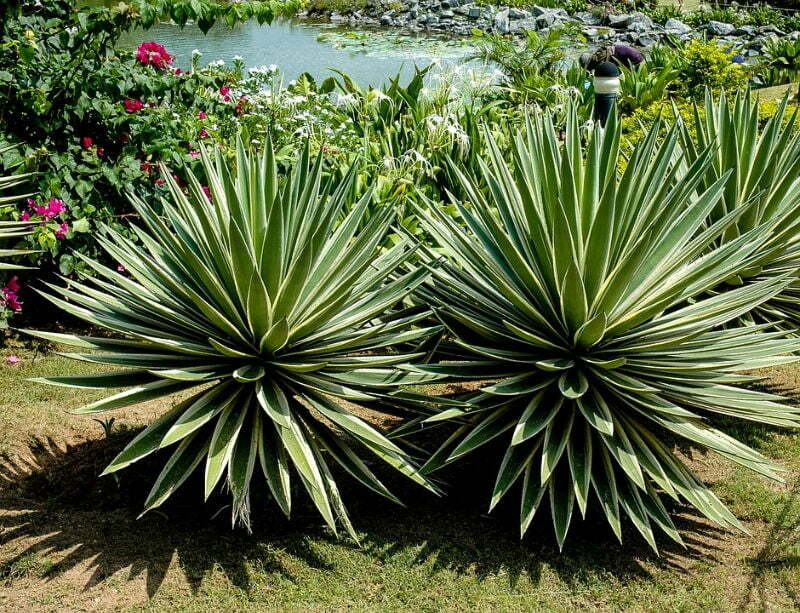
With similar appearances, it’s easy to understand how identifying an Agave from an Aloe Vera plant, or any kind of Aloe for that matter, can be difficult. This post will teach you the differences between Agave and Aloe Vera so you can identify them differently and care for both plants.
Agave vs. Aloe Vera: Agave leaves contain sharp spines and are often larger, whilst Aloe Vera leaves are serrated but not sharp. Aloe Vera leaves are thick, meaty, and loaded with transparent gel, whereas agave leaves are fibrous. They come from diverse places and have distinct life cycles, but they all require the same level of care.
Continue reading to learn more about the differences and similarities between Agave and Aloe Vera plants.
Can you use Agave like aloe?
While they both require comparable growing conditions and care (drought tolerant and prefer full light), aloe and agave have significant internal distinctions that are vital to understand in specific scenarios.
Aloe vera plants, for example, produce a therapeutic liquid that can be used to burns and other mild skin irritations. We wouldn’t recommend attempting to remove this off an agave. Despite their similar appearances, agaves are used to manufacture rope from their fibrous leaves, whilst aloes have a gel-like material inside.
Aloe juice can be ingested in a variety of ways, but don’t confuse it with agave, as one woman discovered the hard way after eating a leaf from an American agave and mistaking it for aloe. Her throat became numb, and she had to pump her stomach. She was able to recover from the deadly plant, but it was a terrible and risky mistake. Another reason to understand the distinction between aloe and agave.
Other differences between aloe and agave include their origins. Aloe originated in the Saudi Arabia Peninsula and Madagascar, from which it spread and evolved throughout the Mediterranean region. Some species developed into winter growers, whereas others developed into summer growers. Some aloes grow throughout both seasons, which is unusual.
Is tequila made of aloe vera?
Contrary to popular perception, true tequila is manufactured from the juice of the blue agave plant, which is native to Mexico. Nonetheless, connoisseurs of home-brewed booze have discovered a way out. They devised a scheme to employ a plant that is chemically related to blue agave. This plant is aloe vera, as it turns out. To manufacture homemade tequila, all you need are a few leaves of aloe vera grown in a flowerpot.
Warning: The suggested tequila recipe only simulates the taste of tequila and does not allow for the production of actual tequila. Most people can’t tell the difference between this vodka aloe infusion and actual tequila when they taste it. However, there is a taste difference.
Theory. Agave includes a unique fructan (a fructose polymer) called inulin. It turns to ethanol with an unique herbal flavor and scent after fermentation. By infusing vodka with inulin-rich botanicals, tequila-like beverages can be created.
Inulin is abundant in Jerusalem artichoke, chickory, aloe, banana, onion, and garlic. The difficulty is that most of these plants have a lingering odor, making them unsuitable for making homemade tequila. Aloe is the only way to get acceptable outcomes.
- Seal the container and give it a good shake. After that, hide in a cold, dark area for 14-17 days. During the infusion process, your homemade tequila will turn green, then golden.
- Filter the infusion through a cotton wool filter and store it in a bottle for 1-2 days to infuse.
- Tequila will remain golden after filtration (sometimes with a green shade). If you don’t want to do that, keep the tequila in a well-lit area for 20-30 days. When chlorophyll is exposed to sunshine, it dissolves, making the liquid transparent.
Another option for clarifying the beverage is to dilute the obtained infusion in a 1:1 ratio with water and distill it in a distillation still. However, this reduces the flavor of homemade tequila.
Is my plant aloe or agave?
The leaves of Aloe are often broader and fleshier than those of Agave. The texture of their leaves may be softer and nearly spongy. The gel contained within the leaves can practically be felt.
The leaves of an Agave plant, on the other hand, are often thinner and more fibrous. An Agave leaf does not yield to finger pressure in the same manner that an Aloe leaf does. Agave strands are so fibrous that they are utilized to manufacture outdoor mats in some types.
If you’re still not sure if a plant is an Aloe or an Agave, try breaking off a bit of the leaf. If it’s an Aloe, the leaf will readily break off and the gel within will be visible and feelable. Agave leaves are more difficult to break, necessitating the employment of shears to remove a portion of the leaf.
The spines that run along the leaf margins are another distinguishing feature of the leaves. The spines on an Aloe plant are visible, but they have a gentler appearance. You should be able to run your finger along the leaf’s edge without much discomfort. The spines may irritate you a little, but they aren’t harmful. The spines of an Agave are sharper and could injure you, so handle the leaf with care.
What plant is similar to aloe vera?
Agave, yucca, haworthia, gasteria, and maguey are all plants that resemble aloe vera. The stems of these succulents are surrounded by rosette leaves, some of which have spines on the edges. These plants can be grown indoors as an alternative to aloe because they have comparable growing requirements.
Is tequila good for your health?
Early study suggests that chemicals found in agave, the basic material used to make tequila, may have health benefits. However, no human research have found a link between tequila and any favorable health effects to date.
Tequila may be a healthier option than other types of alcohol, even if it does not have any health benefits.
Myths regarding tequila’s potential health benefits, health benefits linked with agave components, tequila’s healthful features compared to other types of alcohol, and the potential health benefits and risks of alcohol usage are discussed in this article.
Is agave poisonous?
Agave is classified as slightly hazardous by the University of California Division of Agriculture and Natural Resources. It says the plant’s leaves contain oxalate crystals, which can cause severe discomfort. The needlelike crystals can irritate a sensitive person’s or pet’s mouth and throat to the point of swelling and breathing trouble. According to the Merck Veterinary Manual, agave plant leaves contain saponins and volatile oils that induce irritation and swelling. To be safe, contact a doctor, veterinarian, or poison control center if any part of the plant is chewed or eaten.
Which part of aloe vera is used?
Aloe vera is a cactus-like plant that thrives in hot, dry environments. Aloe is grown in Florida, Texas, and Arizona in the United States. Aloe produces two compounds that are utilized in medicine: gel and latex. The clear, jelly-like material found in the interior section of the aloe plant leaf is known as aloe gel. Aloe latex is yellow and emanates from just beneath the plant’s skin. Some aloe products contain both gel and latex since they are manufactured from the full crushed leaf. The aloe referenced in the Bible is a different kind of aromatic wood used for incense.
Aloe-based treatments can be taken orally or administered topically. Weight loss, diabetes, hepatitis, inflammatory bowel disease, osteoarthritis, stomach ulcers, asthma, radiation-related skin sores, fever, itching, and inflammation, as well as as a general tonic, are among conditions that aloe gel is used for. For HIV/AIDS, acemannan, a substance found in aloe, is given by mouth. High cholesterol is treated using aloe extract.
Aloe latex is mostly used as a laxative to relieve constipation. Seizures, asthma, colds, bleeding, menstrual irregularities, colon swelling (colitis), depression, diabetes, glaucoma, multiple sclerosis, hemorrhoids, varicose veins, joint inflammation, osteoarthritis, and vision issues are among the disorders for which it is prescribed. For cancer, fresh aloe leaves are administered by mouth.
Aloe gel is used to treat acne, lichen planus, inflammation in the mouth, burning mouth, radiation-induced skin damage, dental plaque, diaper rash, frostbite, gum disease, bedsores, scabies, dandruff, wound healing, internal hemorrhoids and pain after surgery to remove internal hemorrhoids, osteoarthritis, inflammation, and as an antiseptic. For genital herpes, scaly and itchy skin, burns, sunburns, and dry skin, aloe extract and aloe gel are used. As an insect repellent, aloe extract is applied to the skin. For anal fissures, aloe leaf juice is administered to the skin. Dry sockets in the mouth and canker sores are treated with acemannan, a substance found in aloe.
How does it work?
The gel and latex of aloe are the most beneficial elements of the plant. The latex is derived from the cells just beneath the leaf epidermis, while the gel is obtained from the cells in the leaf’s center.
Aloe gel may create changes in the skin that may aid in the treatment of disorders such as psoriasis.
Aloe appears to have the ability to accelerate wound healing by boosting blood circulation and preventing cell death around a wound.
Aloe gel also appears to have characteristics that make it hazardous to certain germs and fungi.
What is the common name of aloe vera?
Plant. Aloe barbadensis miller is the botanical name for Aloe vera. It is a perennial, xerophytic, succulent, shrubby or arborescent, perennial, xerophytic, pea-green hue plant that belongs to the Asphodelaceae (Liliaceae) family. It is primarily found in drier areas of Africa, Asia, Europe, and North America.
What is aloe vera used to treat?
The clear gel of aloe vera is mostly used topically in creams and ointments to treat burns, psoriasis, and acne. Some people consume the gel orally to cure specific ailments. Constipation has been treated with aloe latex, a laxative.