
First and foremost, DO NOT FREAK OUT. This afternoon, don’t work yourself into into a frenzy trying to cover every plant in your garden. Instead, concentrate your efforts on a few key areas in order to safeguard the plants that will benefit the most. Here’s our priority list for cold-prep:
PRE-FREEZE
Because the roots aren’t sheltered underground, anything grown in a container above ground is more vulnerable to frost. Protect your container gardens by taking the following steps:
1.Store any light-weight containers, window boxes, or hanging baskets in a garage or carport, or at the at least, close to the base of the home or under the eaves.
This will keep you safe from strong frost and drying winds.
2.Use frost fabric that reaches all the way to the ground to cover container gardens.
To keep the fabric from blowing away, use bricks or heavy-duty landscape staples.
To protect the exposed roots of the plants, the frost cloth must reach all the way to the ground.
The frost sheet will also trap any remaining heat rising from the sun-warmed ground, further protecting the plants’ roots from the freezing temperatures overnight.
3.Mound fallen leaves, mulch, or straw at the base of the pots if you don’t have enough frost cloth for all of them.
Anything you can do to create a barrier between the roots and the chilly air will be beneficial.
4.Plants that are still in their nursery pots are subject to the same protection measures that apply to container gardens.
Cover with frost cloth or mulch and group them near together in a shaded area.
Before covering, turn evergreen plants on their sides to shield their foliage from the wind.
Refrain from bringing these plants inside.
It’s acceptable to store them in an unheated garage, but they don’t want to spend the winter next to a raging fire in your living room.
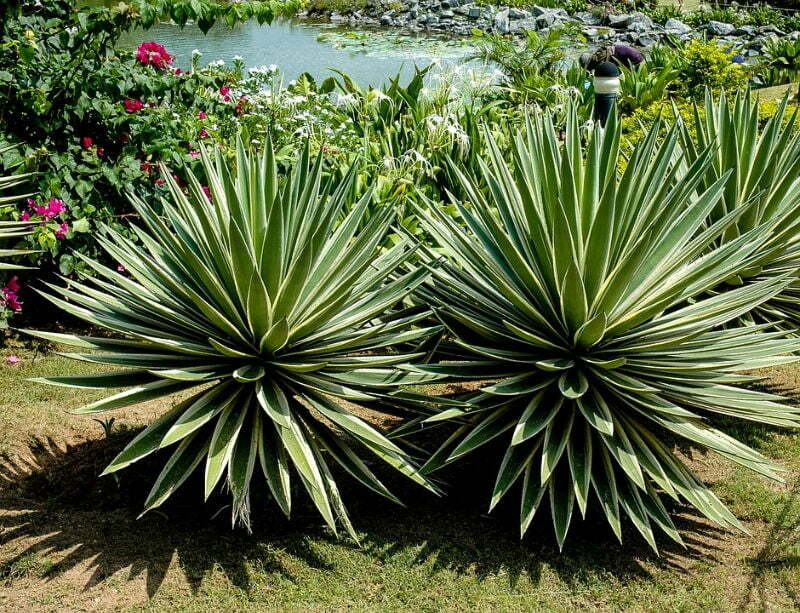
Succulents like yucca, sempervivum (hens-and-chicks), and sedum (stonecrop) are cold hardy and will not be affected by the cold.
A few of agave species can also withstand cold temperatures admirably.
If you have some of the more vulnerable species, such as Agave americana (Century Plant), you should absolutely safeguard them.
To thoroughly cover the agave from its spines to the ground, use frost cloth, bubble wrap, a plastic sheet, or even a large cardboard box.
To protect the covering from blowing away, anchor it with something hefty.
Are you unsure if the agave species you have is cold tolerant?
It should be covered.
Even the hardiest types will benefit from some extra protection from the rain and high temperatures.
In an intense cold snap like the one we’re about to have, newly planted herbaceous perennials – that is, perennials that die back to the ground or to a small cluster of leaves at the crown of the plant – will require extra protection.
Mulch is the finest form of defense.
Nuggets, shredded bark, pine straw, or fallen leaves are all good options.
Apply a heavy coat of paint to all of the plants.
You can even mound it over the basal leaves at the crown of the plant if you’re in a hurry, as long as you remember to rake it back once the temperatures warm up again.
The most crucial thing is to insulate the newly planted perennials’ weak roots from the cold.
Cover any freshly planted perennials with frost cloth if you can’t mulch, or if they’re in a rock garden or another place where organic mulch isn’t utilized. Be sure to secure the cloth so it doesn’t blow away.
During this cold spell, woody plants (trees, shrubs, conifers, and any perennials with thick, woody stems) will be alright.
They’ll be fine if you cover them with a thick layer of mulch.
Deep watering before a freeze is advantageous in two ways: it gives valuable moisture that the plants won’t have if the earth freezes solid for an extended period of time; and it helps elevate the ambient air temperature immediately surrounding the plant through evaporation.
This guideline applies to both in-ground and potted plants.
Succulents are the only exception.
During the winter, keep them as dry as possible and protect them from snow and ice with a large cardboard box or other covering.
When it comes to watering, use your best judgment.
Unless you have container gardens that aren’t exposed to the rain, you won’t need to supplement water if a lot of rain is forecast.
So that your garden hoses don’t freeze and explode, remember to unplug and empty them.
To prevent pipes from freezing, drain outside irrigation lines and leave exposed spigots leaking.
POST-FREEZE
It’s fine to leave it in place for days (or weeks) if the temperature does not increase above 50 degrees. Once temps reach the 50s, remove the cloth to allow the plants to acclimatize to the cold and avoid becoming too comfortable in their improvised greenhouses.
If your plants are frozen, resist the desire to prune them.
Allow time for the plants to defrost before assessing any damage.
It’s also a good rule of thumb to put off trimming any cold-damaged sections until April.
Can agave survive a freeze?
Because agave plants aren’t frost-sensitive, frost damage isn’t normally an issue; yet, freezing temperatures might cause damage. When the temperature dips below 20 degrees Fahrenheit, agave americana, for example, might suffer freeze damage. According to the University of Florida IFAS Extension, freeze damage causes cracks, blotches, and wet-looking spots on the fleshy leaves, which eventually turn brown.
How do you protect agave in the winter?
1. Select a suitable place with consideration. Northern exposures, low places, and spaces below roof drainage should all be avoided.
2. Provide wind protection for plants. Plant agaves near a dense wind break or cover firmly for the winter where high wind is usual.
3. Plant agaves near huge rocks, which absorb heat during the day and slowly release it at night.
4. Plant in an area with enough of drainage. Fill a hole the same size as the root system with an equal blend of soil and pumice or gravel. Overfill the hole to form a tiny mound, then plant the agave on top of it.
5. Protect plants from the elements throughout the winter. Make a plant-covering frame out of wood or other readily available materials. Staple plastic to the frame or cover it with a sheet and secure it tightly. During the winter, leave the frame up. Make sure the plastic does not come into contact with the plants. Snow can shelter plants like a blanket, but it has a cost: the consequences of melting and a cool spring can be more harmful than the cold. Cold-tender agaves benefit from any type of overhead protection, whether from a tree, port overhand, blanket, or cardboard box, even in practically tropical climates.
How cold can agave tolerate?
It forms medium-sized rosettes with blue-gray leaves and grows slowly. In hot areas, it will tolerate mild shade and is cold hardy to -20°F.
What do you cover plants with to protect from frost?
You must know the point at which prized greenery fades to frost-burned brown in order to know what to do when freeze warnings are issued. The usual rule is that most plants will freeze in five hours if the temperature remains at 28°F.
There are, of course, exceptions to this rule. When temperatures drop to 32-33°F, seedlings with their sensitive new leaves typically die. Plants in the tropics have different low-temperature tolerances. When temperatures drop below 40°F, some keel over, while others crumble at 35°F. Other plants are naturally hardy, surviving temperatures as low as 18-20°F. Search garden books and internet resources for the threshold for your plants.
Pick It Up The simplest approach to protect plants from the cold is to move them out of the way. This method works for seedlings in flats as well as potted plants. Plants can often be protected by moving them under a deck, into a garage or shed, or onto a porch with a roof.
Water Soil Just Before Nightfall – Water soil just before sundown to raise the evening air temperature around plants as the water evaporates. During the day, fill gallon jugs or buckets with water and place them in the sun. Place them near endangered plants at night. If the water freezes, it will emit heat, which will help to cool the air. To boost daytime heating, paint a few water-holding containers black for the best impact.
Keep the Air Moving – Plants are most harmed by cold, unmoving air. To prevent frost from accumulating on plants, use an electric fan to create a wind all night. Keep in mind that electrical connections should be kept dry.
Cover plants with sheets, towels, blankets, cardboard, or a tarp to protect them from all but the harshest freezes (28°F for five hours). Baskets, coolers, and any other container with a solid bottom can also be inverted over plants. To trap warmer air, cover plants before it gets dark. Coverings should ideally not come into contact with the foliage. If windy conditions are expected, secure cloth coverings.
When the temperature rises and the frost has dissipated in the morning, remove the blankets. Heat from the sun can build up beneath solid covers, and extreme temperatures can kill plants.
Break Out the Blankets Have a supply of gardening blankets, also known as row coverings, on hand. These covers are composed of various thicknesses of synthetic fibers or plastic. Lay row covers directly on plants or use poles to hang them over a bed to form a tunnel.
Turn on the lights An incandescent light bulb creates enough heat to elevate the temperature of the surrounding air sufficiently to safeguard a plant from a deep freeze. This strategy only works if the bulbs are close to the plants (within 2-3 feet). (Fluorescent lights do not produce sufficient heat for this task.)
Individual Plants Should Be Protected At planting time, place heat caps stiff plastic containers with venting holes over individual seedlings. Hot caps function similarly to cloches (small greenhouses), but venting holes avoid the need to place and remove the covering on a regular basis. Using plastic two-liter bottles or gallon jugs with the bottoms cut off and lids removed, make the equivalent of a hot cap (but saved). When the weather becomes cold, replace the lids at night.
A Wall O’Water tepee, which encircles individual plants with a sleeve of water-filled tubes, is a variation on the hot cap notion. During the day, the water absorbs the heat of the sun. As the water gently freezes at night, it releases the sun’s stored radiant heat, keeping the air within the tepee frost-free.
How do I protect my succulents from frost?
The first step is to relocate them out of the cold so that they do not continue to be exposed to the frigid temperatures.
Allow them to dry for a few days, if not weeks, depending on the severity of the frostbite. All of the mushy frostbite regions should be allowed to dry out and scab over. Your succulent will go into survival mode, attempting to protect itself from further harm.
If you water your succulent too soon after it has developed frostbite, it will rot and die.
If feasible, clip off the frostbitten parts once they have dried off. This may need chopping off big sections of the plant. Sometimes all you’re doing is clipping off the ends.
The ends of a tender Aloe or Agave, for example, may dry out. In such instance, simply cut the leaf to resemble a regular Aloe or Agave leaf, removing all of the dried-out and crispy areas.
Frostbite usually affects the succulent’s outside edges first, but it doesn’t impact the plant’s center. This is the ideal situation, a sort of “worst-case scenario.”
If the frostbite reaches the succulent’s stem, it is unlikely to be rescued. However, if you cut off and clean any damaged areas of the plant, your succulent will have a better chance of surviving.
Wait another 2-3 days before watering once you’ve chopped off the damaged sections. You should also give these cuts time to callous and heal.
Then, once everything is completely dry, it’s time to begin watering your plant. To support healthy root growth, make sure you’re using the soak and dry approach I recommend.
It’s crucial to understand that the damaged sections of your succulents will not regrow. However, if all goes according to plan, your succulent’s new growth should be healthy and normal-looking.
The succulent will take some time to recover its former glory, but as with most succulent gardening, perseverance pays off. As your succulent grows over the next several weeks and months, it will revert to its previous joyful self.
Make sure the succulent is shielded from cold, as well as intense heat or sunlight, when you put it back outside (or in the original site where it was growing). You’ll need to ease your succulent back into the growing circumstances it was used to after it’s been in a protected place.
Shocking your succulent with drastic temperature or light changes will also cause difficulties.
Can you grow agave outdoors?
Agave Planting: How To Grow Agave Agave is a succulent plant with long leaves that grows in a rosette and produces a flower spire with lovely cup-shaped blooms. Drought-tolerant and perennial, this plant is suitable for the mature dry garden.
What is a frost cloth for plants?
Frost cloth is a woven fabric that is light enough to allow air and light through but thick enough to assist retain warmth from the soil and shield the plant from frost. Always cover plants with frost fabric developed for that purpose.
What is the most cold hardy agave?
Agave parryi v neomexicana (AG001) CACTUS HARDY IN THE COLD Many consider this Agave to be the most cold-hardy. From the highest peaks of the Guadalupe Mountains in New Mexico. It has magnificent blue leaves with prominent, dramatic black spines at the tips. Agave parryi is more compact than Agave new Mexico.
Can you use garbage bags to protect plants from frost?
Never cover plants with plastic of any kind, including black plastic rubbish bags, because plastic conducts cold to the foliage and increases the risk of harm. The best frost protection blankets (also known as Reemay cloth or floating row covers) are old sheets, blankets, drop cloths, and special frost protection blankets (also known as Reemay cloth or floating row covers). Even winter-weight floating row covers, however, only provide protection down to around 22 degrees Fahrenheit. Examine the package’s label.
Can you cover plants with plastic bags?
The most typical plant coverings for protecting plants from frost or cold weather are listed below.
- Burlap – This natural fiber works well as a winter cover for plants that are only moderately hardy, as well as protection for young shrubs and trees. Wrap the burlap over the plant loosely, or better yet, make a simple tepee of sticks and drape the burlap around it, securing it with twine. This will keep burlap from breaking when it becomes damp and heavy.
- Plastic – Plastic is not the greatest winter covering for plants since it does not breathe and can retain moisture, which can cause the plant to freeze to death. In a pinch, plastic (even a plastic waste bag) can be used, but the covering must be removed first thing in the morning. If a sudden cold spell is forecast, an old sheet or a layer of newspapers is preferable to plastic, which can cause more harm than good.
- Polypropylene or polypropylene fleece – Garden supply companies have a variety of polypropylene plant covering materials. The covers, which are also known as garden fabric, all-purpose fabric, garden blanket, or frost-protect, come in a variety of thicknesses and levels of protection. Polypropylene is beneficial in a variety of situations since it is lightweight, breathable, and allows some light to pass through. It is supplied in rolls for large applications. It can be put on the ground or wrapped around a staked, bamboo, garden fencing, or PVC pipe framework.