
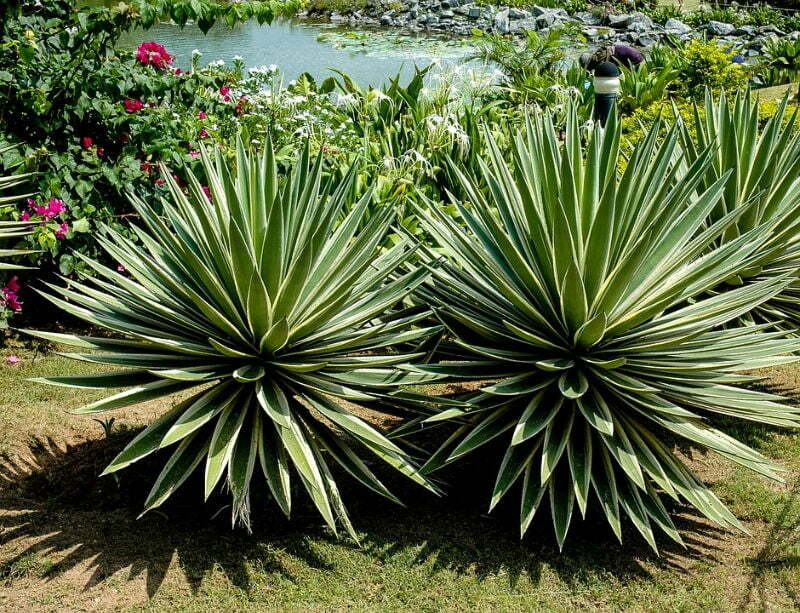
The yellowish green leaves form a lovely rosette around the base, ranging in length from 20″ to 28″ inches and breadth from 5″ to 6″ inches. The stems remain visible when the leaves go away.
These stems can grow up to 60″ in length. The inflorescence, on the other hand, can grow up to ten feet long.
The arching flower stalk curls back towards the earth, with a second arch that resembles a fox tail.
Many “suckers,” or offshoots, are produced by the fox tail agave. These offshoots cause the leaves to clump together, resulting in thicker growth.
Does The Foxtail Agave Flower?
The flower stem of the inflorescence has little greenish-yellow petals when it blooms.
Agave propagation is simple because the flowers eventually fall and are replaced by seed pods.
What Lighting and Temperatures Does The Fox Tail Agave Prefer?
The cactus prefers to be planted in moderate shade, although it also thrives in full sun.
If it was grown in the shade, it will need to adapt to the sun before transplanting.
It is sensitive to frost and cold temperatures. If the temperature drops below 50 degrees Fahrenheit, don’t plant it outside.
Generally, you should strive for a temperature that is close to room temperature. While you want to stay out of the cold, you also want to stay out of the heat.
How Much Water And Fertilizer Does The Plant Need?
The water requirements of the fox tail are minimal. It is drought tolerant and only has to be watered on occasion to keep the earth from drying up completely.
Apply a light balanced liquid fertilizer to the Fox Tail Agave during the summer growing season. The plant does not require much more fertilization in general.
Water the plant thoroughly once a week during the summer. You should need to water it less frequently as the weather cools.
There is no need to wet the leaves when watering. When watering potted plants, make sure the soil is adequately moistened and that the water drains completely.
Foxtail Soil and Transplanting Needs
The plant requires a sandy, well-drained soil mix with plenty of gravel to thrive. The soil should drain well and be dry for the most part.
The foxtail attenuata, on the other hand, may be grown in practically any soil with adequate drainage. It’s only that the sandy soil makes it easier to ensure that the soil drains well.
NOTE: Planting it in an area with a lot of strong breezes or freezing weather is likewise a bad idea.
Keep plants about eight feet apart in the landscaping when planting multiples. This gives the plants enough room to grow out to their maximum spread of eight feet.
When transplanting, you should also be cautious. The Foxtail Agave is sensitive to abrupt changes in illumination.
The plant does not require a deep container or pot when placed in one. The root system isn’t particularly deep. While the plant can still be found in deep soil, it is a waste of space.
When the plant is in a container or pot, the soil should be replenished every two years.
If the offsets are crowding the mother plant, you can remove them when transplanting or repotting.
Pruning, Grooming and Trimming Agave Plants
Plant grooming is only essential if you’re concerned about the leaves becoming too huge. For aesthetics or propagation, you may want to remove the basal suckers.
How often should you water foxtail agave?
Agave attenuata is most commonly seen in sunny subtropical gardens with temperatures that are close to room temperature. The plant can withstand both heat and cold, but for optimal results, it should be planted in places with moderate temperatures and light conditions ranging from full sun to partial shade. The plant can thrive in a variety of soil types as long as they drain well and are normally dry. The plant’s root system is rather shallow, so there’s no need for depth if you’re growing it in a container. However, the plant’s roots will quickly overflow the pot, and the plant itself need fresh soil every few years, necessitating repotting.
Watering and nutrients
The succulent Agave attenuata is remarkable in that it can resist both overwatering and underwatering. It prefers sandy soil and should be left to dry between waterings. For plants in full light, wait at least one week between deep soakings. The Agave attenuata requires even less water in the cooler months. Container plants will need to be watered more regularly.
During the summer, liquid fertilizer should be applied every two weeks during the active growing season.
Propagation
The easiest way to propagate the Agave attenuata is to divide its offshoots, though the plant also produces seed pods that can be sown. Remove the pods in the spring or summer and let them dry out if you want to plant from the seeds. When inserted in damp potting soil, they will germinate.
Alternatively, you can remove and transplant the suckers that emerge at the base of the plants. To do so, you’ll need a sharp pair of shears or scissors, as well as a container of soil or a spot in your garden to plant your new specimen. Remove the sucker from the parent plant’s base, as well as a tiny portion of the stem where it attaches. Allow this cutting to air dry for several days. Place the cutting in a wet soil container or directly into the garden once a scab has developed over the cut area.
Pests and diseases
A variety of diseases and pests can harm your Agave attenuata. Snails and slugs damage young plants, and soft plant scale and Agave snout weevils can also attack the plant. Insect infestation is indicated by dry leaves with brown patches. If your plant does not receive enough sunlight, it may become infected with fungal diseases such as root rot or crown rot, which can spread from one plant to another. If your plants exhibit signs of infection, you should remove them.
Light
The foxtail agave is a full-sun plant that thrives in this environment. It can adapt to partial shade, especially if it occurs in the afternoon, as the plant can suffer from excessive heat and would benefit from some relief during the warmest part of the day.
If you’ve been keeping the plant in partial shade and want to shift it to full sun, do it gradually over a few weeks, gradually increasing the hours of direct sunlight it receives. The plant may fall into shock and lose its leaves if it is suddenly transferred to a different lighting location.
Temperature
The fox tail agave is native to Mexico and thrives in hot climates. It is hardy in USDA hardiness zones 10 to 12, and can be grown outdoors all year. This plant can also be kept as a houseplant and will thrive in moderately warm environments. Because the fox tail agave is not cold-hardy, it should not be left outside year-round in locations where frost and freezing temperatures are common.
If you reside outside of zones 10-12, one option is to keep your fox tail agave in a pot and move it outside during the summer, then bring it inside or to a heated greenhouse for the winter. The plant can withstand temperatures as low as 28° F for short periods of time, but not for long periods of time.
Repotting
If you’re growing your fox tail agave in a container, you’ll need to repot it every two years or so. To reduce stress on the plant, this should be done in the spring or early summer.
To repot the plant, choose a new container that is only one or two inches wider in diameter than the existing one, and fill it with fresh soil. By carefully pushing and rotating the fox tail agave out of its pot, you can get it out. Remove as much soil from the root ball as possible without damaging the roots, then drop it into the new pot and cover it with more new soil.
Make sure the plant is sitting at the same level in the new pot as it was in the old one, then press it in and water it thoroughly. Because foxtail agave plants have a shallow root structure, they thrive in shallow containers.
How long does it take for foxtail agave to flower?
Other rosettes will grow from the center stem over time. A tall flower spike, up to 3m tall, with clusters of very lovely creamy white bell shaped flowers in spring and summer can take up to ten years to grow.
Why is my foxtail agave turning yellow?
Q: In June and July, one of my friends’ century plants, agave, and cactuses start to turn yellow. These plants are in a rock garden that is watered by hand. They’ve been together for two years.
When agave begins to yellow in the early to mid-summer, two possibilities spring to mind: overwatering or agave weevil. We witness yellowing of the tops and agave weevil death during the months of May, June, and July. Because you said that so many plants are afflicted, it’s possible that overwatering is the issue.
The weevil deposits its eggs in the crotches of the leaves. The eggs hatch and tunnel into the agave’s core to eat, carrying fungi and bacteria with them, which destroy the delicious center. The plant begins to yellow after extensive feeding and breakdown, and eventually collapses during the summer heat.
Insecticides that kill the insect before it feeds are used as a preventative therapy in April. Insecticides are administered as a liquid drench, granules, or a liquid spray that runs into the leaf crotches around the plant and is watered in.
In April, use a single treatment of systemic insecticides or repeated applications of organic pesticides. Always stick to the instructions on the package.
Another cause could be overwatering, which causes the roots to rot. Between waterings, the soil should be completely dry. If you must water your plants regularly, use tiny amounts of water at each irrigation.
Q: In February, the leaves closest to the trunk of my 2-year-old loquat began to turn yellow and fall off. New leaves have begun to emerge, and they currently appear to be in good condition.
A: This tree was most likely shocked, which caused the leaves to fall off. Watering, fertilizers applied too intensively or too close to the trunk, a freeze, or borers decimating loquats can all cause shock.
Because yellowish pigments persist in the leaves after they die, they lose their green chlorophyll and turn yellow.
The good news is that new growth has emerged, indicating that the condition was just transitory. This time of year, borers aren’t an issue, so the concentrate is on irrigation and fertilizers.
Watering issues might arise from using too much water or not watering frequently enough. It will drop its leaves if there has been a dry spell or if it has become extremely hot. It will drop its leaves if the soil is excessively damp for a lengthy period of time. The plant will drop its leaves if fertilizer was administered too close to the trunk or at a rate that was too high for the plant.
Overwatering can take two forms. One is concerned with the amount of water applied to the plant, while the other is concerned with the frequency with which the water is applied. I’m talking about overwatering, which is when you apply water too frequently.
If the soil does not dry out before the next watering, giving a plant too much water in a single application is usually not an issue. Unless you have a drainage issue, once a week is not too often, in my perspective.
I would wait and see what happens if you don’t think the soil was too damp or if you haven’t fertilized the tree.
If you apply fertilizer to the soil and think it was too much, flood the area with water and force the fertilizer away from the trunk and past the roots to dilute it.
A: Pomegranates thrive in Southern Nevada’s climate, which is comparable to that of their native lands. Pomegranates can freeze back in colder climates. Pomegranates have disease concerns in warm, humid regions that we never see in the desert.
We offer a large variety of pomegranates accessible in the United States, collected from all over the world. In some portions of our valley, some of the newer varieties may be cold-sensitive. Unless you want to try something new, I would avoid unfamiliar types.
For the most part, all commercially available pomegranates perform admirably. The flagship pomegranate variety, of course, is Wonderful, which has a stunning ruby red outer and inner color.
Pomegranate rinds are available in a variety of colors, ranging from dark purple to nearly black, to lemon yellow and off-white. The arils, or pulp around the seeds, range in hue from off-white to pink to dark crimson. Seeds can be hard or soft, and they can be eaten.
Sweet and Eversweet are two flavors that you can’t go wrong with. Utah Sweet, a Sweet selection, is a local favorite that is sometimes referred to as seedless. Parfianka is a recently released type from the former Soviet Union that has received outstanding reviews.
Sharps Velvet, Red Silk, Pink Satin, and Grenada are some of my other favorites. In our climate, none of the aforementioned types have suffered any winter damage.
Q: During the summer, I have a 23-year-old ash on a drip irrigation system that I water twice a week. For 30 minutes, the tree is watered with 10 5-gallon-per-hour drip emitters. It is planted in a rock mulch and has a southern exposure. The tree’s leaves have started to fall off, and its limbs are decaying. Is it only the age of the tree, or am I doing something wrong?
A: If all of the emitters are operating properly, you’re watering this tree roughly 50 gallons each week. With the warmer summer approaching, that won’t be enough water to keep this tree alive. That tree, at 23 years old, should get 3 to 5 times as much water in a week during the summer.
If the emitters are positioned 2 to 3 feet apart under the canopy of the tree, ten emitters should suffice. Each time you water, aim to soak about half of the area beneath the tree’s canopy and to a depth of 18 to 24 inches. Increase the number of emitters beneath the tree if possible.
Instead of simply adding more emitters to the tree’s canopy, another option is to add other plants with drip emitters to the canopy. The tree will benefit from this in a number of ways.
May 1 is normally the important date for increasing the frequency of applied water from once a week to twice a week (from the first week of February).
Ash Decline is a disease that has been present in the valley for more than 30 years and exhibits these signs. This disease has affected ash trees planted in rock mulch in hot regions more than trees planted in other locations or in lawns.
The ash tree’s branches are killed by Ash Decline. These trees will become a safety threat if they are not clipped and managed properly. Unfortunately, this illness has no cure, therefore the trees must be eradicated.
This disease was first discovered on Modesto ash, but it has since been discovered on other ash species, including Arizona ash. Because of this illness, I no longer suggest ash trees for use in home landscapes in this area.
This disease is not to be confused with limb dieback that occurs when older, established ash trees are removed from lawns and replaced with desert landscaping. The most common cause of limb die back in situations like this is a lack of water after re-landscaping and installing a new irrigation system.
Why is my agave dying?
The fact that agave plants dislike cold weather should come as no surprise. These plants will suffer if the temperatures go too much below freezing.
Freezing temperatures may cause agave plants to die, and the leaves will be the first to go. The leaves may begin to turn black and eventually fall off after being extremely dry.
If the freezing temperatures only stay a few hours, an agave plant will most likely recover. The plant will have major problems if the temperature remains so low for an extended period of time.
To try to protect agave plants, keep them closer to regions that can keep them warm. Having agave plants on your patio and near a warm house, for example, may help them survive cold nights better than if they were out in the open.
How often does Foxtail Agave bloom?
After around ten years, all of the types bloom once, with a seven- to fifteen-foot tall flower stalk with yellowish-green blossoms that arch downward. Offsets will form after the plant blossoms, assisting the plant in reproduction.
How long do Foxtail Agave live?
According to the Matthaei Botanical Gardens, American agave plants generally flower after roughly 10 to 25 years in nature, which makes this agave’s 80-year life span so uncommon. Another of nature’s many mysteries is why the plant flowers when it does.
Do you trim Agave attenuata?
Agaves are commonly planted in gardens in USDA hardiness zones 8b to 11 because of their drought tolerance and the visual attractiveness of their broad, spiky leaves and towering bloom stalks that can exceed 40 feet in height. Most of the time, the plants require little attention, although they do benefit from occasional trimming to improve their overall appearance. Agaves, on the other hand, dislike excessive pruning and can die back if healthy leaves are removed, so just remove spent flower stalks and any damaged or dead leaves that occur.
Do agave plants need full sun?
Agaves are native to the desert, but they should not be exposed to direct sunlight. Many agaves thrive in the wild beside scrub oak or other larger plants that give shade during the warmest times of the day. Smaller and younger agaves should be given moderate shade, although larger and older agaves can tolerate several hours of intense sunlight. Agaves have a woody root structure that is very large and deep. This makes it easier for them to look for water in new places, but it also makes transplanting huge plants more challenging.
How much sun does Foxtail Agave?
Plants of the Agave attenuata thrive in full sun, ideally for 5-8 hours every day. They will, however, endure some shade, especially in severely hot and dry conditions. Acclimate plants that are moving from indoors to outdoors or from shade to full sun. The leaves might be burned by a sudden change in solar intensity.
How fast do Foxtail Agave grow?
Agave palmeri (Foxtail Agave) is a hardy drought-tolerant succulent endemic to the southeastern United States and Mexico. With its enormous rosette of long fleshy spine-tipped leaves, it makes a stunning presence in any garden. Its waxy leaves resist evaporation and allow the plant to absorb and roll liquid down to its large root system below.
The Foxtail Agave is a monocarpic plant, meaning it only blooms once before withering.
From June to July, it produces a long blooming stalk with pale yellow flowers in its final year.
The main plant dies after blooming, but seeds and rhizome suckers continue to spread the species.
The Foxtail Agave reaches a height of 1.5 meters and a width of 1 meter.
It grows at a leisurely pace, taking up to three years to achieve maturity.
Grows best in full sun or partial shade. Requires sandy soil that drains well.
The Foxtail Agave is a succulent that is evergreen in appearance.
It features a dense rosette of stiff blue-green leaves with spiky edges.
It produces a solitary flower stalk up to 4.5m long with pale greenish yellow flowers in its final year of life. The primary clump dies after blooming, releasing suckers that sprout into new plants.
Uses: Accent plant; works well in rock gardens and pots.
The size of potted specimens will be smaller.
Planting Foxtail Agave too close to walkways can result in damage because to the prickly leaves.
The aggressive leaf tip can be snipped off, but be careful not to cut too deeply into the leaf to avoid shredding.
To maintain the plant neat, clip dying leaves at the base near to the trunk.
Notes: Native Americans ate the plant’s leaves and made ropes and baskets out of the plant’s fibers.