
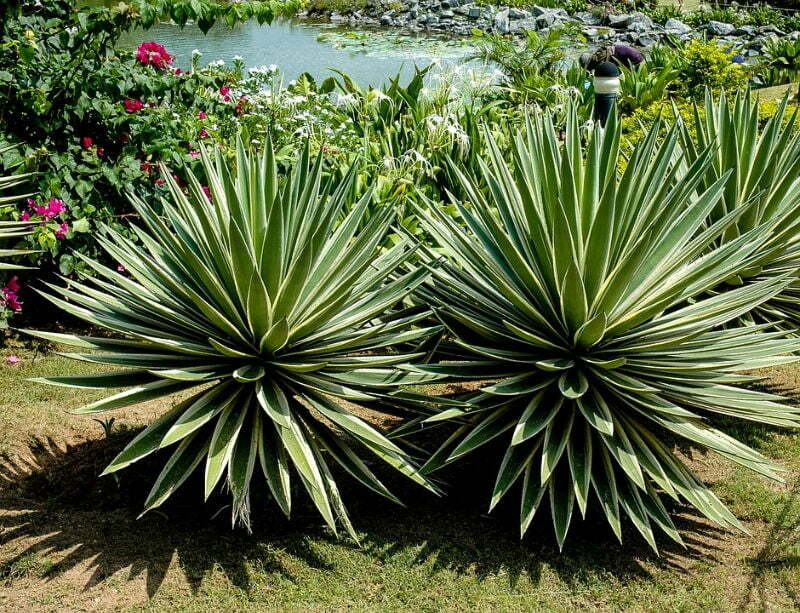
One of the species that pollinates agave is the Mexican long-tongued bat, but its environment is being disrupted by large-scale, cheaper tequila production. It’s also difficult to grow agave without bats, as a few species of these winged mammals serve as the plant’s major pollinators.
Why are bats attracted to agave plants?
Agaves are chiropterophilous, which means they are pollinated by bats. Through coevolution, these plants and their pollinators have shaped each other. Agaves in bloom can reach a height of 15 feet, with candelabra-shaped flower clusters at the top. The flowers only bloom at night and smell like rotting fruit, alerting bats to the presence of a nectar bar. Bats are sprinkled with agave pollen as they swoop in for a drink, which they transmit from plant to plant as sexual surrogates.
Agave nectar has up to 22% sugar, and pollen contains 50% protein. The sugary treat keeps the bats fed for flight, and pollen left over from grooming is ingested by bats. Several bat species pollinate agaves, and several migrate from central Mexico to the Southwestern United States and back, following the agave and cactus blooms.
What plants use bats as their major pollinators?
Many people are unaware that bats pollinate the blossoms of over 500 plant species, including mango, banana, durian, guava, and agave (used to make tequila). Say gratitude to the bats the next time you drink tequila or eat a mango! Chiropterophily is the term for bats pollinating plants.
Bat-pollinated plants frequently feature pale nighttime blooms (in contrast, bees are mostly attracted to bright, daytime flowers). Some bats have developed expressly to reach the nectar at the bottom of these blooms, which are frequently big and bell-shaped. For this reason, Ecuador’s tube-lipped nectar bat and Mexico’s banana bat, which only lives on the Pacific coast, both have extremely lengthy tongues. The tongue of the tube-lipped nectar bat is more than one-half the length of its body!
Bats need on the fruit and blooms of these plants to thrive, much as these plants rely on bats to pollinate their flowers. Disturbance of this complex system might have serious repercussions. In Mexico, for example, the lesser long-nosed bat is responsible for pollinating agave plants and is used to manufacture mescal and tequila. Farmers harvest the plant before it blooms in the majority of tequila manufacturing, which means it must multiply by cloning. Bats eat the flowers as well as pollinate them, so this is bad for them. It’s also harmful for agave harvests since they’re lacking in variation all tequila plants in one agricultural region can be traced back to just a few clones. In certain locations, disease has lately destroyed more than a third of the agave plants, which may have been averted if more agave plants were allowed to flower and proliferate through pollination. Visit our blog for more information.
How do bats help pollinate?
Plants don’t just develop on their own; they require a lot of assistance. There are many support systems that help plants develop all throughout the planet, whether it’s sunlight, rich soil, or a nice rain shower. Bats are an important support system for many plants.
There are more than 530 blooming plant species that rely on bats as their primary or sole pollinators. Agaves (which are harvested to provide the multibillion-dollar tequila business), bananas, and balsa trees (which produce the world’s lightest wood) are just a few of these plants. In fact, bats and agave have such a strong link that bat populations fluctuate in size in response to agave success.
Pollen must be transferred from a male stamen to a female pistil within a plant in order for it to reproduce. Because plants are planted to the ground, they can’t easily meet up, so they rely on others to transport their pollen for them, such as hummingbirds, bees, and bats.
Bats have an advantage over insects when it comes to pollination since they are highly mobile species that can fly longer distances. In Puerto Rico, the Phyllostomid bat family may move pollen up to 800 meters between trees, and in Brazil, leaf-nosed bats (Phyllostomus sp.) can transport pollen up to 18 kilometers between trees. Bat pollination improves plant resistance to pests and disease while also aiding reproduction.
Bats and plants have a give-and-take relationship. Some plants, such as four types of columnar cactus from Venezuela (Stenocereus griseus, Pilosocereus moritzianus, Subpilocereus repandus, and Subpilocereus horrispinus), have developed in size and shape to accommodate bat pollinators. If a few of plants recognize that bats must be accommodated due to the services they bring, then so can we as people!
Does harvesting agave hurt bats?
Cinco de Mayo is a holiday that honors many aspects of Mexican American culture, with a focus on traditional cuisine and drink. Tequila fans can also rejoice this year as the lesser long-nosed bat is being removed from the endangered species list in the United States. The bat is one of the most important pollinators of the agave plant, which is used to make tequila.
More than half of all bat species in the United States are endangered or threatened. The lesser long-nosed bat, whose ecological range includes the American Southwest as well as central and southern Mexico, will be the first species to be removed from the list as of May 18 after a considerable population recovery.
“According to the US Fish and Wildlife Service, “a careful evaluation of the science suggests that dangers to the bat have been eliminated or decreased, populations are healthy and stable, and species is no longer endangered or threatened with endangerment under the ESA.”
In 1988, scientists listed the lesser long-nosed bat as an endangered species, estimating that only 1,000 of them existed over the whole range. According to Rodrigo Medelln, a professor of ecology and conservation at the National Autonomous University of Mexico’s Institute of Ecology, bats have long been vulnerable to human vandalism in the caverns and mines where they sleep. This, according to Medelln, is due in part to widespread misconceptions about bats, such as their reputations as vicious bloodsuckers. “They were either gassed or dynamited out of caverns,” Medelln says. “Bats would be burned, and caves would be sealed. “Just because they had a bad reputation in the public eye.”
The lesser long-nosed bat, which weighs between four and six ounces and spends its summers in Arizona and New Mexico before migrating south for the winter, spends its summers in central and southern Mexico. It follows a pattern during migration “It’s one of just three nectar-feeding bats found in the United States. The nectar from flowering plants like blue agave and saguaro cacti is the bat’s primary source of energy.
The lesser long-nosed and blue agave’s plant-bat interaction is critical to both species. In his area, Medelln is regarded as the “The success of the lesser long-nosed bat can be attributed to “Bat Man.” He’s addressed tequila producers several times in the last decade to stress the significance of allowing the agave plant to completely flower so that bats can collect the nectar they need to help pollinate the species. Agave is harvested by the majority of agave producers before the long, flowering stalk appears. Agave plants achieve sexual maturity and blossom after six or seven years of growth. Plus, shortly before flowering, agave collects the greatest sugar, which is a desirable attribute for tequila producers.
However, not only does this method of harvesting harm bats, but it also harms overall agave output. If agaves are solely grown asexually, as most agave harvests in Mexico were before Medelln interfered, they will create precise clones of their own DNA, generating whole crops of genetically identical agave. If a crop could not withstand a disease or pest, it would be completely wiped off for several years.
“Every year, they were losing genetic variety,” says Medelln. “It was critical to put money into allowing bats to feed in order to disseminate genes.”
After a few agave growers lost their entire crop and had to replant, according to Medelln, they began to give attention to the idea of replanting “Agave that is bat-friendly.” Agaves that are bat-friendly are left to develop for longer periods of time before being harvested. The resulting blossoms provide a great diet for the lesser long-nosed bat as well as a reliable way for the plant to reproduce. According to Medelln, one hectare of agaveroughly two football fields worthcan feed around 100 bats per night in steady conditions.
Do we need bats for tequila?
Tequila’s greatest threat isn’t a scarcity of agave. Or there’s the glut of celebrity-endorsed products.
It’s the absence of bats, actually. The blue agave plant, which is used to make tequila, is pollinated mostly by the lesser long-nosed bat. These bats eat the nectar from agave blossoms and then carry the pollen to other plants to fertilize them. However, the industrial processes utilized in tequila production have resulted in a loss of genetic variety in agave plants, as well as a food supply for the endangered lesser long-nosed bat species.
To protect the bats, biologist Rodrigo Medellin and the International Union for Conservation of Nature (IUCN) are working with tequila companies to make them “bat-friendly.” That’s the genuine term on the labels of seven tequila brands and three mezcals; to qualify for the name, the brands must let at least 5% of their agave plants to flower, pollinate by bats, then replant the fields with the seeds.
This procedure, as well as Medellin’s work, is featured in Nature: The Bat Man of Mexico, a David Attenborough-narrated documentary directed by Tom Mustill that airs on PBS (as well as on the public television network’s website and video app) on Wednesday, June 30.
The fascination with bats in Medellin dates back decades. “My first bat came into my hands when I was 12 or 13 years old,” he says. “I was already volunteering at UNAM’s (National Autonomous University of Mexico) mammal department, and people were telling me how great bats were, and I saw how cruelly they were treated.” I was shaking with excitement when I held my first bat, a Waterhouse leaf-nosed bat, Macrotus waterhousii, and marveled at how incredible its ears, leaf nose, small claws, extremely soft, supple wings, and silky, lovely fur were. The combination of mystery, curiosity, and unfair treatment they represented prompted me to make the decision right then and there, in the middle of the Caon del Zopilote in Guerrero, to devote the rest of my life to understanding and defending bats.”
Which tequila is bat friendly?
Under the supervision of tequila advocate David Suro and the Universidad Nacional Autónoma de México, Tequila Ocho has been granted Bat Friendly recognition for estates that meet the standards of the Tequila Interchange Project.
Is agave unethical?
Alternatives to simple white sugar have grown in popularity as we’ve been conditioned to believe they’re better for us or the environment.
Agave syrup is made from the sap of the blue agave plant, which has been purified and filtered. The blue agave plant, like tequila, is native to Mexico and comes with a slew of agricultural, social, and manufacturing issues.
While more research has been done on the environmental effects of tequila manufacturing than on agave syrup production, we do know that the plant must be completely died to obtain the syrup. Because blue agave is a slow-growing species, this is an issue for both the environment and farmers. Even worse, agave plantations are poorly managed. The majority of blue agave is grown on large-scale monocrop plantations, which necessitate the use of chemical fertilizers, herbicides, and pesticides to keep production going.
Agave sugar isn’t harvested like honey or syrup, despite the fact that it’s commonly referred to as “nectar” or “syrup.”
Consider it a step closer to the processes required to produce high-fructose corn syrup.
The fructose sugars in agave nectar syrup range from 60 to 84 percent. High fructose corn syrup, which is reviled for a variety of reasons, one of which is its high fructose content, contains only approximately 40 to 55 percent fructose.
Triglycerides and blood lipid levels have been demonstrated to rise as a result of all that fructose. Furthermore, fructose is solely processed in the liver. As a result, anything that isn’t digested there (sugar overdose! ), is stored as fat.
Are bat pollinated plants important to humans?
Bats play a vital role in ecosystems all over the world. Bats also aid in the distribution of these crucial plants’ seeds, allowing them to multiply and produce more fruit for us to consume and enjoy. Many ecosystems would perish if bats weren’t pollinating and distributing seeds.