
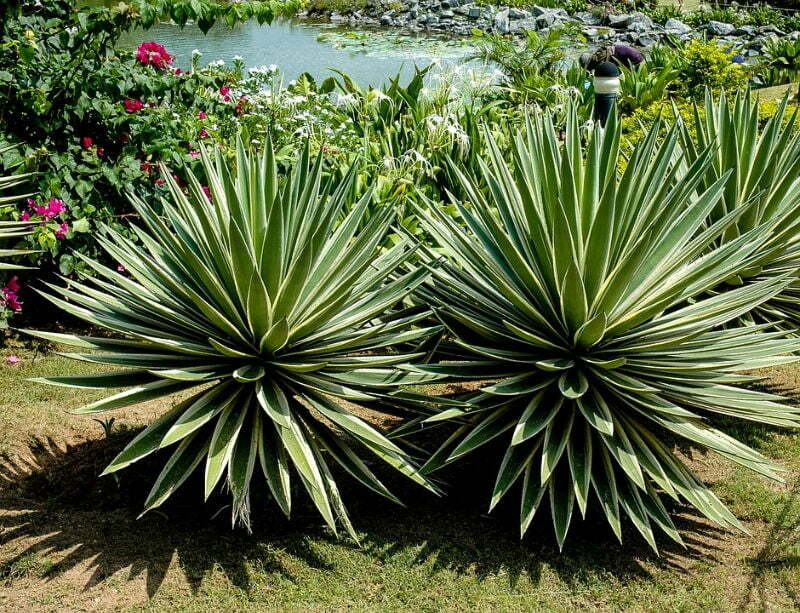
Organic Truth Is Simple The Blue Agave Plant is used to make Blue Agave, a natural organic sweetener. It’s a delectable Multi-Purpose Sweetener that may be used in beverages, baking, and on the table in general. Because our Sweet Mild Syrup is 25% sweeter than sugar, you’ll use less of it.
Where Agave Comes From
Agave nectar and blue agave nectar are both made from the agave plant, a succulent that grows all over the world in hot, dry climates. Each variety of nectar, however, comes from a different agave plant species.
Agave nectars aren’t all created equal. Because they obtain their agave from numerous sellers, many agave growers employ a mixture of agave varietals. This makes it more difficult for them to ensure that their product is of high quality. Agave that is developed, grown, and harvested exclusively for the tequila business is known as blue agave. This plant produces a premium agave nectar that contains more fructose and has a lower glycemic index than nectar from mixed agave.
Mexican Regulations for Agave Production
When you buy blue agave nectar, you’re guaranteed a high-quality product because the Mexican government has established tight requirements for the product of agave nectar made from blue agave plants. To acquire the blue agave nectar appellation, all blue agave nectar must contain at least 80% fructose, according to Mexican regulations. It can’t be blended with other sugars, and it has to be prepared entirely with blue agave. The greatest focus in the manufacturing of blue agave nectar is product purity and quality. In the case of mixed-source agave nectar, however, such quality criteria may not be adhered to as strictly.
Blue Agave Characteristics
Blue agave nectar has a lower glycemic index and is 1.5 times sweeter than sugar. While all blue agave nectar variations have a mild smokey aftertaste, lighter agave species have a more balanced flavor profile. They’re commonly employed in direct-to-consumer applications such as beverage sweetening and salad dressing. Darker agave varieties offer a more unique flavor character and are more commonly utilized in baking.
Tierra Group Blue Agave Nectar
In the creation of our luxury products, we also adhere to rigorous social responsibility requirements. At our workplace, we have medical facilities and care for all of our employees. In addition, we support local sports teams, nursing homes, youth initiatives, and government activities in the city where our manufacturing is located.
We feel that rewarding our employees pushes them to do their best work. A great product is ensured by exceptional work. And happy customers are ensured by a superb product.
Is blue agave light golden honey?
While there is evidence of honey harvesting as long back as 8,000 years in Spanish art, agave is a more recent trend, having first entered the American market in 1995 at a health trade expo in Anaheim, California. For its infrequent blooms, the plant is affectionately known as the “century plant,” and early documentation in Mexican history reveals that it has been used for everything from medicine to needles, clothing, and, of course, sweet nectar.
Though the plant’s bulk makes it appear intimidating, using its nectar in everyday cooking is anything but. I’ve smoothly incorporated it into smoothies and dessert recipes since going vegan, as I try to cut down on artificial sweeteners.
DIFFERENT AGAVE VERTIALS
Depending on how it’s picked, agave can have a variety of properties, according to Bannan.
Raw: It’s light in color and flavor, and it’s made at a lower temperature to preserve the enzymes that naturally reside in it.
Blue: Made from the blue agave plant, it has a medium-golden tint and a light flavor. Tequila is made from the nectar of the blue agave plant, which is rich and sweet.
AGAVE HEALTH BENEFITS
The agave plant has various health benefits on its own. According to the Journal of Agricultural Food Chemistry, the procedure of extracting fructans from nectar removes them. “One of the reasons agave is popular is that it has a lower glycemic index than other sweeteners,” says Bannan, who adds that it is more likely to elevate blood sugar slowly. Because agave is predominantly made up of fructose rather than sucrose, and excessive consumption may contribute to weight gain and elevated LDL (bad) cholesterol levels, Bannan recommends that it be consumed for its flavor rather than its health benefits.
What is golden blue agave?
Product Specifications. Agave is a sugar substitute derived entirely from the juice of the agave plant. Ideal for sweetening coffee and tea, as well as incorporating into your favorite recipes. It’s gluten-free, Kosher, and Vegan-friendly, and it’s 1.4 times sweeter than sugar, so you’ll use less of it! Sweetener with a low glycemic index.
Is 100% agave the same as 100% blue agave?
Not all mezcal is tequila, and not all tequila is mezcal. Tequila can only be manufactured from agave tequilana (blue agave), but mezcal can be made from over 30 different agave species (AKA maguey). (Agave espading is used to make the majority of mezcals.)
Agave is not a cactus.
Agave is a succulent, not a cactus. Tequila and cacti have nothing to do with each other. Unless you’re sitting next to one, sipping a joven, of course. The agave plant is a succulent that grows in the desert.
Blue agave typically takes eight years to mature.
Agave is difficult to grow, to say the least. The correct desert conditions are required, and even then, most blue agave takes eight years to mature. And that’s only to get you to the harvesting stage. Add some more time to your tequila if you want it to age.
The blue agave plant only has one life to give.
The fact that blue agave is a one-time use plant doesn’t help efficiency. When the agave plants are ready to be harvested, their pias or hearts are ripped out. They’re called that because they end up looking like pineapples. These are the portions of the plant that will be cooked, crushed, and fermented to make tequila.
Tequila is legally required to be only 51% blue agave.
Tequila is created from blue agave, but it does not have to be made entirely from this plant. Many tequilas claim to be made entirely of blue agave, while the legal requirement is 51 percent. The balance of the bottle can be filled with a neutral spirit prepared from cane sugar juice, resulting in a “mixto” tequila. These are, unsurprisingly, believed to be of poorer grade.
Your tequila bottle should not have a worm in it.
There will be no worms in the tequila, FYI. The link between tequila and worms is (possibly) due to the fact that maguey plants are frequently chewed on by “gusano de maguey,” small larvae that, if not interrupted, would develop into a mariposa, a butterfly-like creature. It’s mezcal, not tequila, when they’re inserted into liquor bottles as larvae. So, if there’s a worm in your tequila, don’t drink it. Who knows what else is wrong in the bottle if the maker got that wrong.
Young tequila is really young.
We consume a lot of tequila that is still young. And by aging standards, that’s still rather young: blanco/joven is 0 to 2 months old, reposado is 2 months to 1 year old, and aejo is 1 to 3 years old. There is, however, such a thing called “extra aejo,” which takes tequila maturation to a new level (3 years or more).
You can buy tequila that has been aged for over a decade.
Although three years may seem like a long time to age tequila, one of the oldest “extra aejos” now for sale is 11 years old and costs upwards of $1000. It’s composed entirely of organic blue agave and aged in French oak barrels. A fantastic (really fantastic) present for the tequila connoisseur in your life?
The name tequila carries legal weight around the globe.
Tequila is protected as a Mexican designation of origin in dozens of nations, similar to European Union products with protected names (e.g. Champagne and Prosciutto di Parma). That protection is built into NAFTA in the United States and Canada. So please don’t try to brew tequila in your bathtub.
The Tahona process is as crafty as it gets.
Tequila may be as artisanal as the most artisanal crafty little spirit. Even if it’s made by a major manufacturer. Tequila is manufactured by heating and crushing the gigantic pias, as you may know. The Tahona processbasically dragging a giant volcanic wheel over the cooked agave heartsis one method those pias can (and have) been crushed. Donkeys are still used in some places, according to tradition. We’re not sure anything is more artisan than using a donkey.
Is there a difference between 100% agave and 100% blue agave?
There is a lot of misunderstanding and misunderstanding regarding the differences between a (mixed) tequila and a 100% agave tequila. Which is the most effective? What are the distinctions between them? We’ll go through the differences between the two types of tequila in this article. How can you tell if you’re drinking tequila or 100% agave tequila?
A mixed tequila should be referred to simply as tequila. This is an agreement reached between the Tequila Regulatory Council and the tequila industry. This naming requirement is established in the official legislation, and while many people refer to tequila as “mixed tequila,” the actual term is “tequila.” How can you identify the difference between a tequila and a tequila made entirely of agave? It’s written on the package. It’s a (mixed) tequila if it doesn’t declare it’s 100 percent agave tequila.
The source of the sugars produced throughout the fermentation process is the difference between them. All of the sugars fermented in a 100 percent Agave tequila come from the Tequilana Weber agave, blue variety, as the name implies. On the other hand, sugars fermented for tequila must contain at least 51 percent agave, but the rest must originate from a different source, according to the law.
It is only natural to find that the sensory notes of a 100% tequila are closer and more similar to the smell and taste of the agave itself, and that those notes are a little more attenuated in a tequila yet, but a good master distiller should know how to control all of the tequila processes so that the agave characteristics are noticeable in either of the two types of tequilas. Whether they are white, young, rested, or ultra-aged tequilas, they can both be high-quality products. As a result, a tequila that is not 100 percent tequila is not always of poorer quality, and provided the quality of the production procedures is correctly maintained, a tequila might very well have a fully qualified sensory profile.
Come experience for yourself how we create the cleanest tequila on the market at Casa Sauza!
Which is healthier honey or agave?
If you have to choose between honey and agave, honey is the healthier option. Honey is mostly composed of fructose, whereas agave contains a higher percentage of glucose. Honey has a number of health benefits that aren’t available from other natural sweeteners. Honey is fundamentally more like table sugar than agave, despite the fact that both are plant-based and related to table sugar. While honey is the better option, agave may be more useful in modest amounts than table sugar.
Which is better for diabetics honey or agave?
Agave has been promoted in the media due to its low glycemic index (GI of 17) as compared to conventional sugar (GI of 68) or even honey (GI between 60-74 depending on variety). Because of its low glycemic index, agave is a favorite among diabetics. However, the American Diabetes Association recommends that agave be treated like any other sweetener (such as sugar, corn syrup, or honey) and used in moderation.
Is agave anti inflammatory?
You may have heard of the Blue Weber Agave plant, which is a miraculous plant. Not just because it is the only component permitted in 100% de Agave Tequila (such as Tres Agaves), but also because it is the only ingredient permitted in 100% de Agave Tequila (such as Tres Agaves).
Agave nectar is made entirely from the Blue Weber Agave plant. The nectar is made by crushing the pias of the agave plant to extract the juices, which are then cooked and filtered to produce the simple sugar fructose, which is then concentrated into a syrup. Despite the fact that agave syrup requires more steps than, example, honey from a beehive, it is still considered a healthy alternative. Agave nectar contains the following ingredients:
- You won’t have high blood sugar levels because honey has a low glycemic index (19-27 vs. 83 and 89 in honey and high fructose corn syrup, respectively).
- Saponins found in agave have anti-inflammatory and immune-boosting qualities (think quinoa and ginseng)
The probiotic inulin is also found in the agave plant. Numerous studies have suggested that inulin can help ease constipation and aid weight reduction by acting as a meal for specific gut bacteria.
What is blue agave used for?
The Asparagaceae family includes the genus Agave. It’s native to Mexico and the Caribbean, among other places in the Americas. Agave nectar is produced by the blue agave plant and Agave americana, often known as maguey or the century plant. This is the same plant used in the production of tequila.
Agave nectar is a natural sweetener that can be used in place of sugar. Because it’s sweeter, you may use less of it to achieve the same impact. It’s a healthier alternative to artificial sweeteners. It’s also vegan, which makes it an appealing alternative to honey for some.