
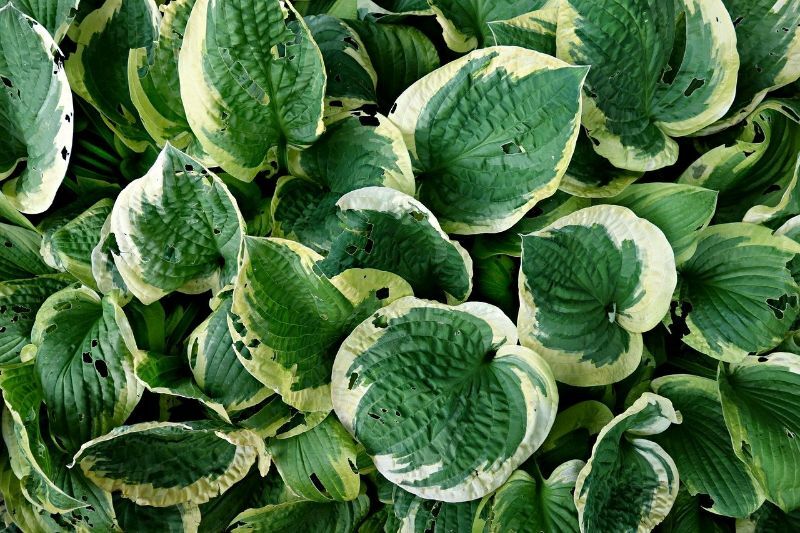
Hostas (Plantain Lilies) are shade-loving perennials that are highly regarded by gardeners for their elegance and gorgeous leaves. They are ridiculously easy to grow and long-lived. These low-maintenance foliage plants, native to eastern Asia, are ideal for shaded settings and pair well with other shade perennials like Astilbe, Dicentra spectabilis (Bleeding Heart), Ferns, Tiarella (Foam Flower), or Hydrangea.
- In terms of size, color, texture, and leaf shape, the world of Hostas is immensely diverse. Thousands of Hosta cultivars are available, reflecting the plant’s enormous popularity among gardeners, and new kinds are constantly being developed. There’s a Hosta for every setting in your garden or landscape!
- Colors range from chartreuse to deep emerald green, greenish gold, gray, and blue, with many beautiful variegated Hostas that change color depending on soil type and environment. Leaves can be puckered, wavy-edged, heart-shaped, lance-shaped, shiny, or dull, and come in a variety of shapes and sizes.
- The elegant foliage is topped in early to midsummer with larger funnel-shaped or flared blooms in hues of white, lavender, or purple, growing from 6 inches to 3 feet tall (15 – 90 cm). Some flowers have a pleasant scent.
- Hostas thrive in rich, moist, well-drained soils and thrive in part shade to full shade. With enough moisture, some are sun tolerant. These plants aren’t picky about soil and can thrive in a variety of environments.
- Hostas are a versatile plant that can be used in shady gardens, blended with other perennials in beds and borders, as groundcover, edging, shrub underplanting, or in containers.
- To encourage the plant’s growth, cut off the stems after it has bloomed. Leaves that have become discolored should be clipped back to the ground.
- As new growth develops in the spring, divide plants every 3 to 4 years by lifting and splitting them into clumps.
Are hostas the same as plantain lilies?
Hosta plantaginea is a magnificent Plantain Lily that is grown for both its gorgeous foliage and intensely fragrant flowers. It creates lovely, dense mounds of glossy, brilliant green leaves that are widely oval in shape with parallel veins and a quilted surface, and it brightens any shaded garden space. They are gracefully crowned with among of the largest flowers in the Hosta species, up to 3-4 in. long (7-10 cm), and are also considered among the most fragrant of any Hostas in late summer and early fall. The trumpet-shaped, waxy white flowers emerge on scapes up to 30 in. (75 cm) and are exquisitely eye-catching when they open in the evening. This Hosta is low-maintenance and forgiving, as well as heat and humidity tolerant.
Why is hosta called plantain lily?
Since the plant was brought to Europe from Asia in the 1780s, it has gone through various name and categorization modifications. It was first termed “hosta” by Austrian botanist Nicholas Thomas Host in the early 1800s, and by the late 1800s, it had been renamed “funkia” by botanist Heinrich Christian Funk, a name it still bears in several European countries. The plant’s name originates from its resemblance to the broadleaf plantain weed. In addition, the plant was once classified in the Liliaceae family, but since the 1980s, it has been classified in its own subfamily, Hostaceae.
Do plantain lilies come back every year?
Plantain lilies are intriguing plants that are gaining in popularity. Some of these lovely perennials are already sought-after collectibles. The heart-leaf lily is not a turbo perennial like many other plants; instead, it grows lusher and more gorgeous year after year as long as it is left alone.
This gorgeous leaf forb captivates with increasing beauty and lifespan with a little patience and good care. As a result, it is generally undemanding and easy to maintain in the proper place.
Where do plantain lilies grow?
Hostas are now available in sizes ranging from a few inches to several feet tall, with leaves in a variety of striking and muted patterns and hues. Larger types can be highly architectural and stand out as specimen plants, while smaller variants are great for edging, lighting up a woodland, and stabilizing a slope.
Light/Watering: Once established, these drought-tolerant plants thrive in evenly moist soil in moderate shade, however a few will withstand full sun with enough water. Hostas can withstand a lot of drought once they’re established, and they’ll compete successfully with tree roots in the north, but they’ll need regular watering in the south.
Fertilizer/Soil and pH: Hostas grow in average, slightly acidic soils, and will benefit from a modest fertilizer application in early spring. These low-maintenance plants can be disregarded and yet perform well; but, to get the most out of them, supply deep, rich soil and continuous watering, as well as a side-dressing of compost or aged manure on occasion. Organic mulch is beneficial, but it should be kept away from the crowns.
Slugs are the plague of Hostas, so use slug bait, beer dishes, and diatomaceous earth to keep them away. Voles have been known to consume the roots of plants, so trap them or use another strategy to keep them away.
Other shade-loving plants that go well with Hostas are ferns, Tiarella, taller Campanulas, Phlox divaricata, Daylilies, and, notably, genuine Lilies. They’re great for planting among spring-flowering bulb patches since their foliage will hide the bulb foliage when it fades down.
Reflowering: Only a few types will reflower; when blooming is finished, clip flower spikes off at the root.
Dividing/Transplanting: These tolerant plants are best divided in the spring when the young leaves are still furled up, but division and transplanting can be done at any time of year if proper follow-up watering is paid attention to.
End-of-Season Care: Cut back foliage in the fall to remove cover for overwintering slugs, although this can also be done in the spring.
When new growth sprouts in the early spring, apply a little application of balanced or slow-release fertilizer, or side-dress with compost and organic amendments. Now is the time to divide or transplant before the leaves unfurl. If the weather is very dry, water newly planted plants well, as Hostas need evenly damp soil.
Mulch plants after the earth has warmed up, but keep mulch away from the crowns to prevent rot.
Late spring: Keep an eye out for slug damage and take precautions if slugs are present.
Unless you wish to collect seed, groom plants by removing yellow or dead leaves and cutting flower spikes down when they complete blooming.
Cut the foliage back to the soil level in the fall. After the ground freezes, cover new plants with a winter mulch of evergreen boughs or salt marsh hay to help prevent heaving.
Can you eat plantain lilies?
Hosta fluctuans ‘Sagae’ (plantain lily) Young hosta leaves and shoots are a popular springtime treat in Japan. Harvest the leaves soon as they begin to unfold and serve lightly blanched with a spring salad. They have a somewhat salty asparagus flavor.
How poisonous are hostas to dogs?
The Agavaceae family includes the hosta plant, which is a perennial herbaceous plant. There are about 40 different species of these hardy plants belonging to the same genus. Hostas, which are native to Asia’s eastern regions, may grow in a variety of environments.
Hostas are a low-to-the-ground plant with ribbed or striped leaves at the bottom and blooms at the very tip of the stalks. The flowers occur in clusters, and the stalks emerge from the leaves in colors of white or a blue-purple combination. Hostas are frequently utilized in landscaping or as houseplants in pots.
Hostas produce saponins that are poisonous to dogs and other small animals. The saponins in hosta poisoning cause vomiting and diarrhea, which are common symptoms. If you have dogs, you should avoid growing hostas on your land and keeping these potted plants indoors.
When dogs swallow the hosta plant, which contains saponins that are toxic to dogs and hazardous if ingested or come into touch with the skin, they develop hosta poisoning.
Is it safe to eat hostas?
To harvest, look for young, sensitive shoots, as older leaves are bitter. This is best done first thing in the morning, when the plant is at its most succulent. Sautéing the leaves, adding them to stir fries, or using them in wheat-free sandwich wraps are all options. If in doubt, treat them like you would any other leafy green. Hosta blossoms, surprisingly, are edible (if a little tasteless), and can be used as colorful garnishes.
Which hosta has the most fragrant flowers?
The growth of fragrant hostas has decreased significantly since the mid-1980s. H. ‘Old Faithful’ (Petryszyn 1991), H. ‘Austin Dickinson’ (Lachman 1992), H. ‘Guacamole’ (Solberg 1994), H. ‘Fried Bananas’ (Solberg 1994), H. ‘Hoosier Harmony’ (Zilis 1995), and H. plantaginea ‘Ming Treasure’ (Zilis 1995) are notable fragrant hostas from the (Zilis 1995). In the late summer, these are all fairly exceptional in terms of vitality and huge, fragrant flowers.
A double flowered variant of Hosta plantaginea was the most fragrant hosta that sparked the most interest. This immediately became a collector’s item after it was imported into the United States in the 1980s. While the plant looked beautiful when it was in bloom, it rarely had the ideal conditions for the flowers to open. Only a few gardeners south of Baltimore have ever witnessed the blossoms in full bloom. To thrive, the double flowered version appears to require wet soils, warm days, and cool nights. Every year, gardeners are teased as the buds enlarge, only to turn to mush a day before opening. At the very least, there are other excellent options for the same scent.
Even if you don’t care about garden scent in your hostas, you can rest assured that any hostas with fragrance genes will thrive in the hot, humid summers of the southeast.
Can plantain lilies be grown indoors?
Hostas are not typical houseplants, but they can thrive under the correct conditions indoors. They are not fickle plants, and when cultivated inside, they are frequently less susceptible to pests and illnesses.
Are hostas in the lily family?
In today’s world, there are around 2500 distinct hostas. They are members of the Lily Family and feature flowers that are similar to lilies. Hostas range in size from a few inches to many feet broad. The leaves of hostas, also known as Plantain Lily, come in a variety of colors.