
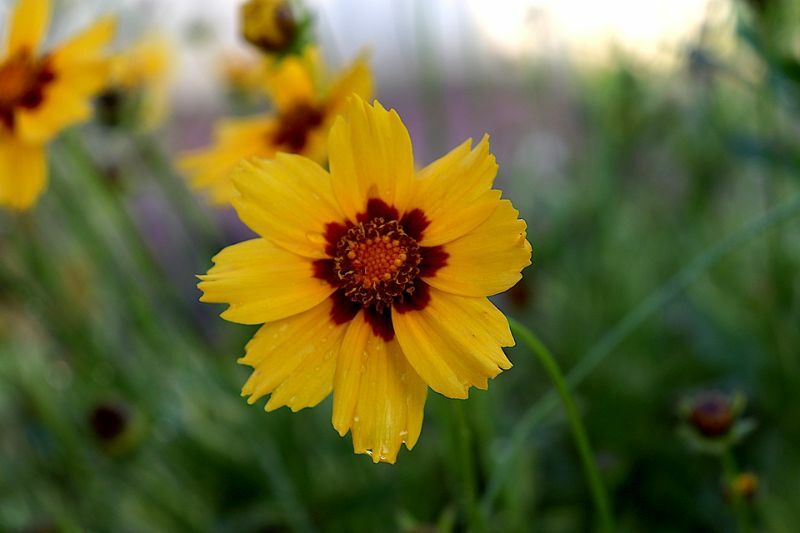
The National Garden Bureau, a non-profit organization dedicated to promoting the joys of home gardening, chooses one perennial, one annual, one bulb, and one edible plant to honor each year. It’s an excellent method to learn about a new plant or to learn more about one you already have.
The perennial coreopsis, sometimes known as tickseed, is the first of 2018’s four plants (Coreopsis). See 2018: Year of the Calibrachoa and 2018: Year of the Beet for details on two more 2018 winners.
Coreopsis is a genus of over 80 species that originated in the New World, with roughly 45 of them found in North America. Annuals and perennials, they are herbaceous plants that are generally small (rarely more than 2 1/2 feet/75 cm tall).
They have daisylike inflorescences that look like individual blooms but are actually compound flowers, as is typical of the Asteraceae family (sunflower family). They have a central disc of fertile florets surrounded by eight ray flowers (more in double and semi-double variations) and a serrated tip. The dominant flower color is yellow, with a reddish-brown halo on occasion.
The common name, tickseed, is derived from the Greek word coreopsis, which means “like a bug.” It gets its name from the bug-like appearance of the seeds of some former species, such as beggar-ticks, which have two projections that adhere to fur and clothing like ticks. Surprisingly, beggar ticks were long ago relegated to the genus Bidens. There are no “bug-like” seeds in any extant Coreopsis species!
Only a few species are cultivated, especially among the hardiest (the vast majority of species are tropical and cannot be grown in cooler climes except as annuals), but they nonetheless provide a wide range of options for our flower beds. Many coreopsis flowers continue to bloom throughout the summer, especially if deadheaded. Coreopsis has long been a favorite in gardens due to their prolific and long-lasting blooms… they also make great cut flowers.
Coreopsis are often meadow plants that thrive in full sun. They can take moderate shade, but prefer to be in direct sunlight. They adapt to all types of well-drained soils, and the most are drought-tolerant. Many species, however, rely on good drainage, particularly during the winter months. Clay soils are particularly troublesome. Many coreopsis thrive in raised beds because they provide improved drainage. Also, coreopsis prefers a soil that is not extremely fertile, as overly fertile soil can lead to weak stems that flop.
Pollinating insects (bees, butterflies, hoverflies, and others) enjoy coreopsis, and seed-eating birds frequent them in the fall and winter… if you don’t deadhead, of course!
From spreading beneath roots, rhizomatous types create masses of single stems. They’re the most hardy coreopsis, living for decades with little attention and being the most resistant to cold damp. They’re not usually invasive, but they may spread beyond their planting area if there are no plants to shade them out, necessitating control in some cases.
Clump-forming types have many stems that grow in tufts. They are usually short-lived in the garden, especially in soils that remain moist in the winter, frequently only surviving two or three years. You may, however, keep them alive for decades by creating new plants every two years from divisions or cuttings. As though to make up for their short lifespan, they are relatively simple to grow from seed, and many will bloom the first year from seed placed inside, which is a feat few perennials can achieve.
Annual variety, by definition, only live for one year. The majority of them survive by profuse self-sowing.
This coreopsis native to the southeastern United States stands out in a genus dominated by plants with narrow leaves by having trifoliate leaves that are relatively large, sometimes nearly spherical. The botanical (auriculata) and common names are derived from the two little leaflets at the base of the much larger center leaflet, which are supposed to resemble mouse ears.
The plant grows in a low rosette with little yellow flowers and evergreen leaves. It’s a long-lasting plant with short rhizomes that isn’t particularly invasive. It’s the first of the coreopsis to bloom, blossoming from spring to early summer because it’s a short-day plant (most others are long-day plants, with mid- to late-summer flowers).
The most popular mouse-ear coreopsis cultivar is ‘Nana,’ which grows to barely 10 in (25 cm) tall, but ‘Zamphir,’ which grows to 12-24 in × 12 in (30-60 cm x 30 cm) and has tubular ray blooms that resemble trumpets, is also extensively grown.
This coreopsis was once the most widely grown species in the genus (now C. verticillata), and most people just refer to it as coreopsis.
It’s a clump-forming plant that produces a plethora of green stems with narrow leaves. Lower leaves are simple, but those on flower stems have three to five lobes. The inflorescences are yellow orange in color, with a hint of reddish-brown at the base of the deeply serrated ray flowers. They range in size from 1 in to 2 in (2.5 cm to 6 cm) in diameter. It blooms all summer and into the fall, especially if you deadhead it (remove the faded flowers).
This species is one of the shortest-lived, very susceptible to powdery mildew and intolerant of damp winter conditions. Continue cuttings and divisions to keep it going. It also grows swiftly and easily from seed, blossoming the first summer after being grown from seed inside in March.
Large-flowered coreopsis can grow up to 36 inches (90 cm) in height in the wild, although practically all cultivated cultivars are much shorter, ranging from 16 inches to 24 inches (40 cm to 60 cm). The species and cultivars combine to form a cluster with a diameter of 12 in (30 cm). It’s a hardy plant that thrives in USDA and AgCan zones 3 and up.
Many hybrids are easy to grow from seed, including ‘Early Sunrise’ (double yellow, 16 in × 12 in/40 cm x 30 cm), which won an All-America Selections Award and a Fleuroselect Gold Medal in 1989.
How do you stop coreopsis from spreading?
After each use or between plants, disinfect pruning or cutting tools by immersing the cutting area of the instrument in rubbing alcohol or washing it off with a bleach solution. This washing aids in the prevention of disease transmission between the coreopsis and any other plants that the cutting tool may come into contact with.
Does coreopsis multiply?
Although perennial coreopsis are tough plants, they only last three to five years on average. A decrease in flowering indicates that it’s time to divide the plants (or start over from seed) in order to propagate them.
Are coreopsis Weeds?
Tick weed is a blooming perennial native to North America that is also known as tickseed or coreopsis. Summer through early fall, the plants grow up to 4 feet tall and produce yellow daisy-like flowers. Tick weed is popular for its ease of care, steady performance, adaptability to a variety of growing situations, and gorgeous blossoms. Once established, tick weed is relatively low maintenance. Tick weed grows in USDA Zones 4 through 9 and requires minimal maintenance in most parts of the country.
Can coreopsis be divided?
Divide Coreopsis (Coreopsis species) in the spring, late summer, or early fall. Cornflower (Centaurea species)Division is required every 23 years. In the spring, divide the crops. Divide daylilies (Hemerocallis species) in the spring or late summer/early autumn.
Does coreopsis attract ticks?
Coreopsis can be pruned in the fall after the growing season is over, but it’s best to leave the plant alone and wait until spring to prune the stems. The stems and seeds will provide cover and food for native insects and birds over the winter.
After all risk of frost has gone, let Coreopsis standing for the winter and cut the stems back to about 2-3 inches above the ground. Perennial Coreopsis varieties will be able to thrive and regrow as a result of this. It will also benefit the annual varieties by providing ample re-seeding opportunities.
Why Is Coreopsis Called Tickseed?
The name Coreopsis was inspired by the shape and look of Coreopsis seeds. Simply because the plant’s seed resembles ticks, Coreopsis is frequently referred to as tickseed. There is no need to be alarmed because this plant does not attract ticks.
Do coreopsis grow back every year?
Perennial coreopsis are a hardy and dependable plant for adding color to your garden in the summer. They’re herbaceous perennials that die back in the winter and sprout back in the spring to provide color year after year.
Plant perennial coreopsis in the autumn or spring to allow them to establish before the main growth season, though they can also be planted in the summer as long as they are kept well watered. Depending on the size of the variety, space plants 40-50 cm apart.
Sow annual coreopsis outside where they will bloom, or in containers to plant out later in the spring. Plant tender coreopsis for borders and containers once the final frosts have passed. Place them in full sun or partial shade, with well-drained soil.
Coreopsis thrives in any fertile soil as long as it is well drained. Use a peat-free multi-purpose potting compost for potted plants.
Do coreopsis come back every year?
Some coreopsis are perennial, meaning they live for more than a year, while others are annual, meaning they only live for a year.
When shopping for and selecting which coreopsis to plant, it’s critical to first determine if the desired plant is an annual or perennial in your location. In warmer climates, some plants are perennial, while in colder climes, they do not survive the winter.
In front of taller summer perennials like garden phlox, bee balm, or coneflowers, plant annual coreopsis. Annual coreopsis looks beautiful in pots on patios and balconies as well.
What can I plant with coreopsis?
The annual variety of Coreopsis, like its perennial sisters, has been hybridized to generate plants that are more compact, floriferous, and colorful than the wild parent. ‘Salsa,’ a compact 15″ tall variety with yellow and red bicolor blooms, and ‘Jive,’ a petite selection with bicolor blossoms with dark red centers and white margins on the petals, are two very appealing hybrids.
Coreopsis is a multi-purpose plant that works well in beds and borders, cottage gardens, and naturalized areas.
- For a splash of color, scatter them throughout the ornamental garden.
- To create texture to your environment, combine them with the spikier shapes of Veronica, Liatris, and Salvia.
- For a traditional color combo, pair the bright, joyful yellow options with contrasting blues or purples.
- In an informal meadow setting, combine Echinacea (coneflower), Hemerocallis (daylily), Monarda (beebalm), Achillea (yarrow), and Gaillardia (blanket flower).
- To soften the appearance of bold-leaved plants, use airy threadleaf species.
- In a seasonal container garden, combine annual species with tall spiky accent plants and trailing “spillers.”
- Plant skippers, buckeyes, painted ladies, and the occasional monarch in butterfly gardens to attract them.
- Full sun is preferred by Coreopsis (six or more hours of direct sun per day). It can grow in part shade, but it will not flower as well.
- Watering: Keep newly planted Coreopsis well watered until it establishes itself. It is drought hardy once established, though it will welcome a drink of water during really hot and dry conditions. C. rosea is an exception, as it prefers soil that is continually moist.
- Fertilizer: Fertilizer isn’t always necessary, and it might actually make the plant seem lanky.
- Apply a little application of a balanced granular 10-10-10 formula in early spring if you fertilize at all.
- Soil Preparation: According to research, Coreopsis thrives in sandy, well-drained soil. However, as long as the soil is sufficiently drained, it will withstand most soil conditions. In the winter, when our heavy, clay-based Virginia soils hold moisture, this is crucial. To fix the problem, add compost to flower beds to increase drainage and mound the planting site slightly to allow the soil to drain more quickly.
- Deadheading: While it may not be your favorite way of spend your free time, deadheading promotes more Coreopsis blooms throughout the growth season.
- It also prevents the plant from devoting all of its energy to seed production.
- Remove both the spent bloom and the flower stalk when deadheading.
- You’ll have a much neater plant if you cut the stems back to the foliage.
- Shearing: When flowering slows down in the middle of the summer, shear the plants by 25% to 50% to induce re-blooming. Shearing will result in the loss of some flowers and buds, as well as spent blooms, but the plant should be back in full bloom in a few weeks.
- Dividing: Divide every two or three years in the spring or early fall to retain vitality. Water newly transplanted specimens on a regular basis until they establish themselves.
- Late Summer Care:Coreopsis flowers so profusely that it exhausts itself. Late in the summer, trim the plants back by half or more to help prevent this. This could boost its chances of surviving the winter.
- End-of-Season Care: Coreopsis does not need to be pruned back in the fall, which will please the lazy gardener.
- In fact, the stems aid in the winter protection of the crowns.
- If you prefer your landscape to be neat and tidy, cut the stems back half way but leave 6 to 8 inches of stems in situ. Clean the crown of the plant of any dead leaves or other debris that could harbor pests, then sprinkle a layer of compost around the plant. A small layer of mulch spread around but not over the crown in late fall will help insulate the roots from winter temperature extremes.
- Seed The majority of Coreopsis species may be cultivated from seed, which germinates quickly and produces plants that are generally true to type.
- Many of the hybrids are sterile, meaning they don’t reproduce. To acquire plants that are true to type, Coreopsis selections with sterile blooms must be grown vegetatively (either by division or cuttings).
- Early in the spring, before the leaf develops, divide the plants.
- This procedure is applicable to both straight species and cultivars.
- Stem cuttings can be used to propagate C. grandiflora selections vegetatively.
- They’re simple to root as long as you have adequate plant material to conduct a stem cutting.
Coreopsis is relatively trouble-free when grown in ideal conditions (full light and well-drained soil). Powdery mildew is the most common condition, however it is rarely severe enough to require treatment. Slug and snail damage, as well as fungal patches and powdery mildew, can all be difficulties for this plant if the weather is consistently wet. Crown and root rot can be caused by poor drainage.
Accept the fact that Coreopsis is, for the most part, a short-lived species.
This is especially true in the case of C. grandiflora.
Many promising new hybrids, on the other hand, have been designed with the purpose of increasing its reliability.
Changing the environment in which this plant is grown can also extend its life and prepare it for winter survival.
Amending and slightly mounding the soil to enhance drainage, deadheading on a regular basis, dividing the plant every two or three years, and leaving the foliage in place over the winter to protect the crown from freezing temperatures are just a few examples.
Also, keep in mind that rhizomatous species are better equipped to endure soil moisture extremes than clumping species.
Virginia’s Flora (Weakley, Alan S., Ludwig, J. Christopher, Townsend, John F., 2012)
Third Edition of Herbaceous Perennial Plants: A Treatise on Their Identification, Culture, and Garden Attributes (Armitage, Allan M., 2008)
Do coreopsis plants spread?
Coreopsis grandiflora and coreopsis verticillata are both self-seeding and spread by rhizomes. The plants may need to be divided or replaced every 3 to 5 years in locations where coreopsis is perennial.