
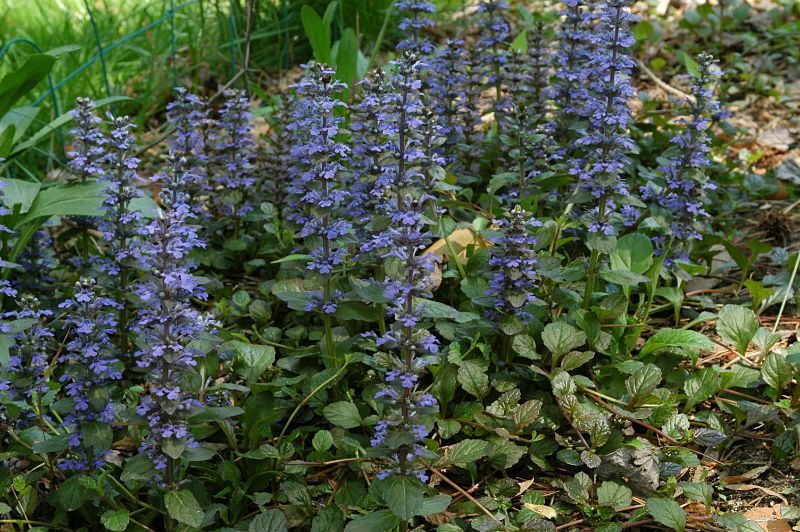
Don’t be fooled by a plant’s size. Ajugas may be little, but they are strong and hardy groundcovers. They can help with erosion control on a bank or slope, fill in a patchy lawn where grass won’t grow, or simply offer color to shaded areas. They’re also excellent for planting beneath bushes and trees.
Ajugas are very attractive because their leaf color and attractiveness last virtually all year, and they produce blue, purple, or white blooms from spring to summer. Ajuga reptans, sometimes known as carpetweed or bugleweed, is a perennial that thrives in zones 3 to 9.
The lustrous leaves of these evergreen shrubs form dense mats. They can tolerate full sun to partial shade, but full sun brings out the greatest color in the leaf. Ajugas are easy to cultivate in practically any type of soil and prefer a moist, well-draining environment, but they can endure dryness for short periods of time.
Because ajuga spreads through stolons, or horizontal stems that creep along the ground, it’s important to consider where you plant it. This mint family member spreads quickly and can become invasive. Planting too close to flower beds, lawns, or other areas where you’ll have to remove it frequently is a bad idea. If you’re worried that ajuga is an invasive plant in your area, check out the Invasive Plant Atlas.
Plant ajugas when all dangers of frost have passed. Then, spacing the holes 8 to 15 inches apart, dig holes just deep enough for the root balls. Gently loosen the roots of the plants, then plant them and firm the dirt around them. To settle them in and eliminate air pockets, water them thoroughly. Fertilizing ajugas is rarely necessary.
To keep your ajugas from becoming overloaded, you should thin them every three years or so. If desired, divide and replant established clumps in the fall or early spring.
Crown rot is an issue, particularly in hot, humid climates or in heavy soils. It’s easy to notice since the lower leaves have rot and spots on the tops of the plants. Give your plants plenty of air circulation and avoid overfertilizing to avoid this illness. Crown rot has no treatment, therefore if it appears, you’ll have to uproot and destroy the damaged plants. When it’s time to replant, consider a new type of groundcover to reduce the chances of the problem reappearing.
Patches of ajuga will occasionally die. If this occurs, remove the dead leaves but leave the roots in place. In most cases, the plants will return the next year.
Ajugas are low-maintenance plants with good rabbit and deer resistance. They don’t need to be pruned, but if you want them to look a little neater after the blooms fade, mow them using a high setting on your mower.
Try coral bells, hostas, ferns, daffodils, astilbe, forget-me-not, violas, hardy geraniums, and other woodland species if your ajugas are in the shadow.
Will Ajuga choke out other plants?
There’s no doubting that Bishop’s Weed in variegated form is a lovely plant. It thrives in shady areas where splotches of white are needed to liven things up. But you’ll never be able to enjoy just a smidgeon of Bishop’s Weed. Its roots form a dense mat as it grows, suffocating any neighboring vegetation. While this may sound like a good way to keep weeds at bay, it will eventually take over your garden plants as well.
Bishop’s Weed was initially labeled as invasive in Rhode Island in 1863, although you can still get it for sale. You may probably determine it’s a member of the carrot family by looking at the white, umbel blossoms, which look a lot like Queen Anne’s Lace. The plant does attract helpful insects, so it has some virtues, but it is simply the incorrect plant for many situations.
If you’ve already planted Bishop’s Weed and regret it, the best way to get rid of it is to use up all of your resources. In the early spring, cut it as short as possible and cover the area with plastic. The plants are unable to photosynthesize, receive insufficient water, and are overheated. They ultimately give up, even if it takes a long time.
Goutweed (a mashup of goat weedgoats will eat it) and Snow on the Mountain are other names for Bishop’s Weed.
How do you stop Ajuga from spreading?
Don’t put the plants in your compost pile; they’ll take root and you’ll be right back where you started – or worse.
Making a DIY, ecologically friendly pesticide by mixing equal parts very hot water and vinegar is another technique for getting rid of bugleweed. Add a pinch of salt and a few drops of liquid dish soap to the mix. Use a spray bottle or a garden sprayer to apply the solution.
If your grass doesn’t have ajuga, you might be able to smother huge portions with black plastic. Leave the plastic secured with bricks or boulders for two weeks to allow the sun to “bake” the ajuga. Leave the plastic in place for another two weeks if the plants are still alive.
Chemical herbicides – If all else fails, a chemical herbicide may be required for ajuga weed control. If you have ajuga in your lawn, read the label carefully and apply a non-selective herbicide that will kill the ajuga while leaving your lawn unharmed.
Chemical management should be utilized only as a last resort because organic methods are more environmentally friendly.
How quickly does Ajuga spread?
Ajuga will try to conquer the entire region in its immediate proximity. Although it is an aggressive spreader, it is relatively easy to contain because it spreads over the ground.
It is recommended that you use a shovel or a spade to edge the borders of the territory limit assigned to Ajuga twice a year, once in the spring and once in the middle of summer.
There is no need to be concerned because this plant does not spread quickly; rather, it spreads slowly and steadily.
You should not plant this next to a lawn because grass cannot compete with it and will quickly become overrun, leaving you with an Ajuga lawn rather than a grass lawn.
Is bugleweed considered invasive?
Kudzu, sometimes known as “the vine that ate the South,” was imported from Japan in 1876 to embellish the Japanese Pavilion at the United States Centennial Exposition in Philadelphia. The fast-growing vine was widely planted as a high-protein animal feed crop and to avoid soil erosion. Kudzu escaped cultivation and now covers millions of acres in the southeast, swallowing trees, buildings, and anything else that gets in its way.
Even if they could locate it for sale, most Southerners are aware of kudzu’s invasiveness and would not deliberately grow it. Other potentially invasive plants, on the other hand, are freely available. Non-native plants such as English ivy (Hedera helix), bugleweed (Ajuga reptans), and periwinkle (Vinca minor) were brought to the United States as ornamentals. They’ve escaped into woodlands and fields across the country, where they produce dense evergreen mats that drown out natural flora.
Can you walk on Ajuga?
It’s true that good things come in small packages. Ajuga, for example, grows only a few inches tall but provides a dazzling display of color in your garden. This easy-care walking groundcover plant, sometimes known as bugleweed, is prized for its ability to carpet your yard with colorful foliage over time. Ajuga produces blue, purple, or white flower spikes in the spring above a base of bronze, chocolate, brilliant green, or bicolor foliage. Ajuga grows well in pots as well.
Is Ajuga a good ground cover?
Ajuga is a ubiquitous groundcover, but this dark, coppery-burgundy variety works well with darker plants with spiky foliage, such as black mondo grass. Don’t be fooled by a plant’s size. Ajugas may be little, but they are strong and hardy groundcovers. The lustrous leaves of these evergreen shrubs form dense mats.
How do you control an ajuga ground cover?
Using impermeable black plastic sheeting, cover huge portions of ajuga to be removed (weed mulch or heavy garbage bags). Leave the area alone for at least four weeks after anchoring it with rocks. This deprives the plant of both light and water, severely limiting its ability to thrive.
Is ajuga invasive UK?
I’d like to issue a caution regarding bugleweed (Ajuga), which gets its name from the shape of the blue blooms that line its flower stalks: don’t be fooled by the pleasant music it makes in the landscape! It’s a very pleasing groundcover (especially those with purple colour), as my photo shows; unfortunately, it’s also an invasive plant like creeping jenny.
The kinds with dark leaves (such as Ajuga ‘Chocolate Chip’) are attractive even when they are not in bloom. Such leaf plants are a smart choice for savvy gardeners, as they provide a longer-lasting visual appeal than plants whose major selling point is their beautiful blooms.
Some cultivars contain the word “purple” in their names, indicating that they have purple leaves:
If you must grow Ajuga, do it in locations where you want it to take over, not in flower beds, because it is an invasive plant. When grown in the latter, off-shoots from the original planting must be cut on a regular basis! Ajuga, for example, would be a good substitute for lawns since it produces a mat and is strong enough to withstand foot traffic.
How do you encourage ajuga to spread?
Ajuga reptans, sometimes known as carpet bugleweed, is a prominent ground cover. It spreads rapidly by runners, forming a mat of dark green leaves 2 to 3 inches across in full sun and 3 to 4 inches wide in part shade. In full sun, selections with bronze or metallic-tinted leaves hold their color the best. The flowers, which are usually blue, are borne on spikes that are 4 to 5 inches tall. Early May to mid-June is when the plant blooms. Set aside established plants in the spring and they will cover the soil in one growing season. Plants should not be planted too deeply. It’s never a good idea to hide the crown. Runner plants can be dug out and replaced in the spring or early fall from established plantings.
Ajuga genevensis (Geneva carpet Bugleweed) is a perennial rock garden plant that grows 5 to 14 inches tall. It has grayish, hairy stems and coarse-toothed leaves up to 3 inches long that do not spread via runners. Blue flower spikes are the most common, but rose and white varieties are also available. Because it spreads more slowly than A. reptans, this upright species is gaining popularity. It is more sun tolerant than other Ajuga species.
Ajuga pyramidalis (Upright Bugleweed) is a 2 to 10 inch tall erect plant. Runners are not involved in the propagation of this disease. Many roundish, 11/2 to 4-inch long leaves grow from the stems, which contain long grey hairs. The huge purple bracts appear to press against the blue blooms on the flower spikes, which are 4 to 6 inches long.