
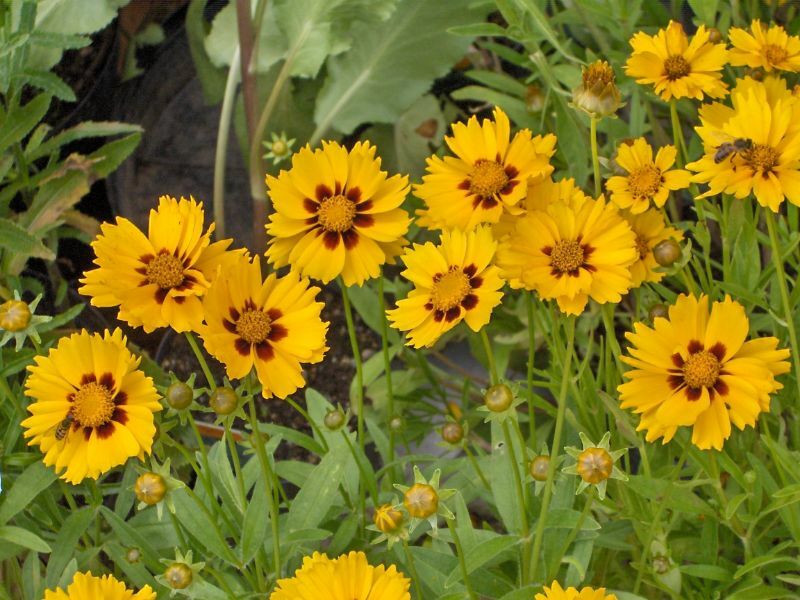
Tickseed is a popular native perennial flower that thrives in a variety of light and soil conditions. There are many newer tickseed types with a variety of bloom colors, including pink, scarlet, and bicolors, but they are not as hardy in all regions of our region. Tickseed leaves come in a range of shapes, ranging from lobed to thin and thread-like. In the summer, the plants produce little daisy-like single or semi-double flowers. Some types’ flowers are also suitable for cutting. Tickseed, like daylilies, is one of the easiest perennial flowers to plant since they grow in less than optimum soil fertility conditions as long as the soil is adequately drained.
While many kinds of tickseed are hardy in New England, some are only here for a brief time. Plant seeds indoors under grow lights 6 to 8 weeks before your last frost date, and then transfer outside once all threat of frost has past. You can also get divisions from a friend’s garden or buy transplants from a nearby garden center. Plant in full or part sun in well-drained soil from spring to early October. Plants should be spaced 1 foot apart.
Make sure to give fresh plants plenty of water. Tickseed requires little maintenance once grown and is drought resistant. To keep the soil moist and weeds at bay, cover plants with bark mulch.
The soil must be well drained during periods of damp summer weather, otherwise the plant will get crown rot. Tickseed may easily self-sow. In the spring, pull out self-sown seedlings. Taller types have a tendency to sprawl and may require support to avoid falling over. Insects and illnesses aren’t a problem for tickseed in general. Plants should be divided every 3 to 4 years to revitalize the mother plant and create extra transplants for replanting or giving away. After a frost, cut the plants back to the ground in the fall.
Plant coneflowers, blazing star, rudbeckia, and gaillardia with tickseed flowers. In meadows and wildflower beds, taller varieties are preferred. Tickseed is also a butterfly favorite. Plant some near the house or on the deck.
“Moonbeam” is a popular pale yellow-colored cultivar with small, fern-like leaves that grows only 1 foot tall. “Creme Brulee” has a similar appearance to “Moonbeam,” but is a faster-growing plant. “Early Sunrise” is a semi-double flowering plant that reaches 16 to 20 inches tall. However, in our climate, it may be short-lived. “Flying Saucers” has sterile yellow blooms that don’t self-sow. It’s a tougher plant that returns year after year and spreads less than other types. “American Dream” is a pink-flowered cultivar that grows 8 to 16 inches tall, although in colder climates, it may need protection.
How do you keep tickseed blooming?
Coreopsis, the cheerful daisies in yellow and pink, have become summer border staples. White with burgundy and salmon are two newer colors. Flowers are produced in large quantities for lengthy periods of time, especially if plants are routinely deadheaded. These drought-tolerant perennials provide bright, cutting-quality flowers and are simple to grow. There are types for the front, center, and back of the border, and they thrive in wildflower gardens and meadows because they are native Americans.
Full light, particularly on well-drained soils, brings out the best in Coreopsis. During droughts, Coreopsis needs to be watered, but once established, it is drought-tolerant.
Fertilizer/Soil/PH: Coreopsis isn’t picky about soil and will bloom profusely in a range of situations. It’s best to have well-drained soils, especially in the winter. Although it is not required, Coreopsis rosea prefers an evenly wet soil (in which it may run a little wild). Fertilize with a balanced granular formula once in the spring; too much fertilizer will result in spindly growth.
Pests/Diseases: Insects are rarely a problem for healthy, vigorous plants in good culture; mild aphid infestations can be washed away with a strong water spray. In addition, diseases are uncommon, especially in well-drained soils. The crowns may decay if the soil is excessively damp.
Companions: Yellow Coreopsis pairs well with butterfly delphinium (Delphinium grandiflorum) or other short Delphiniums. Flowers like alliums, daylilies, and coneflowers look great with these vibrant daisies.
Reflowering: While daily deadheading is inconvenient, it will provide the gardener with nearly constant bloom. Shear plants back by a few inches as flowering slows down in late July to obtain an attractive plant with the possibility of reblooming in the autumn.
Plant Dividing/Transplanting: To maintain vitality, divide plants every three years in the spring or early fall. Please keep in mind that Coreopsis ‘Moonbeam’ will arrive as a tangle of roots and stems that will make it difficult to tell top from bottom. Simply dig a wide, shallow hole and place the spidery creature inside, covering it with an inch of earth. The plant will send roots down and branches high when gravity takes over.
End-of-Season Care: Don’t prune all the way back for the winter; the stems that remain will safeguard the crowns. A mulch of salt hay or evergreen boughs will help ‘Moonbeam.’
When new growth sprouts in the early spring, apply a light application of granular 10-10-10 fertilizer or side-dress with compost and organic amendments. If spring rains are inconsistent, water newly planted Coreopsis on a regular basis. If wanted, divide or transfer immediately.
Summer: Deadhead every day to ensure a longer bloom time. To foster more appealing form and probable reblooming in the autumn, shear plants back by 1/4 to 1/2 inch.
Fall is a good time to divide or transfer plants if necessary. To protect crowns through the winter, don’t prune all the way backleave stems at 68. Salt hay or evergreen boughs can be used to mulch ‘Moonbeam.’
Do you have to deadhead tickseed?
If not deadheaded, they self-seed aggressively and quickly crowd out less vigorous plants. Unless you want a wide swath of tickseeds in your garden bed, volunteers should be removed and either thrown or replanted in another part of the garden.
How long do tickseed flowers last?
Bloom Coreopsis tinctoria (04) In Southern gardens, this short-lived perennial lasts two to three years, but in Northern gardens, it lasts four years.
Do you need to trim tickseed?
Pruning. To extend the blooming period of tickseeds, deadhead them. Shear the plant to 1/3 of its original size or snip off the flowers right above the next bud. It’s possible that by cutting it back like this, the tickseed will generate new buds.
How does tickseed spread?
Coreopsis has only one flaw: it is short-lived and unreliable in terms of perenniality. Many gardeners lament the fact that it only lasts two or three years. Others have seen that some varieties self-seed all over the garden and grow up in unexpected locations. Despite these drawbacks, this perennial favorite remains popular and is regularly planted or replanted year after year.
In order to improve Coreopsis, famous plantsman Darryl Probst and others instituted a number of hybridization programs.
Plant trials, including a three-year trial undertaken at the Mt. Cuba Center botanical garden in Delaware between 2012 and 2014, show that these hybridization efforts have improved the species.
With so many highly hybridized selections on the market these days, it’s a good idea to take a step back and learn about Coreopsis kinds and species.
Coreopsis is a genus of roughly 100 annual and perennial plants belonging to the Asteraceae (aster or daisy) family.
They can either form clumps or spread by rhizomatous roots.
The majority of Coreopsis species are clump forming.
Unfortunately, these are usually short-lived, and several of the members of this group are best handled as annuals.
Rhizomatous species have a longer lifespan and are more dependable perennials.
The following are some of the clump-forming and rhizomatous Coreopsis species commonly found at garden centers around the Mid-Atlantic:
- Coreopsis auriculata (Lobed or Mouse-Eared Coreopsis) Coreopsis auriculata (Lobed or Mouse-Eared Coreopsis) Orange-yellow blooms and oval-shaped leaves characterize this rhizomatous species. When in bloom, it develops spreading clumps that grow 2 to 3 feet tall and spreads quickly by rhizomes and seeds. A dwarf cultivar, ‘Nana,’ is half the size and one among the best in the genus. ‘Jethro Tull’ and ‘Zamphir,’ two popular C. auriculata cultivars, with open-ended, fluted ray blooms.
- C. grandiflora (Large-flowered Coreopsis) This clump-forming plant blooms early in the season and then blooms again later in the season.
- Although it is not a true perennial, lasting only 2 or 3 years on average, it has a strong ability to self-seed and may appear as a pleasant surprise throughout your garden.
Does tickseed need full sun?
The majority of tickseed varieties require full sun, however a few varieties will grow in moderate shade. In zones 4 through 9, “Rising Sun” (Coreopsis grandiflora “Rising Sun”) grows in full sun to moderate shade and produces enormous, yellow blooms. Moonbeam (Coreopsis verticillata “Moonbeam”) is another full sun to partial shade tickseed that thrives in zones 4 through 9. “Moonbeam” blossoms are a pale yellow color with a star-like appearance. The colorful flowers of this drought-tolerant tickseed grow between 1 and 3 feet tall and attract butterflies.
Why is my tickseed dying?
Crown rot (Sclerotium fungus), root rot (Rhizoctonia fungus), and stem rot can all affect Coreopsis (Alternaria, Rhizoctonia or Sclerotinia fungi).
When can I move tickseed?
Tickseed flowers (Coreopsis spp.) thrive in USDA plant hardiness zones 4 through 9. Many kinds climb up to 3 feet tall and spread 2 feet wide in the summer, with daisy-like flowers. Butterflies are drawn to this herbaceous perennial in the yard. Overcrowding of flower clusters can be avoided by transplanting tickseed. Tickseed clones are created by dividing up the parent clumps. Dig up the tickseed clumps every two to three years, either in the fall after the plant has finished blooming or in the early spring before new growth begins.
How do you winterize tickseed?
In the autumn, whether you decide to prune back or not, surround the plant with plenty of mulch. Apply at least 2 or 3 inches (57.5 cm) if you reside in the northern reaches of the growing zone, and more if you live in the northern reaches of the growing zone.
After late summer or early fall, don’t fertilize coreopsis. It’s not a good idea to stimulate young, sensitive growth that will be suffocated as temps drop.
Until the ground freezes, keep watering coreopsis and other perennials. Although it may seem counterintuitive, roots in damp soil are better able to resist freezing temperatures than those in dry soil. Watering and mulching are the most critical actions to do when it comes to winterizing coreopsis plants. Because the plant will be in a dormant stage of growth, no extra coreopsis winter care is required.
Remove the mulch as soon as the threat of frost has passed in the spring. If you wait too long, moist mulch could attract pests and illness. Apply a little application of all-purpose fertilizer, followed by a thin coating of new mulch.
Why is it called tickseed?
When rookie gardeners hear the word tickseed, they are likely to flee for their lives. Ticks are one of the parasites you don’t want to see in your yard or around your house, so the idea of a flower that can attract ticks sounds like a nightmare. Of course, anyone who knows anything about tickseeds knows that the name of this bloom isn’t a danger. (However, if ticks are a concern, try planting some of these deer-resistant plants!)
Tickseed is a popular name for Coreopsis and a few other genera of flowering plants with beautiful heads. Coreopsis, the genus name, means “bug-like” in Greek. The popular name Tickseed comes from the form and color of the seeds, which resemble ticks. Coreopsis are stunning blooms that would be a welcome addition to any garden. Tickseed comes in a variety of colors, including yellow, peach, red, and fuchsia, and they look great in patio planters and borders. Oh, and some of them also attract bees and butterflies, so you can be assured that your buds will be fertilized properly!