
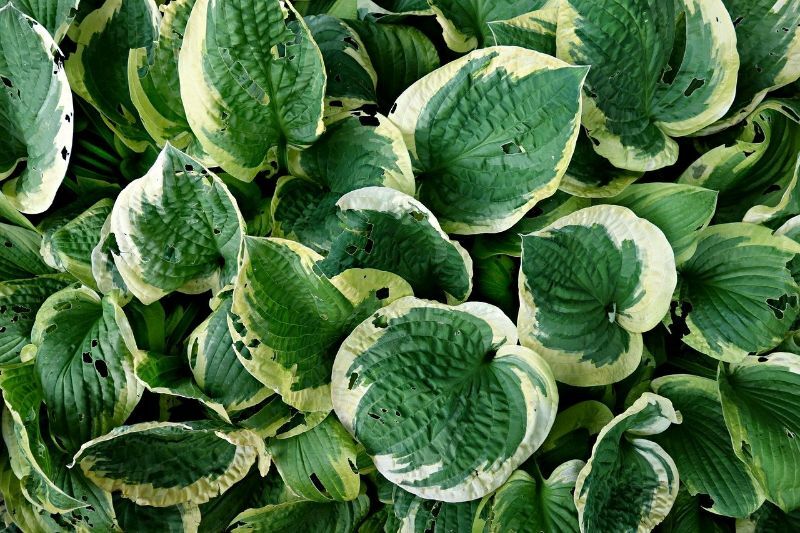
Hostas are now available in sizes ranging from a few inches to several feet tall, with leaves in a variety of striking and muted patterns and hues. Larger types can be highly architectural and stand out as specimen plants, while smaller variants are great for edging, lighting up a woodland, and stabilizing a slope.
Light/Watering: Once established, these drought-tolerant plants thrive in evenly moist soil in moderate shade, however a few will withstand full sun with enough water. Hostas can withstand a lot of drought once they’re established, and they’ll compete successfully with tree roots in the north, but they’ll need regular watering in the south.
Fertilizer/Soil and pH: Hostas grow in average, slightly acidic soils, and will benefit from a modest fertilizer application in early spring. These low-maintenance plants can be disregarded and yet perform well; but, to get the most out of them, supply deep, rich soil and continuous watering, as well as a side-dressing of compost or aged manure on occasion. Organic mulch is beneficial, but it should be kept away from the crowns.
Slugs are the plague of Hostas, so use slug bait, beer dishes, and diatomaceous earth to keep them away. Voles have been known to consume the roots of plants, so trap them or use another strategy to keep them away.
Other shade-loving plants that go well with Hostas are ferns, Tiarella, taller Campanulas, Phlox divaricata, Daylilies, and, notably, genuine Lilies. They’re great for planting among spring-flowering bulb patches since their foliage will hide the bulb foliage when it fades down.
Reflowering: Only a few types will reflower; when blooming is finished, clip flower spikes off at the root.
Dividing/Transplanting: These tolerant plants are best divided in the spring when the young leaves are still furled up, but division and transplanting can be done at any time of year if proper follow-up watering is paid attention to.
End-of-Season Care: Cut back foliage in the fall to remove cover for overwintering slugs, although this can also be done in the spring.
When new growth sprouts in the early spring, apply a little application of balanced or slow-release fertilizer, or side-dress with compost and organic amendments. Now is the time to divide or transplant before the leaves unfurl. If the weather is very dry, water newly planted plants well, as Hostas need evenly damp soil.
Mulch plants after the earth has warmed up, but keep mulch away from the crowns to prevent rot.
Late spring: Keep an eye out for slug damage and take precautions if slugs are present.
Unless you wish to collect seed, groom plants by removing yellow or dead leaves and cutting flower spikes down when they complete blooming.
Cut the foliage back to the soil level in the fall. After the ground freezes, cover new plants with a winter mulch of evergreen boughs or salt marsh hay to help prevent heaving.
Can you keep plantain lilies indoors?
Hostas, in general, are shade-loving plants. This makes them ideal for growing indoors, where light levels are typically low, especially during the winter months.
Do plantain lilies come back?
Plantain lilies are intriguing plants that are gaining in popularity. Some of these lovely perennials are already sought-after collectibles. The heart-leaf lily is not a turbo perennial like many other plants; instead, it grows lusher and more gorgeous year after year as long as it is left alone.
This gorgeous leaf forb captivates with increasing beauty and lifespan with a little patience and good care. As a result, it is generally undemanding and easy to maintain in the proper place.
Where do hostas grow best?
Choose a location that receives partial to full shade when planting hostas. Hostas can survive morning sun but prefer to be in the shade. It’s crucial to understand that these perennials thrive in lush, organically rich soil. Hostas should not be planted in heavy clay soil since the drainage will be inadequate. Place hostas where snow tends to pile up in places that get a lot of snow in the winter to preserve stems and leaves.
Do plantain lilies spread?
‘First Frost’ (Plantain Lily) develops lovely, thick mounds of erect, heart-shaped blue-green leaves, 7in. long (17 cm), with wide gold borders in spring, gradually ripening to creamy-white, and is prized for its foliage that remains attractive until first frost. In midsummer, funnel-shaped pale lavender blooms occur on scapes 28 in. long (70 cm), but the hosta’s main feature is its gorgeous foliage. Hosta ‘First Frost’ is a low-maintenance plant that grows to a height of 16 inches (40 cm) and a width of 24-36 inches (60-90 cm).
Why is my plantain lily turning yellow?
Hosta leaves can become yellow for a variety of reasons, and it’s critical that you figure out which one relates to your plant.
Hosta Leaves Turning Yellow from Scorch
When yellow hosta leaves suggest too much sun, it’s probably the easiest problem to fix. Hosta are shade-loving plants that thrive in partial or full shade. In fact, they’re a common sight in the shade garden. Yellow hosta leaves can be expected if grown in full sun. The leaves turn yellow and burn at the edges. Hosta scorch occurs when the leaves of a hosta plant become yellow as a result of too much sun.
If the plant is also cultivated in poor soil, the scorch will be significantly worse. The plant prefers moist soil that is rich in organic materials. The hosta leaves turn pale and burn when they are dried out in full light during a drought. You can provide temporary relief to the plant by watering thoroughly early in the day, but a better and more permanent option is to relocate the hosta to a shaded location with high organic matter soil.
Yellowing Leaves on Hosta Indicating Disease
When yellow hosta leaves signal disease, the treatment options become more limited. Petiole rot, caused by the fungus Sclerotium rolfsii var. delphinii, can produce yellowing leaves on hosta plants. Yellowing and browning of the lower leaf edges are the first signs of the disease. Your plant most likely has this disease if you notice brown, mushy decay with white fungal threads or fungal fruiting structures around the size of mustard seeds near the base of the petiole.
How do you plant a Plantain Lily?
Seeds or roots can be used to grow Plantain Lily. These can be planted in the spring or buried in the summer. Cover the seeds with earth and bury the roots to a depth of about 10 cm (4 inches). They prefer a wet slightly acidic to neutral pH of 5.5 to 7 in a shaded section of the garden.
Plantain lilies can be started indoors, but success is hit or miss. At 10 degrees Celsius (50 degrees Fahrenheit), they take two to three months to germinate. Plant out in the spring with a 45 cm (18 inch) spacing (small Hosta variations) or 90 to 120 cm spacing (big Hosta types) (36-48 inches; larger species).
What term best describes the leaves of a Plantain Lily?
, also known as hostas, plantain lilies, and gibshi in Japan) is a genus of plants that includes hostas, plantain lilies, and gibshi. Shade-tolerant foliage plants, such as Hostas, are extensively grown. The genus is native to northeast Asia and belongs to the Asparagaceae family, subfamily Agavoideae (China, Japan, Korea, and the Russian Far East). The genus was originally classified in the Liliaceae family, like many other “lilioid monocots.” In 1812, Austrian botanist Leopold Trattinnick named the genus after Austrian scientist Nicholas Thomas Host. In honor of Heinrich Christian Funck, a fern and alpine collector, German botanist Kurt Sprengel introduced the generic name Funkia in 1817; this was later used as a common name and can be found in some older literature.