
Place your jar in a dark location. The tiny seeds may be harmed if they are exposed to direct sunlight. The recommended storage temperature is between 86F and 30C. It’s a good idea to keep your belongings in your drawer. The kitchen cabinet is also functional.
How long do Adenium seeds last?
7. Every day, remove the nylon to allow fresh air to enter. The nylon rest should last 10-20 minutes, after which it should be covered again. If the substrate does not dry out during germination and remains moist, you have done an excellent job. However, if the substrate appears to be dry on the surface, spritz it with water, as the seed should not be in a dry substrate.
8. Your flowerpot must be placed in a well-lit area, but under no circumstances should it be exposed to direct sunlight, since the seed will overheat in heated soil and burn up after germination. The ideal temperature is from 77 to 95 degrees Fahrenheit (25 to 35 degrees Celsius). It’s not a problem if the temperature dips to 62-64°F (17-18°C) during the night, but it’s ideal if it stays above 77°F (25°C) during the day. The seed will germinate in a room with a temperature of 70-71°F (21-22°C), but it will take longer and have a lower germination success rate.
9. If you’ve supplied ideal conditions, the majority of seeds will germinate between days 3 and 5. Germination will take longer if there isn’t enough moisture or if the temperature doesn’t get over 77°F (25°C). It shouldn’t be more than ten days lengthy. There have been instances where the seed has germinated even after a few months, but this is unusual.
10. After the seed has germinated, leave the nylon cover on for a few more days. You can take it off later if you like, and you don’t have to cover the seed.
11. When the seed germinates, the seed shell on the leaves typically falls off on its own, but it sometimes get caught and prevent the leaves from opening. If it doesn’t fall out after 2-3 days, GENTLY remove it; else, the seedling may perish. Spray the plant first to soften the shell, then gently push the shell from the bottom with your nail, and it will easily slide off. You can easily shatter the leaves if you pull the shell from the top. Even if you do this, don’t discard the plant; instead, allow it the opportunity to produce new ones.
12. The seedlings should be kept in a bright light and kept warm for the first 2-3 months following germination, up to 100°F (38°C), but should never be exposed to direct sunlight. Just after 2-3 months should you gradually expose your plant to the sun, but only for an hour or two in the early morning or late evening, when the sun is not too intense.
Adenium maintenance:
The most crucial factor for rapid growth in young plants is plenty of light and temperature. If you’re sowing in the winter, when the days are shorter, try to place the plant near a bright light bulb or a window. During the day, that should be the window that receives the greatest light. If the plant does not receive sufficient light, it will develop in height rather than width. Allow the plant to gradually become accustomed to direct sunlight after 2-3 months, but do not allow it to spend the entire day in direct sunlight during this time. During the first 5-6 months, try to leave it somewhere where they will get 1-2 hours of light. After that, you can leave the plant out in the sun for greater lengths of time, and after the first year, you can leave it out in the sun all day (provided that it was accustomed to it beforehand).
The optimal temperature is from 77 to 95 degrees Fahrenheit (25 to 35 degrees Celsius). When the daytime temperature rises above 95°F (35°C), the plant should be moved out of direct sunshine to avoid burns. When it comes to low temperatures, Adenium can withstand temperatures as low as 50°F (10°C), so if the temperature drops below that at night, it’s time to bring the plant inside. Older plants are more robust, and they can withstand a few nights below 50°F (10°C). It is, nevertheless, preferable to bring them indoors.
Despite its reputation as a desert plant, Adenium prefers plenty of water. The more water it requires, the hotter and sunny the weather becomes. The most significant factor is soil drainage. You can even water it everyday if the drainage is good and the extra water runs out quickly. During the summer, though, it’s a safe bet to water it every 2-3 days. Simply wait for the substrate to dry before watering it, whether it’s once a day or once a week. If the soil has inadequate drainage and the root is frequently submerged in water, the root will rot and die. Young plants, up to a few months old, cope considerably better with additional water, so don’t let the substrate dry completely.
Adenium may grow in practically any substrate as long as it is bright and has adequate drainage to let the roots to breathe. A nice idea would be to use a cactus mix that includes quartz sand. You can combine any sand, perlite, broken brick, or anything else with granulation 0.07-0.15 inches (2-4 millimeters) with store-bought garden soil to improve drainage. Coconut peat is also a good option, but keep in mind that it contains no nutrients, therefore you’ll need to fertilize the soil on a weekly basis.
Adenium responds well to topdressing, but when it comes to these plants, a simple rule applies: use topdressing frequently and in little amounts. That means that when you buy fertilizer, you should dilute it by half or even more than the amount specified on the package. Equal fertilizer, with an equal amount of macroelements NPK and microelements like as magnesium and calcium, is the best option. NPK 10-10-10, for example, might be a decent pick. If you can’t find something similar, go with a fertilizer that contains more N and P. Plant growth necessitates the use of nitrogen, whereas blooming and root system strength necessitate the use of phosphorus.
Adenium’s mortality is most commonly caused by a combination of cold temperatures and over-watering. If your country experiences frequent cold temperatures during the winter nights and no high temperatures during the day, you can reduce watering to once a month. If it’s really hot and sunny where Adenium lives, you can water it nearly as much as you would in the summer.
Do you soak desert rose seeds before planting?
Remember to soak the seeds in water before sowing them. Soaking your seeds for 2-4 hours helps compensate for moisture loss over time if your seeds are more fresh. If the seeds are a little older, soaking them for 24 hours will weaken the shell and increase the germination rate.
How do you start a desert rose from seed?
When it comes to desert rose plant seed beginning, the most important thing to remember is to start with fresh seeds. Fresh desert rose plant seed will germinate more quickly and have a greater germination rate. Purchase your seeds from a reliable dealer or locate an owner of a couple adult plants (two plants are required to produce seeds) who can provide you with seeds directly from the plants.
Begin by filling a container with a well-draining growing medium, such as perlite or a sand and soil mix, to start adenium seeds. Place the seed in the growing medium and only cover it with the medium.
Water daily from below and once every three days from above until seedlings sprout. Place the growing tray or container on a heating pad and keep the growing medium between 80 and 85 degrees Fahrenheit (27-29 C.).
If the seeds are fresh, your desert rose plant seeds should germinate in one week. It may take longer if they are not fresh (if at all). Water just from below once the seedlings appear. The seedlings will be large enough to transplant to a permanent container in approximately a month.
How many days does it take to germinate Adenium seeds?
Adenium are simple to cultivate as long as you provide them with the necessary nutrients. They normally germinate in 7 to 10 days, while some may germinate in as little as a day or two.
What is the best time to sow Adenium seeds?
Spring is the optimum time to plant adenium seeds. However, don’t let anyone tell you that you can’t seed in the winter because you can. However, you should only do so if you are confident that you will be able to give enough light and warmth throughout the winter season.
How deep do you plant desert rose seeds?
Position the seedling in the center of the pot, with the root ball’s top 2 inches below the pot’s top. Add more dirt to the pot until the soil surface is level with the root ball’s top. Plant the seedling no deeper than it was growing before.
Is Adenium a bonsai?
Yes, planting Adenium obesum or Desert Rose bonsai is a wonderful way to enjoy these plants.
This small, robust, and easy-to-grow succulent tree is native to Arabia and Africa and belongs to the dogbane family. In the United States, it is also a favorite decorative.
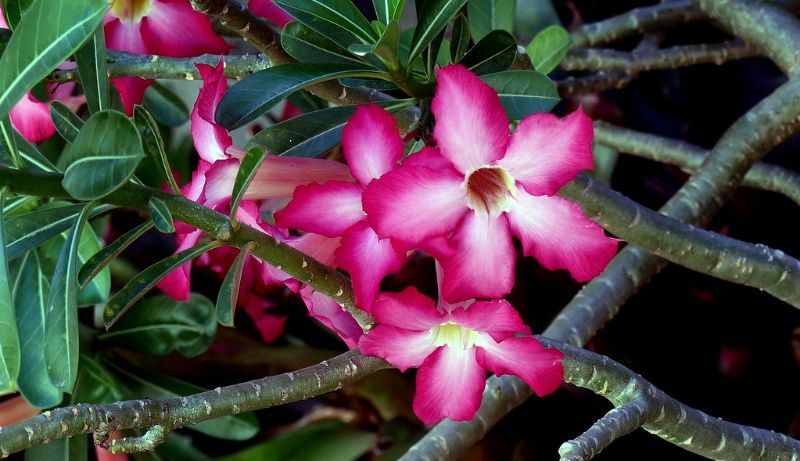
The tree grows to be around 3′ 5′ tall on its own, with magnificent (occasionally fragrant) pink, white, red, or black trumpet-shaped blooms, thick, glossy leaves, and a bulbous base. For bonsai, look at the Black Adenium.
Rose of the Desert Adenium obesum is a common ornamental home plant that is also frequently cultivated as a bonsai!
Cuttings or seed are both basic ways to propagate the Adenium obesum plant.
It is fast-growing and thrives in a compact container, so you won’t have any trouble keeping it as a bonsai tree.
How long do desert rose Flowers last?
During the spring and summer, desert roses bloom for several weeks. Some new and improved cultivars may bloom all year if properly cared for. Be patient once again.
Is Epsom salt good for desert roses?
Epsom salts are highly recommended by rose producers in particular. It not only makes the foliage greener and lusher, but it also generates more canes and roses, according to them. To apply Epsom salt to existing rose plants, either mix 1/2 cup of the salts into the soil surrounding the bush and water well, or dissolve 1/2 cup of the salts in water and use to moisten the soil around the rose bush. This is best done in the spring, when the buds are just beginning to open.