
- Start seeds inside 2 months before the last frost; cold stratification in the refrigerator is essential.
- Seeds should be started in a cup of water. Make use of a seed mat that has been heated. There is no need for cold stratification.
How do you grow Asclepias tuberosa from seed?
Sun-loving Asclepias (Milkweed) plants are important perennials for monarch butterflies because they provide food for larvae and nectar for adult monarchs. They bloom from mid-summer to early-fall and are resistant to rabbits and deer because to their milky sap.
For plant care, Asclepias tuberosa with orange (occasionally yellow) blooms and all other species with pink (sometimes white) flowers can be split into two groups.
The seeds of milkweed (Asclepias) germinate best in warm soil. To germinate, the seeds require a chilly, inactive phase called as stratification.
They can be successfully sown outside in frost-free locations in the fall for spring germination. All species (A. tuberosa, A. syriaca, A. sullivantii, A. incarnata) will germinate relatively well when sown into warm earth after being stratified in mid to late spring (chilled).
Dry stratification is the process of putting dry seed in the refrigerator for 30 days or more. A more effective technique is to moist stratify them in the refrigerator for 30 days by mixing seed with moist (not soggy) sand in a zip-lock plastic bag. The seed’s inherent chemical germination inhibitors have disappeared after 30 days of cool wet storage, and it is ready to sprout.
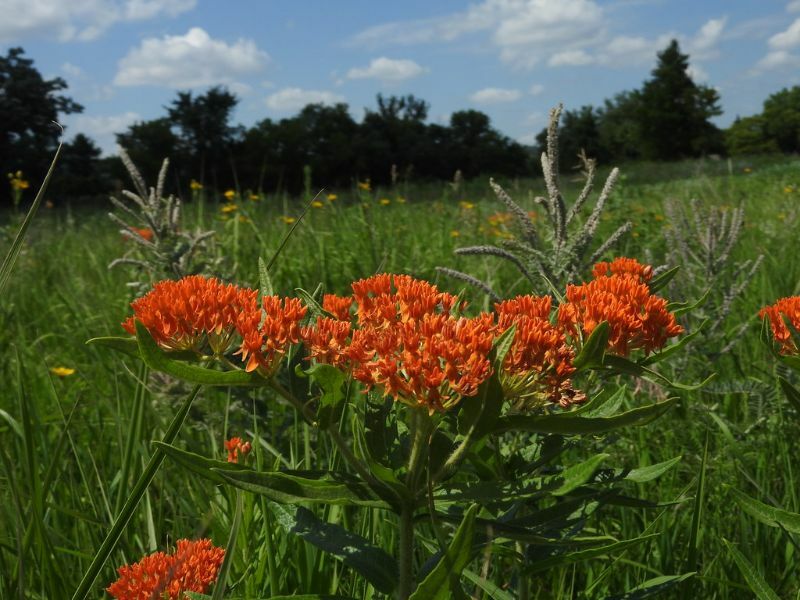
- Orange Butterfly Weed (Asclepias tuberosa) – This perennial, especially when cultivated in containers, stays dormant until later in the spring than many other plants. Planting dormant plants is OK; do not repot them for planting later in the season.
- Soils that are sandy or gravelly are required (except the Clay form which does well in heavier soils including dry clay.)
- After their second growing season, they just need to be watered deeply but infrequently. Plant in direct sunlight.
- It only takes a few handfuls of compost and Yum Yum Mix to fill the planting hole. Planting in a rich, substantially modified soil is not a good idea.
- When planting dormant plants, water thoroughly after planting and then wait until the plant begins to develop actively, at which point a deep soaking once a week or so is sufficient. Young transplants should not be overwatered.
- Asclepias has a long, carrot-like tap root that should not be separated and should be left alone after planting.
- These are moist-loving perennials that thrive in moist to moderately moist soil.
- Asclepias syriaca and A. speciosa will expand to form large patches of plants, thus they should be planted in areas where they won’t force out less vigorous species. It’s not a good idea to use it in the most prominent areas in your perennial beds.
- Swamp Milkweed (Asclepias incarnata) is a more refined grower that is good in perennial beds.
Milkweeds don’t always develop much in their first year in the ground, so be patient. They’re building their root and crown systems. The plants will begin to grow larger and more vigorous by the second growing season. Asclepias species are unusual perennials that don’t behave like most other perennials. As a result, be patient and accept their peculiarities.
- Use Yum Yum Mix and Planters II to fertilize Asclepias only once in the fall. Additional fertilizer is not required for naturalized plantings.
- Leave the stems intact over the winter to enable re-seeding and provide winter interest with their attractive seed pods. Remove old stems just above ground level in mid-spring.
- Because all Asclepias species emerge late in the spring, don’t be alarmed if other perennials sprout first and they stay dormant.
How do you start Asclepias seeds?
Milkweed seed can be directly planted in the ground or started indoors. Milkweed seeds can be sown by sprinkling them 1/4-1/2 inch apart on the soil surface, then covering them with another 1/4 inch of earth. After planting, water the area often until the plants have established themselves. Before planting, several species must be vernalized (cold treated). After the threat of frost has gone, vernalized seeds can be planted in the spring. Non-vernalized seeds can be planted in the fall, and the cold treatment will be provided by nature. Further advice, information on vernalization, and directions for beginning milkweed seeds indoors can be found in Monarch Watch’s milkweed propagation guide. Watch Chip Taylor of Monarch Watch discuss milkweed growing techniques and best practices in our Monarch Conservation Webinar: Growing Milkweed for Monarch Conservation (scroll down to May 2016). Visit the Xerces Society’s Milkweed Practicitoner Guide for more information on milkweed growing and conservation use. It’s a comprehensive guide on milkweeds, including biology/ecology, propagation, wildlife benefits, and use in restoration projects.
Should I soak milkweed seeds before planting?
- Soak milkweed seeds for several hours or overnight in water; tap water will suffice.
- After the seeds have soaked, place them in a sealed plastic bag with moist stratification mix (we mean “wet” as in a damp sponge with no surplus water).
- For at least two weeks, keep the bag of damp seeds in their mix refrigerated. 30 days of cool wet stratification gives 85% germination or better for several Asclepias species.
- Check your seeds once or twice a day; some seeds, such as A. incarnata and A. tuberosa, may germinate in the bag.
What is the best time to plant milkweed seeds?
Planting Milkweed Seeds in the Fall – The optimum time to plant milkweed seeds is in the fall. Because the seeds require natural freezing and thawing to soften the seed coat and allow the embryo plant to grow, they won’t germinate until spring.
How do you germinate common milkweed seeds?
The following important procedures must be followed in order for a large percentage of Milkweed Seeds to germinate.
- For 30 days, winter-sow or cold-moist stratify the seeds. You can also sow directly in the fall/autumn. This will cause the seeds’ dormancy to be broken, allowing them to germinate.
- Keep the seeds in a location that gets morning and afternoon sun (Typically East-Facing wall)
Materials
The items indicated below are for individuals who want to start their seeds in pots or winter-sow. If you’re using direct sowing, you can jump forward to the next step!
*To avoid making a mess when gathering Milkweed Seeds, we created a guide.
You might want to take a look; it’s quick, simple, and straightforward.
Process to Germinate Milkweed Seeds
To get a high germination rate, milkweed seeds should be winter-sown or cold stratified for at least 30 days.
- Fill your containers halfway with potting soil that has been moistened. To the top of the container, leave a 1/2 (12 mm) gap.
- It’s important that the soil is damp but not dripping wet.
- You should be able to squeeze a fistful of it and just have a few droplets come out.
- Sow your seed.
- In each container or cell, scatter 3-5 seeds on top of the soil.
- Firmly press the seeds into the soil.
- Milkweed seeds require strong soil contact to germinate.
- Seeds placed too deeply, on the other hand, will not germinate.
- It’s completely good to plant quite shallowly.
- More soil should be added.
- Top the seeds with a light sprinkling of dry potting mix.
- I usually only plant 1-3 mm deep.
- Using your spray bottle, mist the seeds.
- Mist the seeds gently with water, being careful not to dislodge them.
- More seed should be planted.
- Sprinkle a few additional seeds on top of the now-wet soil.
- Firmly press them into the dirt once more.
- Not all seeds will germinate.
- Adding a few additional seeds on top of the soil can help assure germination, according to my experience.
- Mist the seeds with water.
- Reapply a little mist with your spray bottle.
- Then gently press your thumb on the cells again to achieve adequate soil contact.
- Plant seeds in an area that gets morning sun and afternoon shade.
- Typically, an East-facing wall is the best choice.
- If this isn’t possible, just make sure the seeds are kept moist and exposed to the sun.
- After temps reach 65-70F (20C) throughout the day, germination should take place in a few weeks.
How long does it take to grow milkweed from seed?
SOWING SEED: After shallow cultivation, seed should be sowed as soon as possible in loose soil. Cover lightly with soil and water thoroughly. In 1-2 weeks, the seeds should sprout.
How many milkweed seeds should I plant?
To help milkweed seeds germinate, they must be stratified. When a seed is soaked, refrigerated, or frozen, then thawed, germination inhibitors on the seed coat, such as waxes, hormones, oils, or thick coatings, are broken down. Milkweed seed is naturally stratified when planted in the fall. The natural process of snow and cold breaking down the seed casing must be replicated by chilling spring-planted seeds in the refrigerator.
Fall seed planting
In the fall, sow seed in a sunny spot. Simply scatter seeds over well-tilled soil, pat them down, cover with earth, and water them in. Outside, fall-sown seed will stratify organically.
Spring seed planting
Milkweed seeds can be planted as soon as the soil can be worked in early spring, but they must be stratified in the refrigerator for 2 to 3 months before planting in the spring for improved germination.
Thin seedlings to 6 inches apart after emerging milkweeds have three to four sets of leaves.
Starting seeds indoors in winter
In the late winter, you can also start stratified seeds indoors. Sow 23 seeds in a seed-starting mix-filled pot, cover with 1/4 inch of mix, water lightly, and place under lights. It takes 7 to 10 days for seeds to germinate. When seedlings have three to four sets of leaves and the earth is warm, plant them outside in a bright area.
How deep should milkweed seeds be planted?
Your purchase of milkweed is the first step toward creating habitat for monarch butterflies. To give the seeds the best chance of germinating and growing, it’s critical to sow them appropriately. Before spreading the seed, double-check that you can get a good seed-to-soil/mulch contact. To anchor in and begin the germination process, the seed must make contact with its growing medium. Seeding can be done anytime between October and June, but not during the hot months. Work the seed into the soil to a depth of 1/8th inch after it has been disseminated. This can be performed by lightly stirring the seed and soil/mulch with the back of a garden rake. Straw may be used, although it is not required. Straw frequently introduces weed seed, which competes with milkweed plants.