
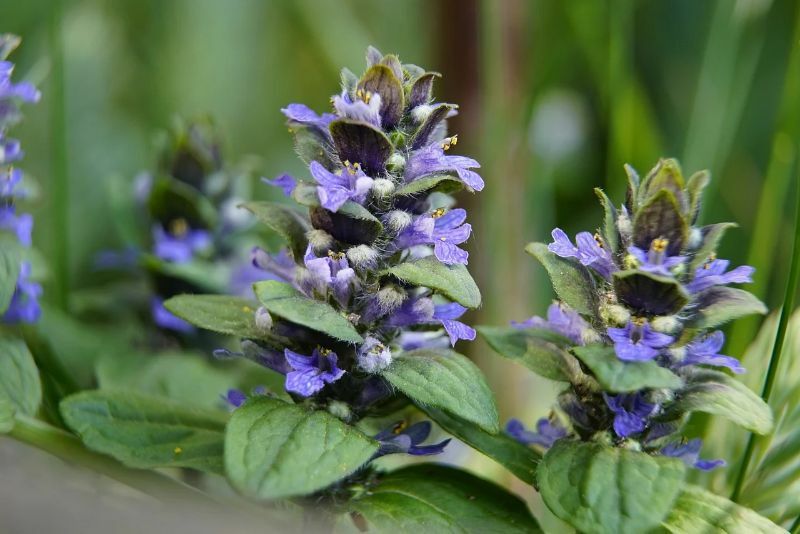
‘Catlin’s Giant’ Bronze-blue foliage supports eight to ten-inch spikes of deep blue blooms. The plants reach a height of 3 to 6 inches and a width of one to two feet.
‘Blueberry Muffin’ Vigorous and quick-to-spread, ‘Blueberry Muffin’ features rich blue blooms and thick, weather-resistant foliage. It’s hardy in zones 5 to 9, but it needs to be watered frequently, especially when the weather gets hot. The plants can reach a height of 6 inches and a spread of 28 inches.
‘Black Scallop’ This dark ajuga with blue flowers and purple-black foliage with scalloped edges will add near-black to your yard or garden.
‘Toffee Chip’ The new leaves of this variety, which is hardy in zones 3 to 10, start out light brown. They become grayish-green with creamy gold borders as they mature.
‘Chocolate Chip’ is a term used to describe a chocolate chip. This dwarf cultivar, also known as ‘Valfredda,’ has chocolate-burgundy leaves and bluish-purple blooms.
‘Burgundy Glow’ This popular ajuga has blue flowers and tricolored foliage in shades of pink, cream, and white that is hardy in zones 3 to 9. The plants reach a height of 6 to 10 inches.
‘Purple Brocade’ In zones 3 to 9, use this ajuga with bluish-violet flowers and rich green leaves with purple patterns. Most ajugas are aggressive, but this one isn’t.
How quickly does Ajuga spread?
Ajuga will try to conquer the entire region in its immediate proximity. Although it is an aggressive spreader, it is relatively easy to contain because it spreads over the ground.
It is recommended that you use a shovel or a spade to edge the borders of the territory limit assigned to Ajuga twice a year, once in the spring and once in the middle of summer.
There is no need to be concerned because this plant does not spread quickly; rather, it spreads slowly and steadily.
You should not plant this next to a lawn because grass cannot compete with it and will quickly become overrun, leaving you with an Ajuga lawn rather than a grass lawn.
Can Ajuga be walked on?
It’s true that good things come in small packages. Ajuga, for example, grows only a few inches tall but provides a dazzling display of color in your garden. This easy-care walkable groundcover plant, also known as bugleweed, is prized for its ability to carpet your yard with colorful foliage over time. Ajuga produces blue, purple, or white flower spikes in the spring above a base of bronze, chocolate, brilliant green, or bicolor foliage. Ajuga grows well in pots as well.
How do you control an Ajuga ground cover?
The most effective ways for treating invasive bugleweeds are listed below.
Hand pulling – Whenever feasible, it’s ideal to manage undesired plants without the use of chemicals. Pulling and a lot of it is the best way to remove ajuga in an environmentally responsible manner. Ajuga will be easier to remove if you water the area the day before and loosen the soil around the plants with a shovel or garden fork. For more effective ajuga weed control, use a weeding fork to dig deep under the roots.
Take your time and remove as many roots as you can, as even small pieces left in the soil can take root and spread. Keep an eye on the area and remove any new plants as soon as they appear. It will take some time, but if you stick with it, you will finally win.
How long does it take bugleweed to spread?
It’s preferable to put Ajuga seeds directly on the soil surface, then cover them with a little dusting of earth. In the spring and autumn, they should be spaced 15 to 30 cm apart.
Ajuga species can thrive in both full sun and partial shade. The soil should be dry, with a pH between 5.5 and 7.1.
It takes three to four weeks for ajuga to germinate. They should be planted at a temperature of 10 to 12 degrees centigrade if starting their growth inside.
Will ajuga crowd out other plants?
There’s no denying that Bishop’s Weed in variegated form is a lovely plant. It thrives in shady areas where splotches of white are needed to liven things up. But you’ll never be able to enjoy just a smidgeon of Bishop’s Weed. Its roots form a dense mat as it spreads, suffocating any nearby plants. While this may sound like a good way to keep weeds at bay, it will eventually take over your garden plants as well.
Bishop’s Weed was initially labeled as invasive in Rhode Island in 1863, although you can still get it for sale. You may probably determine it’s a member of the carrot family by looking at the white, umbel blossoms, which look a lot like Queen Anne’s Lace. The plant does attract helpful insects, so it has some virtues, but it is simply the incorrect plant for many situations.
If you’ve already planted Bishop’s Weed and regret it, the best way to get rid of it is to use up all of your resources. In the early spring, cut it as short as possible and cover the area with plastic. The plants are unable to photosynthesize, receive insufficient water, and are overheated. They ultimately give up, even if it takes a long time.
Goutweed (a mashup of goat weedgoats will eat it) and Snow on the Mountain are other names for Bishop’s Weed.
How do you encourage ajuga to spread?
Ajuga reptans, sometimes known as carpet bugleweed, is a prominent ground cover. It spreads rapidly by runners, forming a mat of dark green leaves 2 to 3 inches across in full sun and 3 to 4 inches wide in part shade. In full sun, selections with bronze or metallic-tinted leaves hold their color the best. The flowers, which are usually blue, are borne on spikes that are 4 to 5 inches tall. Early May to mid-June is when the plant blooms. Set aside established plants in the spring and they will cover the soil in one growing season. Plants should not be planted too deeply. It’s never a good idea to hide the crown. Runner plants can be dug out and replaced in the spring or early fall from established plantings.
Geneva carpet Bugleweed (Ajuga genevensis): This upright species is becoming more popular because it spreads less vigorously than A. reptans and tolerates more sun than other Ajuga species. It has grayish, hairy stems and coarse-toothed leaves to 3 inches long, and has grayish, hairy stems and coarse-toothed leaves to 3 inches long. The 2-inch tall flower spikes are usually blue, but rose and white forms are also sold.
Upright Bugleweed (Ajuga pyramidalis) is an erect plant that grows 2 to 10 inches tall and does not spread by runners. The stems have several roundish, 11/2 to 4-inch long leaves, and the flower spikes are 4 to 6 inches long with enormous purple bracts that appear to push against the blue blooms.
Is Ajuga a good ground cover?
Ajuga is an ubiquitous groundcover, but this dark, coppery-burgundy variety works well with darker plants with spiky foliage, such as black mondo grass. Don’t be fooled by a plant’s size. Ajugas may be little, but they are strong and hardy groundcovers. The lustrous leaves of these evergreen shrubs form dense mats.
Wild Thyme(Thymus serpyllum)
Climbing thyme and mother-of-thyme are other names for wild thyme. It’s a common ground cover used by landscapers to fill in gaps between pavers, sidewalks, bluestone, and garden paths, as well as around edging.
Wild thyme is native to Europe, although it may be grown as a perennial in USDA hardiness zones 48 in North America. With its small, delicate pink blossoms, it adds a splash of color to your garden or landscape. Wild thyme emits a warm, spicy scent when touched or walked on, comparable to the culinary thyme you could grow in pots on your patio.
Wild thyme is drought tolerant, which is a feature that gardeners appreciate. It only grows to be three inches tall and can withstand severe foot activity. So, if you’re looking for a plant to line your garden path, wild thyme is an excellent choice.
Moss Phlox (Phlox subulata)
This plant is also known as moss pink or creeping phlox. It’s a North American plant that thrives in the east and central United States. This ornamental ground cover can be used in USDA hardiness zones 3-9.
It stands a little taller than other ground covers, with an average height of 6-inches. Moss phlox is attractive because it is resistant to soil erosion, drought, wildlife, and pollution. Plant moss phlox if you have a deer problem or an area that is prone to erosion. There aren’t many ground covers that function better for erosion management than this one.
Moss phlox comes in a variety of hues, depending on the kind you cultivate. White, pink, red, blue, and purple variants are available to add diverse flashes of color throughout your landscape.
Trailing Periwinkle(Vinca minor)
Periwinkle is a ground cover plant with periwinkle-colored flowers that will brighten up your landscape. The fragrance is pleasant and ideal for any location near your patio or porch.
If you don’t keep an eye on this ground cover, it will quickly take over your landscape. It develops so quickly that you must be cautious and keep track of it. You don’t want it to take over your whole garden.
Trailing periwinkle thrives in both the sun and the shade, so it can be planted around the base of your trees or on a rock wall. This ground cover can be used wherever you need some fillers.
Sweet Woodruff (Galium odoratum)
Sweet woodruff is a Eurasia-native perennial ground cover. Sweet woodruff has been naturalized to USDA zones 4-8 by landscapers, and it now flourishes in hundreds of home landscaping.
Sweet woodruff is a fast-growing ground cover plant in forests, rock gardens, and borders that prefers wet, shady conditions. You’ll be shocked at how quickly it grows if you plant in these regions!
Another reason to like sweet woodruff is that it has a lovely perfume that reminds you of freshly mowed hay. Who doesn’t like the scent of that? Sweet woodruff blooms in clusters of little white flowers in the spring.
Variegated Snow on the Mountain(Aegopodium podagraria)
Are you seeking for a low-maintenance ground cover that thrives in the shade? Take a look at this plant. Bishop’s weed or goutweed is the name given to variegated snow on the mountain. It’s a plant with umbrella-like clusters of white flowers that’s soft green and creamy white. As a result, the name “snow on the mountain” was coined.
This ground cover grows to a height of 10-inches and spreads to a width of 18-24 inches, making it a bit taller than the average ground cover. Because it thrives in the shade, gardeners adore this ground cover in desolate spaces under trees. It thrives in USDA hardiness zones 38 in wooded habitats.
Aubrieta (Aubrieta deltoidea)
Finding a ground cover for sunny settings might be difficult, but Aubrieta is an easy-to-care-for evergreen perennial that hails from the Mediterranean region and thrives in hot, dry climates. Aubrieta can be found in USDA hardiness zones 4 through 8.
Aubrieta is linked to annual garden vegetables like cabbage and broccoli, and it belongs to the Brassicaceae family. Despite being in the same family as tomatoes, Aubrieta is an ornamental ground cover that cannot be eaten. Isn’t it strange?
Make sure it gets 4-6 hours of light every day if you want it to be a fast-growing ground cover plant. It grows to a height of 6 inches and a width of 24 inches. From early spring through early summer, this plant produces brilliant purple flowers against grey-green leaves.
Firecracker Sedum (Sedum)
Are you seeking for a colorful and fast-growing ground cover plant for sunny areas? You might like Firecracker as a ground cover. It grows in USDA hardiness zones 4 through 9, producing deep burgundy foliage that forms dense mounds that keep weeds out of your landscaping.
Firecracker sedum is popular among gardeners due of its rabbit-resistant foliage. It blooms in late summer or early autumn with little pink flowers. The flowers attract pollinators such as butterflies and other beneficial insects to your yard.
Make sure this plant gets at least six hours of direct sunlight each day to grow properly. When grown in the right conditions, it can reach a height of 6 inches and a width of 18 inches.
Dragon’s Blood Sedum (Sedum)
Another sedum plant linked to Firecracker Sedum is this one. It’s one of the toughest and most adaptable weed-controlling ground coverings available. Dragon’s blood sedum is hardy in USDA zones 38, and it thrives in a wide range of circumstances. It grows well in both full sun and partial shade, as well as in poor soil, so you can plant it almost anyplace.
Because it has trailing branches that root easily, it grows similarly to creeping Jenny (see below) and is easy to propagate. It may be grown in containers as a spiller, but it thrives in rock gardens, under trees, and other places. The Dragon’s blood sedum will grow if nothing else does.
This plant features brilliant green leaves in the spring that turn red as the weather cools. It produces gorgeous red blossoms in the summer, which is why it’s called Dragon’s Blood.
Golden Creeping Jenny(Lysimachia nummularia)
Creeping golden Jenny is a hairy ground cover that thrives in moist environments. While it thrives in partial shade, it will produce more bright colors if grown in full sunlight.
This plant thrives in USDA hardiness zones 3 through 9, although it requires a lot of water. It does not thrive in locations that are prone to drought. Make a ring around a pond, a route along a wall, or a walkway edging. In mixed container gardens, it works well as a spiller.
Long, trailing branches with vivid yellow blooms and spherical leaves characterize the golden creeping jenny. It spreads swiftly, quickly covering wide areas and suppressing weeds. Be mindful that some golden creeping Jenny cultivars can be aggressive growers. “Aurea” is a well-behaved variety that won’t take over your entire garden.
What ground cover grows in full shade?
This plant, unlike the ginger used in stir-fried foods, only smells like ginger when the leaves and roots are crushed. The jar-shaped blooms of this plant, unlike most flowering plants, grow at ground level and may be buried by stalks. The leaves are evergreen and deer resistant.
Yes, there is flowering. In the early spring and summer, it blooms with white, green, or purple flowers.
What are the benefits of bugleweed?
Bugleweed is a type of flowering plant. Medicine is made from the components that grow above ground.
Bugleweed is used to treat excessive thyroid hormone levels (hyperthyroidism). Premenstrual syndrome, breast pain, agitation, difficulty sleeping (insomnia), and bleeding, particularly nosebleeds and excessive bleeding during menstruation, are also treated with it.
How does it work?
Thyroid hormone production may be reduced by bugleweed. Bugleweed also appears to inhibit the production of the hormone prolactin, which may aid in the relief of breast pain.