
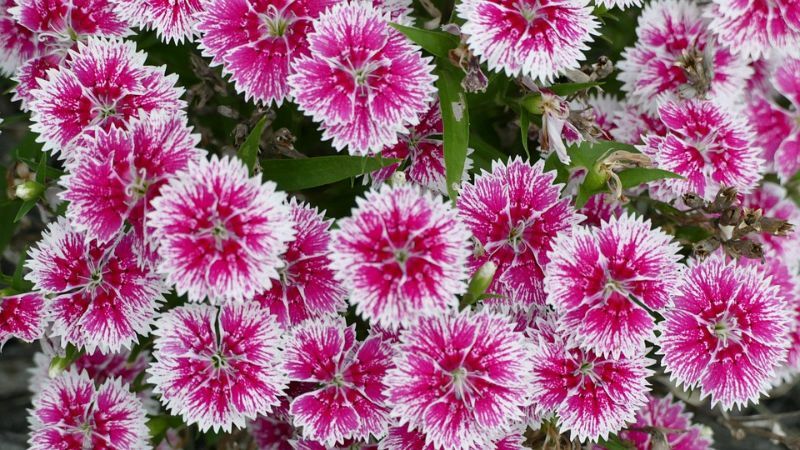
Drought-tolerant dianthus plants are ideal for sunny places near the edge of a flower border or a sidewalk. The plants freely take up residence in the fissures of a rock wall, where their roots can remain cold. Pinks stretch out in small flower pots to form a lovely spectacle. They thrive in the cool spring and fall conditions, but they are remarkably flexible. They endure heat and thrive in areas with excessive rainfall and humidity as long as they are planted in well-drained soil. Dianthus blooms bloom profusely in early spring and summer, but if you clip the blossoms off as they fade, many dianthus will rebloom later in the gardening season. Hedge shears will suffice, leaving a tufty mound of greenery behind. Mulch away from your Dianthus as much as possible.
How do you keep dianthus blooming all summer?
- To produce the most amount of flowers throughout the year, the plant will require full sun. It’s possible that the plant won’t produce as many blooms if it doesn’t get enough sunshine (if any at all).
- Deadheading annual dianthus is extremely crucial to keep the plant from generating seeds and spreading. Do not deadhead if you want to collect seeds to develop more plants or if you want the plant to spread spontaneously in your garden.
- Using rubbing alcohol, sterilize the shears or scissor. This reduces the danger of disease transmission from plant to plant.
- You may decide to trim the blooms before they become sad-looking. That’s fine, and you’ll be able to appreciate the cut flowers in an arrangement!
Do you cut dead blooms off dianthus?
The removal of dead blossoms from a plant is referred to as deadheading in horticulture. Deadheading can be done by pinching off the bloom by hand or with pruning shears, depending on the type of plant and the woodiness of the stems. Taking off dead blooms before they go to seed promotes the plant to blossom again. Pruning shears should be used to deadhead Dianthus, popularly known as carnation or sweet William. Because dianthus can re-bloom on each stem, deadheading it should be done with caution.
Do dianthus come back every year?
Pinks should be grown in full sun in well-drained compost. To stimulate a second flush of blossoms, cut back after flowering and feed with a liquid tomato feed. In the autumn, reshape the plant.
Dianthus are short-lived plants that get woody at the base and seem straggly after a few years. However, cuttings may be easily propagated, allowing you to grow new plants every year.
Wait until the buds have somewhat opened before picking pinks as a cut flower; if you pick them while the buds are closed, the aroma won’t be as intense. In a cool room, they can last for a number of weeks.
Is dianthus annual or perennial?
Dianthus are plants with feathery silver-green or blue-gray leaves that form a tight mound or mat and can be perennial, annual, or biennial. Dianthus flowers range in height from two inches to two feet above the foliage, leaning a bit lazily toward the light. The blossoms are normally only about an inch across and have a ruffled edge that appears like it was trimmed with pinking shears, yet vigorous plants produce dozens of stunning flowers at once. Snow white, blush pink, brilliant magenta, or bicolored dianthus blooms with a flamboyant contrasting center or picotee edge are all possibilities. The delicate blue of ‘Diana’s Blueberry Hybrid’ is beautiful.
Will dianthus survive winter?
Annual dianthus tolerates minor frost well, but strong freezes can be damaging. Dianthus can be grown as a winter annual in milder climates.
How long do dianthus plants last?
A dianthus plant can be found for practically every garden space and climate. Dianthus chinensis, called Chinese pinks, is the most common annual dianthus.
Cheddar (D. gratianopolitanus), Cottage (D. plumarius), and Grass pinks are among the perennial variants (D. armeria). All of these have blue-gray foliage that comes in a variety of colors.
The common Sweet William, D. barbatus, is a biennial. The variety produces both double and single flowers, and it self-seeds.
Allwood pinks (D. x allwoodii) have a long flowering period of at least eight weeks. They are typically double flowering and range in height from 3 to 6 inches (8-15 cm) to 10 to 18 inches (25-46 cm).
Is Firewitch dianthus a perennial?
With highly fragrant rose-pink flowers and gorgeous gray-blue evergreen foliage, Dianthus Firewitch is a wonderful Garden Pink. The Perennial Plant Association (PPA) had its annual meeting in 2005. Perennial plant that is drought resistant or tolerant (xeric).
Can dianthus be divided?
Dianthus plants that have reached maturity can be easily divided. Early spring is the optimum time to do this because the plant will be actively developing but not producing blossoms. If you wait until after the plants have blossomed for the first time, you can deadhead them so that the energy isn’t squandered on flower production and can be used to create new root systems following transplanting. Plants should not be divided late in the growth season because they will not have enough time to create new roots before going dormant for the winter. The optimum time to divide the plants is in the morning, when the roots are more hydrated and less prone to injury.
A day or two before chopping the plant up, give it plenty of water. So the plant doesn’t stay out of the earth for too long, prepare the new spot ahead of time. Allow for at least 12 square inches of growing space for the new plant. To avoid the transmission of bacteria, use clean tools. Dianthus has a robust root structure that can withstand a lot of abuse. Dig at least 6 inches beneath the plant and try to get as much of the root ball as you can. Cut the plant into new plants of equal size, and place the newly generated root balls in the holes that have already been prepared. For the first month, water the young plants at least once a week to aid in their establishment.
Every 3 to 5 years, dianthus should be divided. This will keep the plants healthy and allow them to blossom lavishly year after year.