
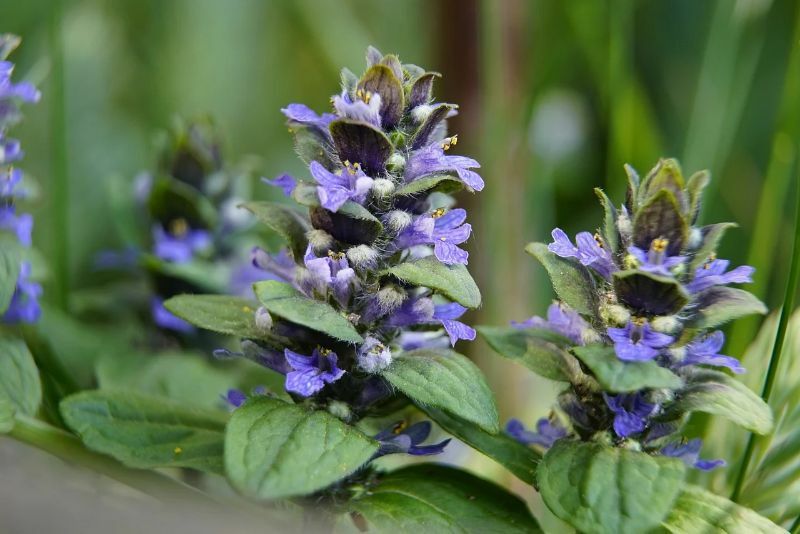
Some ground coverings, like lilyturf, are invasive. Before using these plants, you’ll have to evaluate your worries about deer management against any issues about their invasiveness. These ground covers, like lilyturf, are such fast growth that you may want to keep them in check:
- This invasive plant, also known as ajuga (Ajuga reptans), is not eaten by invading deer, making it valuable for deer management. It blooms in a bluish-purple color. Ajuga may be planted in zones 3 to 10, and it usually stays short, though it does gain a few inches when in flower. Ajuga is a simple plant to growalmost too simple. It may grow in full sun or partial shade, and it doesn’t mind what kind of soil it’s in as long as it has proper drainage. It will grow into a dense mat with both lovely foliage and blooms. However, it will appear all over the terrain, frequently in unwelcome locations.
- Vinca minor, often known as creeping myrtle or periwinkle vinca vine, is a perennial ground cover used as a grass substitute in grassy areas and as a deer deterrent. Creeping myrtle, which grows in zones 4 to 8, requires good drainage. This shade-loving, deer-resistant ground cover is frequently planted under huge trees, where a lawn grass would have quickly died due to a lack of sunshine. The vine of the creeping myrtle grows just 3 to 6 inches above the ground, but its trailing stems with evergreen leaves can reach up to 18 inches in length. As the stems creep along the ground, they root at the nodes and spread quickly to make an attractive ground cover. It’s appealing, but it’s also intrusive. Keep it under control to avoid it spreading to places you don’t want it to. In the spring, the creeping myrtle produces a bluish-lavender flower, which blooms intermittently throughout the summer.
- Deadnettle (Lamium maculatum) and yellow archangel (Lamium galeobdolon) are close relatives. Both are invasive (yellow archangel is the worst culprit), variegated, shade-loving perennials with poor drainage. Landscapers who want to keep deer out can use them. They grow 1 to 2 feet tall with a similar spread and may be cultivated in zones 4 to 9. Deadnettle has purplish or white flowers, whereas yellow archangel has yellow flowers. Both are renowned for their leaves. The leaves of the yellow archangel have a medium green tint with silver splotches. The silver content of deadnettle leaves is higher than the green content. Both are considered good plants for dry shade once established.
What plants do deer not like to eat?
Deer-Resistant Plants (24 of them)
- Marigold (French Marigold) (Tagetes) French marigolds are a favorite of gardeners globally since they come in a rainbow of vibrant hues and bloom for a long time.
What can I plant with Bugleweed?
Don’t be fooled by a plant’s size. Ajugas may be little, but they are strong and hardy groundcovers. They can help with erosion control on a bank or slope, fill in a patchy lawn where grass won’t grow, or simply offer color to shaded areas. They’re also excellent for planting beneath bushes and trees.
Ajugas are very attractive because their leaf color and attractiveness last virtually all year, and they produce blue, purple, or white blooms from spring to summer. Ajuga reptans, sometimes known as carpetweed or bugleweed, is a perennial that thrives in zones 3 to 9.
The lustrous leaves of these evergreen shrubs form dense mats. They can tolerate full sun to partial shade, but full sun brings out the greatest color in the leaf. Ajugas are easy to cultivate in practically any type of soil and prefer a moist, well-draining environment, but they can endure dryness for short periods of time.
Because ajuga spreads through stolons, or horizontal stems that creep along the ground, it’s important to consider where you plant it. This mint family member spreads quickly and can become invasive. Planting too close to flower beds, lawns, or other areas where you’ll have to remove it frequently is a bad idea. If you’re worried that ajuga is an invasive plant in your area, check out the Invasive Plant Atlas.
Plant ajugas when all dangers of frost have passed. Then, spacing the holes 8 to 15 inches apart, dig holes just deep enough for the root balls. Gently loosen the roots of the plants, then plant them and firm the dirt around them. To settle them in and eliminate air pockets, water them thoroughly. Fertilizing ajugas is rarely necessary.
To keep your ajugas from becoming overloaded, you should thin them every three years or so. If desired, divide and replant established clumps in the fall or early spring.
Crown rot is an issue, particularly in hot, humid climates or in heavy soils. It’s easy to notice since the lower leaves have rot and spots on the tops of the plants. Give your plants plenty of air circulation and avoid overfertilizing to avoid this illness. Crown rot has no treatment, therefore if it appears, you’ll have to uproot and destroy the damaged plants. When it’s time to replant, consider a new type of groundcover to reduce the chances of the problem reappearing.
Patches of ajuga will occasionally die. If this occurs, remove the dead leaves but leave the roots in place. In most cases, the plants will return the next year.
Ajugas are low-maintenance plants with good rabbit and deer resistance. They don’t need to be pruned, but if you want them to look a little neater after the blooms fade, mow them using a high setting on your mower.
Try coral bells, hostas, ferns, daffodils, astilbe, forget-me-not, violas, hardy geraniums, and other woodland species if your ajugas are in the shadow.
Is creeping thyme deer resistant?
Thymus praecox is a low-growing perennial hardy in USDA hardiness zones 49. It requires very little care. This creeping thyme variety is an evergreen with sparsely hairy leaf that grows in low, dense mats that sprawl randomly and swiftly fill in areas as a ground cover, rarely exceeding 3 inches or 7.5 cm in height. Another creeping thyme cultivar is T. serpyllum.
When crushed or steeped for teas or tinctures, creeping thyme, like other thyme cultivars, has a flavor and perfume similar to mint. Remove the leaves from the stems of creeping thyme ground cover or dry them by snipping from the plant and hanging them upside down in a dark, well-aerated place. Early in the morning, when the plant’s essential oils are at their optimum, harvest creeping thyme.
Another interesting aspect about creeping thyme is that, despite its appealing odor, it is deer resistant, making it a perfect landscape contender in deer-infested areas. Creeping thyme can also endure being tromped on by energetic children (making it kid resistant! ), making it an excellent choice for planting in areas with a lot of foot traffic.
Flowering creeping thyme attracts bees and is a great addition to a honeybee-friendly garden. The pollen from the flowering thyme will really flavor the honey.
Are hydrangea deer resistant?
Hydrangeas aren’t a deer’s favorite flower in general. Hydrangeas, on the other hand, are neither deer resistant nor deer proof. Taking extra precautions to keep deer from eating your lovely shrubs isn’t difficult, and it shouldn’t keep you from trying to plant hydrangeas in your garden.
Do coffee grounds keep deer away?
It’s aggravating to wake up in the morning to discover that all of your hard work in the garden has suddenly transformed into a shambles, with the culprit being deer.
Deer have a keen sense of smell, which they employ to locate readily available food sources. While there is no scientific evidence that coffee grounds will keep deer away from your property, the bitter smell of leftover coffee grounds may alert deer to the presence of humans and keep them away.
Deer, as benign as they appear, frequently enter your property at night and either destroy your trees by rubbing their antlers against them or devour your plants. Is it true that coffee grinds may actually stop deer in their tracks?
How do I keep deer out of my garden naturally?
Sure, if you’re quickand quietenough, you can get a glimpse of deer sprinting off into the distance.
They will ravage your young tulips and luscious pansies if you let them loose in your garden, leaving the greenery raggedy and the fruits of your labor robbed. Fortunately, by understanding their tendencies, you can keep your flowers, bulbs, and vegetables from turning into a free meal. To keep deer out of your garden, use these 20 tips.
Deer-proof plants and home treatments are among them, as are organic solutions and compassionate exclusion strategies. Our guide is part of a deer-prevention approach you should start today, even if you haven’t seen the first deer of the season.
Don’t over-stock your garden with tasty plants
Deer are at one of their most hungry states in the spring: Does are feeding their fawns, and all deer are looking for high-protein, moisture-rich vegetation to help them regain weight lost during the winter’s cold. Large amounts of English ivy, lettuces, beans, peas, hostas, impatients, and pansies should be avoided. Fruit trees are also popular targets. “The richness and aroma of strawberries and peaches make them as tempting to deer as they are to people,” Rhonda Massingham Hart writes in her book Deerproofing Your Yard & Garden (Storey), which explains how to keep deer out of your yard.
Keep deer-favorite plants close to the house
You’ll be able to keep track of the plant’s progress at all times, ensuring it doesn’t turn into a meal. Deer prefer to eat everything that is smooth, sensitive, and tasty, such as chrysanthemum, clematis, roses, azalea bushes, and other berries. To help deer proof your yard, grow smelly plants.
Plant pungent perennials as a natural barrier
With 18 to 24 deer per square mile, according to wildlife experts, and full-grown adults eating 6 to 10 pounds of vegetation every day, the best line of defense is to make your property less appealing than your neighbors’. Because deer rely significantly on their sense of smell to find food, planting patches of highly scented herbs, such as garlic and chives, mint, and lavender (left), can help to hide the enticing aroma of neighboring annuals.
Plant thorny, hairy, or prickly foliage
When it comes to picking what to eat for dinner, a deer’s sense of smell takes precedence over touch. That isn’t to say that deer aren’t troubled by particular textures in the middle of a meal. Try planting fuzzy lamb’s ear, barberries, and cleome near the plants you wish to preserve, as well as where deer might find their way into your garden. For a more extensive list, see Plants Deer Hate.
Make deer-resistant substitutions
Massingham Hart recommends substituting daffodils for tulips, as daffodils are often at the top of deer-resistant plant lists. Choose roses with a lot of thorns, such as Scotch or rugosa roses. If you’re looking for flowers that will offer a certain color or function to your outdoor space, check out Rutgers University’s list of deer resistant plants to see what changes you can make in your garden to keep deer out.
Out of sight, out of mind
Plant huge, sprawling deer repellant species around the perimeter of your garden, such as thick boxwood hedges or short needle spruces. Deer are less likely to take that leap of faith onto your property if they can’t see what’s inside.
Create levels
Deer aren’t particularly fond of climbing, so creating terraces or sunken beds can deter them from entering the yard. Consider putting pallets around your property, which deer are scared to walk or jump on, if your property is very wooded and vast.
Don’t underestimate the power of scare tactics
Deer, like neophobes, are afraid of new and strange things. Scarecrows, sundials, and other garden ornaments, especially those with moveable elements, make deer nervous, even if they aren’t usually appealing. To discourage deer out of your yard, combine them with wind chimes or flashing lights.
Fence it in
A fence is the most efficient form of exclusion. Whitetail deer, who wreak havoc on most residential gardens, are notorious jumpers. Fences should be at least 8 feet tall with no gaps larger than 6 inches by 6 inches. Another alternative is to install electric fences during the peak feeding seasons of early spring and late fall.
Wrap new plantings
Covering fruit, bulbs, and plants with netting. To physically keep deer from munching on your firs, use Vexar garden netting, Tubex tree protectors, or plastic tree wrap.
Rotating repellents throughout the growing season
The University of Illinois Extension School suggests Havahart’s Deer Away Big Game Repellent, a powder that has a high concentration of stinky egg solids to target deer’s sense of smell and keep them away of your yard. Deer Off, a spray containing capsaicin that deters mostly by taste, and Hinder, a spray of ammonium salts of higher fatty acids that provides an olfactory barrier, are also available. To protect plants and avoid deer adaption, reapply repellent after rain and use a different formula from time to time. Coverage should begin at the ground and extend six feet upward.
Use a lot of homespun repellents to keep deer guessing
Fabric softener strips and/or wrapped bars of soap, both of which can confound a deer’s sense of smell, are hung from trees by certain gardeners. Others recommend spraying the garden with spicy peppers, garlic and rotten egg mixes, ammonia-soaked rags, and bags of hair and/or blood meal for the same reason. For optimal effectiveness, swap things around, learning by trial and error, just like with commercial repellents. Roger Cook demonstrates how to deer-proof plants in this video. Experiment with deer juice, which TOH design director Amy Rosenfeld provided as a tried-and-true recipe.
Avoid products that may be poisonous to people and pets
You don’t want to accidently damage your family or other wildlife by using commercial repellents or homemade solutions. Always go for compassionate formulas rather than poisons.
String fishing line around prized plants
String a line of monofilament around your beds within the deer feeding zoneideally two to three feet above groundfor a fraction of the cost and effort of erecting a fence. Deer are perplexed by this clear, taut barrier, which is similar to how they are perplexed by glass. As a result, they flee.
Let Fido out as much as possible
Deer management is greatly aided by having a dog as a pet. Their fragrance and bark, regardless of size, are natural deer repellents, so bring the dog along when you’re gardening or the kids are playing in the yard.
Shine a light on it
Because deer dislike bright lights, they will often wait until dusk to eat. Installing a system of motion-sensitive floodlights will halt a deer dead in its tracks, albeit they will eventually discover that the beam is harmless.
Make a lot of noise
Loud bangs and booms irritate deer. You could use firecrackers or make a wind chime out of tin cans, but tuning a radio to the static between stations might be the best option.
Remember these tips won’t work all of the time
Deer are similar to humans. What deters one person may not repel another, but doublingor triplingdown on these methods can only help. The easiest approach to avoid damage to your vegetation is to put a couple of these tips into effect before deer become a problem. However, go through each of your options before acting, as some solutions are more expensive than others.
What foods are poisonous to deer?
Plants that are toxic to deer, such as rhubarb, are poisonous. Deer avoid root vegetables (which require digging) and prickly vegetables with hairy leaves, such as cucumbers and squashes. Deer do not enjoy the aromas of onions, garlic, and fennel, which are common in cultivated crops.
Will bugleweed spread?
Ajuga reptans, sometimes known as carpet bugleweed, is a prominent ground cover. It spreads rapidly by runners, forming a mat of dark green leaves 2 to 3 inches across in full sun and 3 to 4 inches wide in part shade. In full sun, selections with bronze or metallic-tinted leaves hold their color the best. The flowers, which are usually blue, are borne on spikes that are 4 to 5 inches tall. Early May to mid-June is when the plant blooms. Set aside established plants in the spring and they will cover the soil in one growing season. Plants should not be planted too deeply. It’s never a good idea to hide the crown. Runner plants can be dug out and replaced in the spring or early fall from established plantings.
Ajuga genevensis (Geneva carpet Bugleweed) is a perennial rock garden plant that grows 5 to 14 inches tall. It has grayish, hairy stems and coarse-toothed leaves up to 3 inches long that do not spread via runners. Blue flower spikes are the most common, but rose and white varieties are also available. Because it spreads more slowly than A. reptans, this upright species is gaining popularity. It is more sun tolerant than other Ajuga species.
Ajuga pyramidalis (Upright Bugleweed) is a 2 to 10 inch tall erect plant. Runners are not involved in the propagation of this disease. Many roundish, 11/2 to 4-inch long leaves grow from the stems, which contain long grey hairs. The huge purple bracts appear to press against the blue blooms on the flower spikes, which are 4 to 6 inches long.